The Moon and the Lantern
By Verdina Sea
Publication Date: 8 October 2026 — GMT
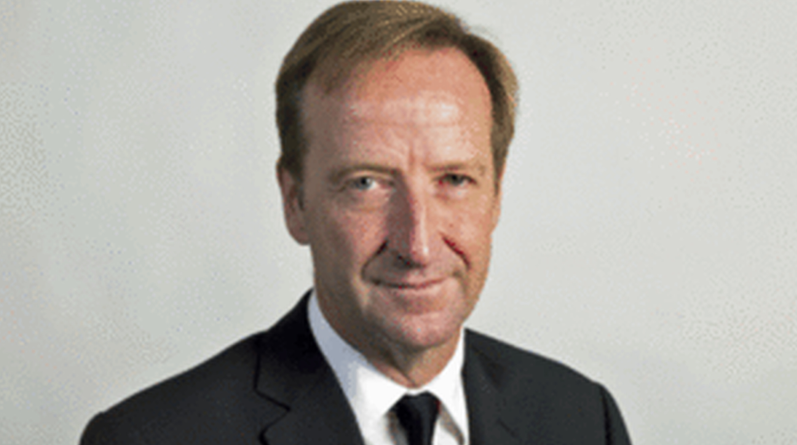
Sir Alex Younger, 2014. Pixilated Photograph: UK Government. Licensed under the Open Government Licence v1.0. The licence permits
publication, adaptation and commercial reuse with appropriate attribution, provided that no official endorsement is implied. (Wikimedia
Commons)
Sir Alex Younger, the nobility of foresight and the immeasurable distance between prolonging life and possessing it.
There are public servants whose achievements are recorded in events. There are others whose greatest achievements are the events that never occurred.
The bomb that was intercepted. The conspiracy that failed. The conflict prevented from crossing a border. The hostile intention discovered while it remained no more than an intention. The citizens who returned safely to their families without ever learning how closely danger had approached them.
Sir Alex Younger belonged to that rarer order of servant.
For almost three decades, he worked in the half-light between what Britain knew and what it desperately needed to know. He served in Europe, the Middle East and Afghanistan, became Director of Counter Terrorism in 2009 and ultimately led the Secret Intelligence Service—M16 — from November 2014 until September 2020 . Before entering the clandestine world, he had served as an infantry officer in the British Army. His six-year tenure made him the longest-serving Chief of M16 in fifty years.
(University of St Andrews).
He was entrusted with an almost impossible national responsibility: to perceive what had been deliberately concealed. That responsibility demanded far more than access to secrets. It required the intelligence to recognise significance within fragments; the patience to wait when haste might destroy understanding; the courage to act when certainty could not be obtained; and the moral discipline to wield formidable powers without becoming intoxicated by them. The language of intelligence is necessarily guarded. Its greatest triumphs are often invisible, its failures immediately historic and its moral burdens carried largely beyond the reach of public recognition. Sir Alex’s career consequently belongs to that peculiar realm in which a life may alter the safety of millions while revealing almost none of the actions through which that safety was preserved. Behind the official record lies the largely unwritten history of a man who spent his adult life standing watch while others slept. And it is perhaps only in the darkness of a great painting that we can begin to see the true shape of such a life.
Sir Alex Younger, 2014. Pixilated Photograph: UK Government. Licensed under the Open Government Licence v1.0. The licence permits
publication, adaptation and commercial reuse with appropriate attribution, provided that no official endorsement is implied. (Wikimedia
Commons)
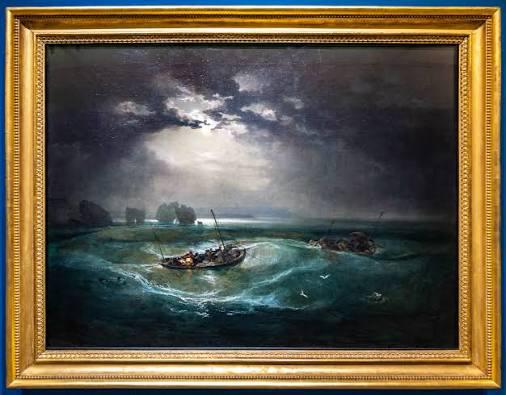
Two Lights Upon the Water
Turner’s Fishermen at Sea contains one of the most profound visual measurements ever made of the human condition. At first, we see darkness. The sea appears almost without boundary: black water rising into black weather, each wave possessing enough force to overturn the small vessel held within it. The fishermen do not occupy the centre of a world arranged for their convenience. They are minute presences inside an environment that neither recognises their wishes nor submits to their courage. Then we notice the light. Or rather, we notice two lights. High above the fishermen is the moon. It breaks through the cloud with an authority that requires no human permission. Its radiance touches the heavens, describes the movement of the waves and opens a pale road across the water. It illuminates not merely an object but an entire condition of existence: sea, sky, storm, distance and destiny. Below it is the fishermen’s lantern. The lantern is warm where the moon is cold. It is made rather than given. It can be carried, shielded, extinguished and relit. It reveals perhaps a hand, a rope, the edge of a boat or the face of another frightened man. Beyond that small circumference, the darkness resumes. Tate identifies this contrast between the potency of the moonlight and the delicate vulnerability of the flickering lantern as fundamental to the painting: the fragile artificial flame emphasises nature’s power over humanity and, most particularly, over the fishermen’s fate. (Tate) But read spiritually, the contrast reveals something greater still. The moon becomes an image of divine illumination: immense, effortless, unowned and bestowed from beyond the vessel. The lantern becomes the accumulated illumination of humanity—reason, observation, medicine, engineering, intelligence and science. One light appears to know the whole sea. The other knows only the next few feet. One light belongs to the order that created the fishermen. The other is what the fishermen, as God’s creatures, have succeeded in creating for themselves. And between them lies the still immeasurable distance between understanding life and commanding it.
The Profession of the Lantern
Sir Alex Younger spent his career in the profession of the lantern. The purpose of intelligence is not to become omniscient. No service, however sophisticated, can illuminate the whole sea. Its purpose is to cast sufficient light into sufficient darkness that catastrophe may be recognised while there is still time to change its course. A fragment of communication may reveal a network. A movement of money may expose an operation. A human source may illuminate the concealed intention of a hostile state. An apparently insignificant anomaly may become the warning upon which thousands of lives depend. Intelligence, at its highest, does not abolish uncertainty. It creates a margin within it. That margin may be only a day, an hour or a few decisive minutes. Yet history often turns upon such intervals. Sir Alex understood that the lantern had to grow brighter without ever being mistaken for the moon. A graduate of St Andrews in economics and computer science, he became a prominent advocate for adapting intelligence work to technological change. He championed the integration of human expertise with emerging technologies and spoke of the fusion between human and technical capabilities required by a new generation of espionage. (University of St Andrews) That balance may prove one of the most important elements of his professional legacy. He led MI through years in which the nature of danger was transforming. Terrorism persisted, yet the field had widened. Cyber operations, disinformation, technological competition and the activities of hostile states increasingly crossed the old boundaries between peace and conflict, domestic and foreign, physical and digital. Under such conditions, leadership required an unusual combination of imagination and sobriety. The Service had to anticipate unprecedented threats without surrendering itself to every fashionable prediction. It had to embrace 6 technology without forgetting that people—not machines— possess motives, loyalties, fears and the capacity for betrayal. Sir Alex was not merely guarding secrets. He was helping Britain learn how to see in a new kind of darkness.
The Intelligence Service Inside the Human Body
Our age is now attempting to apply the same principle to human health. For much of medical history, illness announced itself before medicine could meaningfully interrogate it. A person felt pain. A function failed. A tumour became visible. Disease entered the story loudly because science had not yet learned how to hear its earliest whispers. Predictive, preventive and personalised health seeks to reverse that order. Its ambition is to discover the hidden threat before the threat becomes destiny. Fountain Life, co-founded by Peter H. Diamandis, advances a healthcare model centred upon AI-guided diagnostics, early disease detection, precision medicine and personalised health planning. It describes its mission as transforming reactive healthcare into a proactive, data- driven system capable of identifying and treating illness earlier than conventional approaches might allow. (Fountain Life) OurSoulsHouse approaches human possibility from a broader frontier, bringing science, wellness, aesthetics, identity, forecasting and personal evolution into the same field of enquiry. Its philosophy—“Predict, Re ne, Elevate” —re ects one of the defining impulses of the present century: to visualise what presently lies beyond ordinary perception and use that knowledge to shape a better human future. (OurSoulsHouse) These enterprises differ in their methods and immediate purposes. Yet both belong to the contemporary determination to extend the reach of the lantern. An MRI is a lantern. A genomic sequence is a lantern. A biomarker detected before symptoms arise is a lantern. An artificial-intelligence system capable of recognising a pattern dispersed across billions of data points is a lantern. They allow us to enter the darkness of the living body and see what previous generations could not see. That achievement is magnificent. It has already altered what it means to receive a diagnosis, survive a disease and understand one’s biological inheritance. It may grant millions of people years of health that would once have been lost. It may help transform medicine from an institution summoned principally by suffering into one capable of intervening before suffering begins. But artificial intelligence is not the moon. It is a brighter lantern.
A Grief Measured in Trillions
Among the most emotionally expansive responses to Sir Alex’s death came from USSR-born actress, fashion entrepreneur and author Antonina Alexeeva, described in publication materials supplied for this article as a prospective OurSoulsHouse Global Brand Ambassador. Her response did not begin as a prepared tribute. According to the account supplied for publication, it emerged during an interview with Valeria Berghinz on the bustling terrace of the Café de Paris Monte-Carlo. They had met over cappuccino to discuss Alexeeva’s forthcoming novel, The Black Oligarch—a story about a black-haired Russian entrepreneur who turns his hand to politics because of what he sees as the inevitable uni cation of the planet—which is scheduled for release in early December in preparation for the Christmas book market. The setting could scarcely have appeared further removed from Turner’s storm. Around them, Monte-Carlo continued in its accustomed brightness: cups touched saucers, waiters crossed the terrace, conversations rose and dissolved into the movement of the square, and the Mediterranean afternoon appeared to promise that life might continue inde nitely. Yet when Berghinz, aware that Sir Alex had served as the moral inspiration for Siralexum in The Pharaoh’s Butterfly, gently turned the conversation towards his passing, the brightness of the terrace seemed to recede and Alexeeva’s manner changed. What had begun as an interview about fiction became, for a time, a reckoning with mortality. Her first response was not orderly enough to resemble a formal statement. It moved between sorrow and science, public service and private wealth, the industrial age and artificial intelligence, the human body and the almost inconceivable computational resources that might one day be required to observe it cell by cell. The thought was too complex—and evidently too painful— to be contained within a single café conversation. Alexeeva followed up with Berghinz in a voice memo. That WhatsApp voice message has been reproduced below exactly as supplied, including its original errors, repetitions and general irregularities. Those irregularities have intentionally not been corrected. Its references to undisclosed fortunes, technological capacity and the consequences of a hypothetical system of cellular AI agents represent Alexeeva’s personal reflections rather than independently substantiated reporting.

Antonina Alexeeva, pictured in the official introductory biography image prepared for fashion designer Manuela Tarquini’s newly released book, Fibres of Tomorrow: An Introduction to the Future of Possibilities. The accompanying publication materials describe Alexeeva as wearing a Lang Antiques necklace through a specialised Cyber Modelling licence agreement.
In a WhatsApp reflection she sent to Berghinz after their meeting, Alexeeva stated:
“in an era where as of June 2026 when we have modern day titans like Elon Musk and potential “unknown” individuals whom have surpassed not merely any Russian Oligarch’s wealth but any American industrial magnet’s from the time of another well known individual with British heritage, Andrew Carnegie and his well calculated buyout via Morgan and thereon after. Wielding a publicly confirmed personal wealth of the likes of up to 1.45 trillion dollars during the scientific space age that has unveiled to us we as human beings only have between 28 to 37 trillion cells in each of our entire inhabited bodies – the whole happening is sobering and makes me want to weep more than I already have. In fact reflecting on the decorated Sor Alex’s death doesn’t merely make me want to weep as I already have many of time, but truly exemplifies how far we are away from a species to wielding utterly technologically contemporary processes like Ai agents tasked in monitoring individual human cell health across board. In fact in my up to now unbeknown sorrow, it became apparent to me, were we yo pick one huma’s combined cell matrix and apply a legion of 37 trillion Ai agents with a responsibility as simple as send a daily text message on individual cell health, it would crash the entire globes current processing capabilities. As if we deployed 37 trillion agents and each agent sent a single 1-kilobyte text message per day to report it’s monitoring status regarding its designated shuman cell. It would generate 37 petabytes of data daily. And in turn the global processing and power grid requirements to compute, track, and store that volume of agent states would instantly crash. I repeat the whole happening is nit merely sobering yet makes me along with many a friends want to weep more, much, much more. Yet all we can do is ask ourselves, why weep when we can act? I I know one friend who in the whole of understanding of just how far away we truly are from Nick Nostrum’s projected technological capabilities during this happening has admirably refused to weep for a long time, very long time and that’s how we should all act”
There is something profoundly human within the disorder and intensity of those words.
Their repetitions resemble grief attempting to think faster than language can contain it. They also explain why the conversation at the Café de Paris could not end when the cappuccino cups were cleared away.
Alexeeva’s reflection moves almost vertiginously—from Carnegie and the industrial age to modern fortunes, from the space age to the cellular interior of one human body, and from trillions of cells to trillions of imagined artificial sentinels.
It is less a conventional tribute than an emotional inventory of human power: everything civilisation has learned to build, calculate, accumulate and explore, placed beside everything it still cannot guarantee.
The biological scale behind her metaphor is real. A major scientific analysis published in 2023 estimated approximately 36 trillion cells in a representative adult male and approximately 28 trillion in a representative adult female. (Proceedings of the National Academy of Sciences)
Her computational image is equally arresting. Thirty-seven trillion reports of one kilobyte each would amount, at the raw-message level, to approximately 37 petabytes every day—before the addition of cellular identities, timestamps, biological measurements, model states, analytical outputs, security architecture, redundancy or historical storage.
The number alone, however, understates the imagined task.
A clinically meaningful system would not merely receive thirty-seven trillion identical messages. It would have to distinguish trillions of changing biological states; understand which variations were ordinary and which foretold disease; preserve spatial and temporal relationships between cells; interpret their interactions with tissues, organs, microbes, immune responses, inherited characteristics and environmental exposures; and decide when observation should become intervention.
It would require not simply trillions of messengers, but trillions of interpreters—and an intelligence capable of understanding the body not as a warehouse of independent units, but as a living society whose members continuously alter one another.
Alexeeva’s prediction that such a system would instantly crash the world’s processing and power infrastructure should therefore be understood not as an audited engineering forecast, but as the rhetorical summit of her lament.
The legion of agents is not yet a clinical design.
It is an image of how impossibly far the lantern must still travel before every cell of a human being can be individually watched, interpreted and defended.
Yet beneath the immensity of her statement lies one clear and consequential proposition:
Why weep when we can act?
It is, in another register, the imperative contained within Turner’s lantern.
The fishermen cannot create the moon. They cannot illuminate the entire ocean or force the storm into submission. But they can protect the small light entrusted to them. They can use what knowledge they possess. They can refuse to allow the darkness surrounding them to become an excuse for surrender.
The current Chief of MI6, Blaise Metreweli, was far, far more restrained in her public comments.
The difference was not necessarily one of feeling, but of office.
Where Alexeeva’s sorrow expanded towards the cosmic, Metreweli’s words carried the disciplined economy of the institution Sir Alex had once led.
She announced his death with “immense sadness,” remembered him as embodying the Service’s values of “integrity, courage, creativity and respect,” and honoured both his commitment to public service and his lasting contribution to Britain and global security. MI6 confirmed that Sir Alex died at sixty-two after fighting cancer for some time, following a twenty-nine-year career in the Service and six years as its Chief. (Secret Intelligence Service)
The words are restrained, as words from such an institution must be.
But restraint is not the absence of grief.
Sometimes it is grief standing at attention.
To Foresee Is Not Yet to Rule
The death of Sir Alex Younger is so affecting because his entire professional life had been dedicated to foresight.
Here was a man trained to seek the concealed danger.
A man who understood that the absence of visible evidence is not evidence of safety.
A man who led an institution whose survival depends upon anticipating what others fail to anticipate.
Yet he, too, remained within the vessel.
His death should not be appropriated to make an unsupported claim that a particular test, institution or technology could have changed his fate. Nor does it diminish the extraordinary progress of oncology, diagnostics or preventive medicine.
Its meaning is more fundamental.
It reminds us that the capacity to detect danger is not the same as the power to abolish it.
We may identify a mutation without possessing the means to reverse it.
We may calculate risk without determining outcome.
We may prolong life without becoming its author.
We may illuminate more of the sea without acquiring authority over the storm.
The modern language of optimisation sometimes makes mortality sound like a technical inconvenience awaiting the correct subscription, algorithm or intervention. It seduces us into believing that sufficient data must eventually make existence obedient.
But life is not merely an engineering problem.
The body is not a machine whose every failure can be permanently eliminated once its components have been sufficiently mapped. It is a living inheritance of almost unimaginable complexity, shaped by genetics, environment, behaviour, accident, time and forces science has not yet learned to name.
Our knowledge is advancing at astonishing speed.
Our sovereignty is not.
Turner understood the difference more than two centuries ago.
His fishermen possess technology. Their boat is technology. Their rigging is technology. Their lantern is technology. Each represents accumulated human knowledge and each may be the reason they survive the night.
Yet none grants them dominion over the ocean.
The painting does not mock the lantern because it is small.
It makes the lantern sacred because, despite its smallness, someone has chosen to keep it burning.
The Nobility of Incomplete Power
There is a temptation to regard human limitation as humiliation.
Sir Alex Younger’s life suggests the opposite.
The fact that a person cannot control every outcome does not make service futile.
It makes service honourable.
The intelligence officer cannot eliminate every danger, but may prevent one.
The physician cannot abolish mortality, but may preserve a life.
The scientist cannot illuminate the entire sea, but may enlarge the circle in which humanity can see.
The leader cannot guarantee history, but may guide others through its most dangerous waters.
Sir Alex’s distinction was not that he possessed perfect knowledge. No intelligence chief ever has. His distinction was that he accepted responsibility despite imperfect knowledge—and carried that responsibility with the integrity, courage, creativity and respect for which his Service now remembers him. (Secret Intelligence Service)
He occupied one of the most powerful positions in British public life, yet much of what he achieved could never become public property. His greatest successes may remain classified. People whose lives were protected may never know his name. Decisions made under his authority may have prevented tragedies that consequently left no monument.
This is the strange and beautiful anonymity of intelligence service.
A surgeon may see the patient who was saved.
A firefighter may meet the family brought from a burning building.
An intelligence officer may prevent the fire from being lit and return home in silence.
To devote one’s life to outcomes for which one may receive neither recognition nor gratitude is a particularly pure expression of duty.
Sir Alex did so for almost three decades. (Secret Intelligence Service)
The Light That Cannot Be Measured in Years
The pursuit of longevity is often expressed numerically.
More years.
Earlier detection.
Lower biological age.
Longer health-span.
These are valuable measures. But the death of an exceptional public servant asks whether length alone can ever contain the meaning of a life.
Sir Alex Younger died at sixty-two. There is no honest language in which that does not feel grievously early. His death deprives his family and friends of a presence irreplaceable by public praise. It deprives Britain of a formidable mind and a voice of rare experience at a time of profound international uncertainty. (Secret Intelligence Service)
Yet the measure of his life cannot be confined to the number of years granted to it.
Some lives consume time.
Others illuminate it.
Sir Alex’s life was extended through the safety he created for people he would never meet, through the institutions he strengthened, through the officers he led and through the example of intelligent, disciplined service he leaves behind.
Science may one day grant human beings far longer lives than those we know today. We should hope that it does. We should invest, research, discover and refuse the fatalism that treats preventable suffering as sacred.
But additional years will possess value only if we understand what years are for.
They are not merely for remaining alive.
They are for protecting, creating, loving, serving and leaving some portion of the darkness more navigable than we found it.
By that measure, Sir Alex Younger lived greatly.
What the Moon Knows
In Turner’s painting, the fishermen cannot see what lies beyond the next wave.
The moon, however, shines upon waters far beyond their vision.
It illuminates the storm approaching from behind them, the coastline they may be struggling to reach and distances their lantern could never penetrate. Its light falls upon the fishermen whether they understand its source or not, whether they recognise its mercy or merely continue working beneath it.
The lantern illuminates what humanity can know.
The moon illuminates what remains beyond it.
That is the tear within Turner’s masterpiece.
Human beings can become ingenious enough to build the lantern, brave enough to carry it into the storm and compassionate enough to use it in the service of others. Yet they cannot command the moon to rise, order the sea to rest or decree that death must pass their vessel by.
Sir Alex Younger’s passing brings that truth painfully close.
The man who helped a nation perceive hidden dangers could not be granted complete authority over the hidden processes of his own mortality.
The intelligence chief who devoted his career to buying time for others could not command time itself.
But that is not the final meaning of his death.
The final meaning is that he carried the lantern nevertheless.
He carried it through distant postings and invisible dangers. Through counterterrorism and technological upheaval. Through decisions that demanded courage without the comfort of certainty. Through almost three decades in which his name mattered less than the country he had undertaken to protect. (University of St Andrews)
He did not possess the sea.
He served those sailing upon it.
He did not command the darkness.
He helped others see through it.
And though humanity remains far from wielding the power of its own life and death, the light created by lives such as his proves that our present limitations do not make us powerless.
God’s creatures may not possess the moon.
But they can protect the lantern.
They can enlarge its flame.
They can hold it above the waves for one another.
And, for as long as the darkness lasts, they can refuse to let it go out.
You May also like