
The Street That Became A Room For The City
By Aletheia Gako
Publication Date: 8 October 2026 — 16:30 GMT
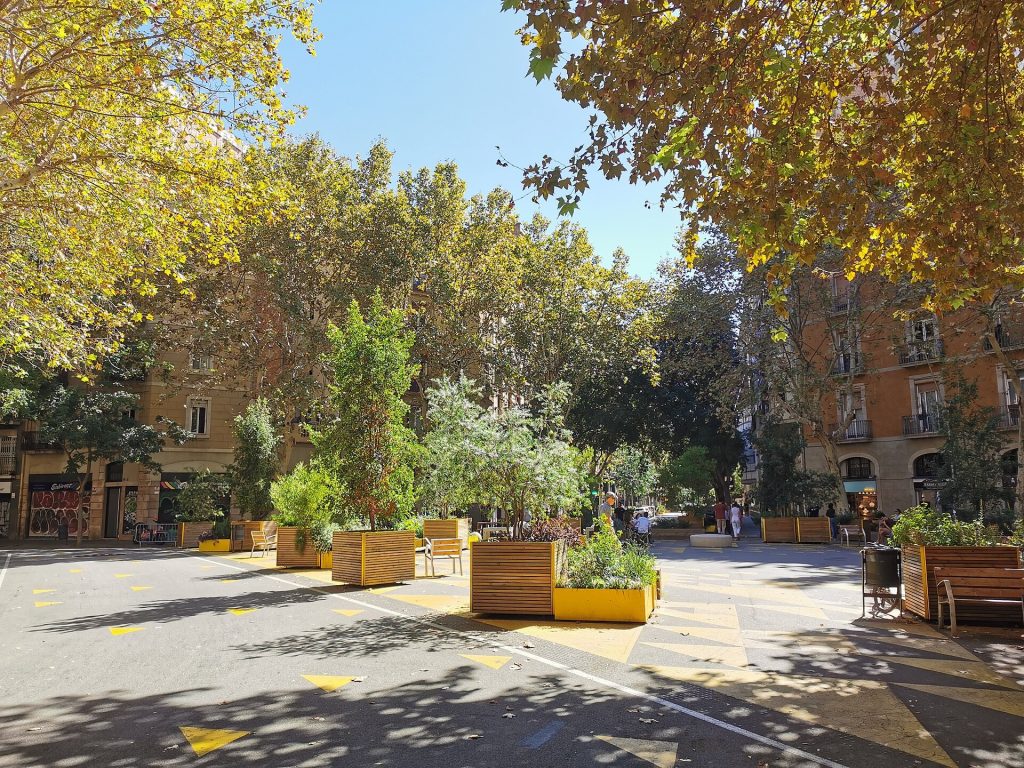
(A redesigned street in the Sant Antoni superblock, Barcelona. Image: Cataleirxs, CC BY-SA 4.0, via Wikimedia Commons.)
Barcelona’s Sant Antoni superblock asks what streets can offer when movement is no longer their only purpose.
A chair on a former traffic route changes the question a street asks. Instead of only directing a person onwards, it permits them to remain. In Barcelona’s Sant Antoni neighbourhood, the reorganisation of streets around the market gave that simple change an urban scale.
The first phase of the Sant Antoni superblock was implemented in May 2018. Sections of two intersecting streets were redesigned, creating a public square at their crossing and more space for pedestrians, planting and activities. The project redistributed an existing surface rather than finding a vacant site for an entirely separate park.
Space For Staying
The architectural intervention is consequently a matter of relationships. Seating needs usable shade; planting needs soil and care; walking routes must accommodate people with different mobility needs. A square can be drawn by reallocating space, but it becomes useful through the detailed conditions that allow people to occupy it.
Changes to traffic arrangements also extend beyond the most attractive photograph. Deliveries, emergency access and journeys by residents still have to work. The distribution of traffic on neighbouring streets must be considered, and the experiences of businesses and households may differ. A persuasive account should investigate those effects rather than assume that every user receives the same benefit.
Health is an important part of the research surrounding Barcelona’s superblocks. A published evaluation protocol set out ways to study activity, environmental exposure and residents’ experiences. A protocol describes an investigation; it is not itself proof of the outcomes. Observed results need their own methods, dates and limits before they can support claims about improvements.
What An Evaluation Can Establish
The direct spatial change is easier to describe. Road space previously organised around vehicles becomes available for other uses, including stopping, meeting and play. Its success can be examined through patterns of occupation: who stays, at what times, and whether the arrangement supports people who had few comfortable places nearby.
Sant Antoni makes the street’s allocation visible as a choice. The distance between buildings is finite, but its purpose is not predetermined. Architecture and urban design can help a city decide which activities deserve room there.
The most compelling image is therefore not an empty composition of furniture and planting. It is a space being used in different ways without demanding that everyone move on. A street begins to act like a room when the city makes staying there an ordinary possibility.
You May also like
By Aletheia Gako
By Aletheia Gako
By Aletheia Gako