A Different Venus Tomorrow or The Same Again?
By Rojina Bohara
How a 25,000-Year-Old Head Rewrote Beauty — and What It Tells Us About Our Continuing Quest for the Perfect Venus
Imagine a tiny sculpture no larger than your thumb, carved from mammoth ivory in the Paleolithic era — yet radiating an uncanny lifelike presence that still chills the spine today. This is La Dame de Brassempouy, affectionately known as the Lady with the Hood — perhaps the very first portrait humanity ever dared to sculpt.
From Ice Age Ivory to Immortal Influence
•Carved roughly 25,000 years ago during the Gravettian era, the figurine was unearthed in 1894 in southwestern France’s Grotte du Pape by Édouard Piette
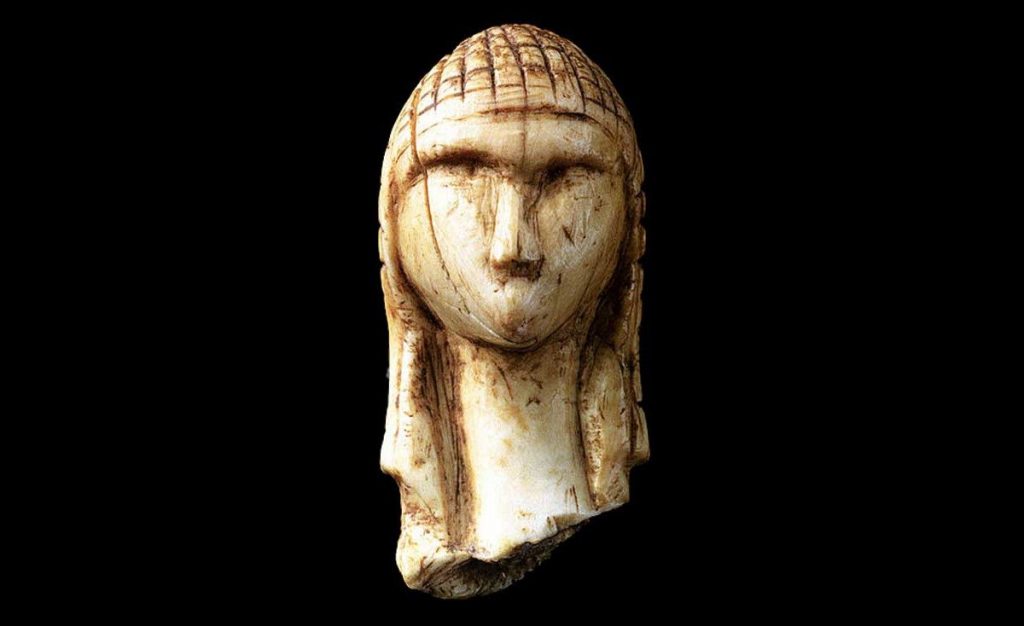
Image Credit: musee-archeologienationale.fr
•Standing a mere 3.65 cm tall, with deeply carved brows, a pronounced nose, almond eyes (complete with one finely incised pupil), and—most strikingly—no mouth at all .
•Her “hood” — a symmetrical pattern of crosshatched lines — may represent braids, a decorative cap, or even cornrows, defying easy interpretation and inviting wonder .
•Unlike other Venus figurines, Brassempouy’s head foregrounds a realistic human visage, setting it radically apart from stylized fertility sculptures such as Venus of Willendorf or Dolní Věstonice .
Venus Then vs. Venus Now: A Story of Reinvention
The term “Venus figurines” originally derives from the Roman goddess of love — a label applied retroactively to Stone Age female statuettes. Yet as archaeologists now emphasize, many of these sculptures were unsexed, symbolic, ritualistic, or entirely misunderstood through modern eyes .
From the modestly bulbous Venus of Willendorf (~28 000 BCE) emphasizing fertility, to Botticelli’s graceful Birth of Venus (1470s), through Picasso’s fractured Demoiselles d’Avignon (1907) — each epoch reshaped the ideal:
•Prehistoric Venuses celebrated life, survival, maternity — abstract, stylized, transcendent.
•Renaissance to Neoclassical Venuses became gracefully nude goddesses emerging from shells or sea foam — symbols of beauty and divine birth.
•Modern & Postmodern reinterpretations (Picasso, Duchamp, Warhol) shattered convention, questioned beauty, rebelled against ideals — turning Venus into a symbol of critique, self-expression, and bold identity reconstruction .
The Importance of Brassempouy Today: A Mirror to Modern Humanity
1.Realism Before Its Time
A human face with bone structure, brows, and identity — 25 millennia ago. That leap from abstraction to portraiture challenges everything we assumed about ancient art .
2.Symbol Without Symbolism
While fertility once dominated prehistoric art, Brassempouy’s head avoids sexual exaggeration — inviting alternative readings: ancestry, memory, spiritual identity, even mathematical symmetry .
3.The Evolution of Venus
A journey from survival symbolism to aesthetic idealism and now to questioning norms—Brassempouy stands at the inflection point, demanding: can we imagine a Venus who simply is?
What This Teaches Us Today
•That beauty and meaning evolve. What one culture worships, another redefines.
•That artistry is more than ornament—it’s insight, expression, agency.
•That every era carves its own Venus, but our collective legacy is richer when we embrace diverse faces, stories, and forms.
The Brassempouy head reminds us: in history, beauty isn’t fixed—it’s reborn through culture, rebellion, and rediscovery.
So… Should Tomorrow’s Venus Be Different or the Same Again?
If beauty is context, creativity and identity must be fluid.
If gendered ideals can imprison imagination, then true artistry expands it.
Let La Dame de Brassempouy be our guide: not the final word in depiction, but the first radical whisper toward endless possibility.
Because the next Venus could be any shape, skin, story—or none at all.
And that—my dear reader—is what makes history endlessly exciting.
In an age that demands new perspectives—from art to identity to society—this tiny ivory head beckons us to imagine what Venus might look like next.
A Different Venus Tomorrow?
Or… The Same Again?
Only our creative courage will dictate which.