
The King, The Camera, and the Climate Reckoning
By Anne Canal
Publication Date 8th May 2026: 06:25 GMT
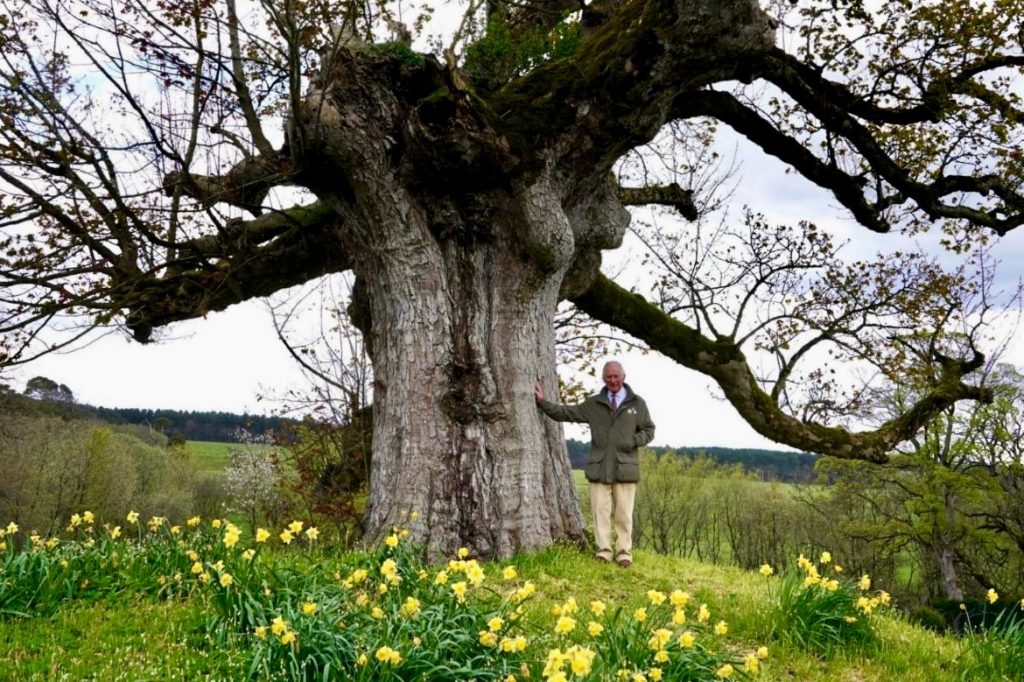
Image Credit: Scottish Government / Wikimedia Commons / CC BY 2.0
Why King Charles III’s Amazon Documentary May Become One of the Most Historically Important Royal Films Ever Produced
For decades, much of the world regarded King Charles III as an anachronism.
A prince who spoke to plants.
A royal who discussed sacred geometry, soil degradation, architecture, biodiversity, craftsmanship, urban alienation, and the spiritual exhaustion of industrial civilisation long before such conversations became fashionable.
A monarch mocked by sections of the press for concerns that now sit at the very centre of global politics.
And yet history possesses a peculiar habit of humiliating those who laugh too early.
Now, through Amazon Prime Video’s Finding Harmony: A King’s Vision, King Charles III has entered perhaps the most consequential communications phase of his public life: the transformation from controversial environmental eccentric to cinematic philosopher-king.
The significance of this moment extends far beyond royalty.
This is not merely another royal documentary.
Nor is it simply a carefully polished exercise in monarchical image management.
It is something far more ambitious:
an attempt to articulate an entire civilisational philosophy through film.
And in an age increasingly dominated by algorithmic distraction, cultural fragmentation, ecological instability, and spiritual exhaustion, the timing could scarcely be more extraordinary.
The Most Unusual Royal Documentary in Modern History
Finding Harmony: A King’s Vision arrives with remarkable ambition. Narrated by Kate Winslet and produced in collaboration with The King’s Foundation, the film follows Charles’s lifelong environmental worldview — one he first articulated publicly decades ago and expanded in his 2010 book Harmony.
Filmed across multiple continents over seven months, the documentary explores everything from regenerative agriculture and sustainable urbanism to indigenous ecological knowledge, architecture, forestry, craft traditions, and the relationship between human beings and nature itself.
That alone would make the production notable.
But what truly distinguishes the film is its philosophical audacity.
Modern documentaries about environmentalism typically follow one of three emotional registers:
- catastrophe,
- guilt,
- or technological salvation.
Charles’s documentary appears to reject all three.
Instead, it advances a profoundly old-fashioned yet strangely radical proposition:
that humanity’s crisis is not merely environmental — but civilisational.
That the destruction of ecosystems reflects the destruction of proportion.
That ugliness in architecture, disposability in manufacturing, alienation in cities, loneliness in digital culture, and ecological collapse are not isolated phenomena but interconnected symptoms of a civilisation that has forgotten how to live harmoniously.
This is not Silicon Valley futurism.
It is almost anti-modern in tone.
And that may be exactly why it matters.
From Ridicule to Vindication
One of the documentary’s most compelling undercurrents is historical reversal.
Charles spent much of the late twentieth century being caricatured for positions that today appear remarkably prescient. He advocated organic farming before supermarkets embraced sustainability branding. He criticised soulless modern architecture long before urban planners rediscovered walkable cities. He warned about ecological instability decades before climate anxiety became mainstream political reality.
There is something almost tragic — and perhaps quietly triumphant — in watching an elderly monarch revisit ideas once treated as aristocratic eccentricities only to discover that history has drifted closer to his worldview than his critics ever imagined possible.
In the film, Charles reportedly reflects on years of criticism and dismissal while reaffirming that he “wasn’t going to be diverted” from environmental advocacy.
That statement resonates far beyond royal biography.
Because what the documentary ultimately chronicles is not simply ecological campaigning.
It chronicles endurance.
The endurance required to hold unpopular convictions long enough for the culture around you to change.
Amazon: The Perfect Platform — and the Perfect Irony
The partnership with Amazon Prime Video is itself layered with symbolism.
For generations, royal documentaries emerged through institutions like the BBC or ITV — broadcasters tied to traditional national audiences and older media ecosystems. Charles instead enters the streaming era through one of the world’s largest technological corporations.
There is undeniable irony in this.
A monarch associated with traditionalism and ecological restraint partnering with a company symbolic of hyper-modern consumer capitalism.
Yet that contradiction may reveal something profound about contemporary influence.
If environmental philosophy wishes to compete culturally in the twenty-first century, it cannot remain confined to academic conferences, specialist journals, or niche activist circles. It must enter mass entertainment systems capable of reaching hundreds of millions of viewers.
And streaming platforms are now among the most powerful narrative infrastructures on Earth.
Amazon does not merely distribute content.
It shapes global consciousness.
Charles appears to understand this.
The monarchy increasingly recognises that modern legitimacy is no longer sustained through ceremony alone. It is sustained through narrative fluency within global media ecosystems.
This documentary is therefore not simply a film.
It is strategic cultural positioning.
The Return of Moral Grand Narratives
Perhaps the most fascinating dimension of Finding Harmony is that it attempts something contemporary Western culture has largely abandoned:
a moral grand narrative.
For years, mainstream culture has fragmented into hyper-personalised identity streams, algorithmic feeds, short-form entertainment, and cynical political tribalism. Shared philosophical frameworks have weakened. Collective meaning has eroded.
Charles’s “Harmony” philosophy attempts to reconstruct a unifying idea:
that human flourishing depends upon recognising interconnectedness.
Nature. Architecture. Community. Agriculture. Spiritual life. Economics. Beauty. Ecology. Craftsmanship.
Not separate domains — but one living system.
This idea is ancient.
It echoes Aristotle.
It echoes medieval cosmology.
It echoes indigenous ecological traditions.
It echoes aspects of Islamic geometry, classical proportion theory, and Eastern philosophies of balance.
In many ways, Charles’s worldview resembles a pre-industrial understanding of civilisation reframed for an ecological age.
And whether one agrees with him or not, there is intellectual seriousness in attempting to articulate such a vision amid an era increasingly hostile to sustained thought itself.
The Monarchy’s Most Important Evolution
The British monarchy has survived for centuries not because it remained static, but because it adapted symbolically to changing eras.
Under Queen Elizabeth II, the monarchy represented continuity and duty.
Under Charles III, it may increasingly attempt to represent stewardship.
That distinction matters.
Because environmental instability is likely to define the twenty-first century more profoundly than many current political debates. Climate migration, agricultural disruption, biodiversity collapse, water insecurity, and urban overheating are not speculative futures; they are emerging realities.
Charles has spent over fifty years positioning himself around precisely these issues.
What once appeared peripheral may become central to his historical legacy.
And this documentary may eventually be viewed as the clearest cinematic articulation of that legacy.
Cinema as Soft Power
Historically, Britain projected power through empire, industry, finance, diplomacy, literature, and broadcasting.
Increasingly, however, cultural influence operates through emotionally resonant storytelling platforms.
This is where Finding Harmony becomes geopolitically interesting.
Because the film does not merely export an image of Charles.
It exports a vision of Britain itself:
- a Britain of ecological restoration,
- traditional craftsmanship,
- conservation,
- sustainable architecture,
- heritage landscapes,
- and philosophical restraint against excess consumerism.
Whether consciously or not, the documentary functions as soft power.
It attempts to reposition British identity away from imperial nostalgia and toward ecological guardianship.
That is a significant transition.
A Film About Time
At its deepest level, Finding Harmony is fundamentally a film about time.
About long-term thinking in a civilisation increasingly trapped in short-term stimulation.
Charles belongs to a generation educated to think in decades rather than quarterly cycles. Trees planted now may mature after his death. Architectural traditions preserved today may shape cities centuries later.
Streaming culture, by contrast, rewards immediacy.
And yet perhaps that tension explains the emotional force of the project.
There is something undeniably poignant about an ageing monarch — after decades of ridicule, scandal, constitutional debate, and personal scrutiny — using one of the world’s most advanced entertainment platforms to advocate for older ideas of balance, stewardship, permanence, and harmony.
It feels almost paradoxical:
a deeply traditional message delivered through hyper-modern infrastructure.
The Real Question the Film Asks
Ultimately, Finding Harmony asks a question far larger than whether audiences agree with King Charles III.
The real question is this:
Can modern civilisation rediscover limits, proportion, beauty, and ecological balance before technological acceleration outruns human wisdom?
That is not merely a royal question.
It is the defining question of the century.
And perhaps that is why this documentary matters.
Not because it features a king.
But because it reveals something increasingly rare in public life:
a serious attempt to think civilisationally.
You May also like

By Rojina Bohora
By Anne Canal
By Sam Stafford & Carolina Berghinz