The Architecture of Calm
By Anne Canal
Publication Date 8th May 2026: 10:00am GMT
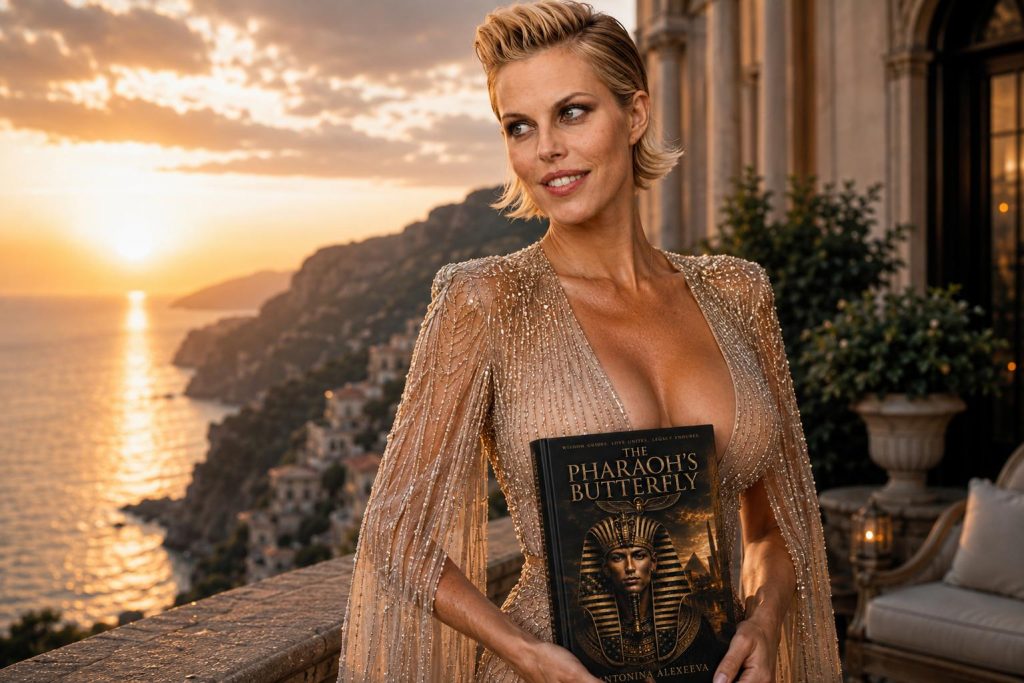
(CWM Publishing Image Credit [Cyber Modelling Licence 23648363928]: Antonina Alexeeva photographed holding The Pharaoh’s Butterfly ahead of the novel’s 19th May release. Promotional press image supplied for editorial/press-release usage.)
Antonina Alexeeva’s The Pharaoh’s Butterfly and the Rebirth of Civilisational Literature
“Butterflies do not conquer fields.
They change them.”
There are novels that attempt to entertain children.
There are novels that attempt to educate them.
And then, once in a generation, there are novels that attempt something far more difficult and infinitely more dangerous:
to prepare them for civilisation itself.
Antonina Alexeeva’s debut novel The Pharaoh’s Butterfly is one of those rare works.
Not because it shouts its intelligence.
Not because it dazzles through complexity.
But because it possesses something increasingly uncommon in modern literature: composure.
In an age intoxicated by acceleration — where culture mistakes spectacle for meaning and loudness for leadership — Alexeeva has written a novel about restraint. About disciplined thought. About the moral responsibility of governance. About the architecture required for societies not merely to survive, but to remain humane while surviving.
That is what makes this book remarkable.
And perhaps historic.
Because beneath its accessible prose, child-readable elegance, and mythic atmosphere lies one of the most quietly ambitious philosophical projects attempted in contemporary fiction: the reintroduction of civilisation as a moral art form.
Not empire.
Not domination.
Civilisation.
I. The Return of the Civilisational Novel
For much of the twentieth and twenty-first centuries, literature increasingly turned inward.
Alienation replaced stewardship.
Psychology replaced statecraft.
Collapse replaced continuity.
Many modern stories ask:
How does the individual survive the world?
The Pharaoh’s Butterfly asks something far older:
How does a society remain wise?
That distinction changes everything.
From its opening pages, the novel establishes a civilisation not built upon intimidation, but upon attentiveness. The Black Hawk Pharaoh does not sit above his family “at the head of the table,” but among them, because “a ruler who placed himself above conversation… soon lost the ability to hear truth.”
That sentence alone reveals the book’s governing philosophy.
Authority here is not performative dominance.
It is organised listening.
This is extraordinarily rare in modern storytelling. Most fictional rulers are written through familiar archetypes:
- the tyrant,
- the fool,
- the reluctant hero,
- the charismatic conqueror.
Alexeeva instead gives us something philosophically more sophisticated:
a ruler whose greatest strength is interpretive discipline.
He is not weak.
Indeed, the novel repeatedly makes clear that Egypt is highly capable of force.
But the Pharaoh understands something deeper:
that a civilisation governed primarily through fear slowly teaches its people to stop thinking.
And once people stop thinking, collapse merely becomes a matter of time.
II. Egypt Reimagined as a Moral System
What Alexeeva constructs is not historical Egypt in the archaeological sense.
It is Egypt as philosophical possibility.
Her civilisation operates almost as an ethical ecosystem:
- schools are visible,
- artisans respected,
- music strategically cultivated,
- governance distributed,
- and symbolism carefully interpreted rather than blindly obeyed.
One of the novel’s most profound recurring themes is that societies become what they repeatedly practice.
Thus:
- Egypt practices listening,
- Sumeria practices projection,
- Greece practices permission through mysticism.
This becomes explicit in the extraordinary Delphi discussions early in the novel, where the Pharaoh reacts with astonishment to Greek rulers placing faith in smoke-induced prophecy.
Yet Alexeeva wisely avoids caricature.
The Greeks are not mocked as primitive.
Instead, the Pharaoh gradually realises something more dangerous:
people often seek mystical systems not because they are foolish, but because such systems relieve them of responsibility.
That insight is devastatingly contemporary.
The novel’s discussion of “pneumamancy” — divination through breath and vapour — evolves into a meditation on how spectacle acquires authority.
And suddenly the novel ceases to be about antiquity at all.
It becomes about modernity.
About influencers.
Political theatre.
Algorithmic persuasion.
Manufactured certainty.
Institutional branding.
Emotional manipulation masquerading as truth.
Alexeeva understands something many political commentators still do not:
civilisations are rarely conquered first through armies.
They are conquered through epistemology.
Through altering how populations determine what is real, trustworthy, meaningful, and authoritative.
That is the true significance of the Butterfly Children.
III. The Butterfly Children and the Psychology of Infiltration
The arrival of Butter and Fly is one of the most intellectually elegant narrative devices in recent literary fiction.
At first glance, the scene resembles ancient myth:
children arriving by river,
mysterious artefacts,
prophetic language.
But Alexeeva subverts the trope almost immediately.
These children are not magical beings.
They are instruments of civilisational testing.
Their accompanying bowl — eventually revealed not as decoration but encoded process and instruction — represents one of the novel’s most sophisticated ideas:
knowledge can be planted within societies long before its purpose becomes visible.
This transforms the novel into something astonishingly modern.
The children are not spies.
They are proofs of concept.
Proof that influence can travel quietly.
That cultures can be redirected psychologically.
That symbolism itself can function strategically.
And yet the genius of the novel lies here:
Egypt does not respond through paranoia.
It responds through education.
That distinction may be the philosophical core of the entire work.
In lesser fiction, the discovery of infiltration leads to militarisation or hysteria.
In The Pharaoh’s Butterfly, it leads to deeper learning.
The Pharaoh does not panic.
He decentralises knowledge.
He teaches observation.
He cultivates resilience.
He prepares people intellectually before strategically.
That is not merely good governance.
It is a complete theory of civilisation.
IV. The Chamber of the Window: One of the Great Educational Metaphors in Modern Fiction
The training of Butter may ultimately become the novel’s most enduring contribution to philosophical literature.
The image is simple:
a small chamber,
a narrow window,
a child instructed to sit and observe the world.
But simplicity here conceals extraordinary conceptual precision.
The window never grows larger.
Butter does.
This is not simply beautiful writing.
It is a complete educational philosophy.
Alexeeva rejects the contemporary assumption that intelligence means endless information accumulation. Instead, she proposes that wisdom arises from disciplined attention.
The world is not chaos.
It is “complexity asking to be read slowly.”
That line deserves preservation.
Indeed, many passages throughout the novel possess this quality — concise observations that feel less invented than discovered.
Another example:
“A leader does not see more than others.
A leader sees deliberately.”
This is not children’s literature in the diminished sense.
It is leadership literature translated into child-accessible emotional architecture.
And that may explain why the novel feels so unexpectedly affecting.
It does not patronise youth.
It inducts them into responsibility.
V. The Feminine Architecture of Governance
One of the book’s most radical achievements is how naturally it integrates female authority.
Loap, Hermina, and Meret-Hathor are not symbolic “strong women” inserted for performative modernity.
They are structurally indispensable to governance itself.
Loap provides emotional correction.
Hermina intellectual provocation.
Meret-Hathor interpretive calm.
Together they form what might be called a distributed cognition model of leadership.
The Pharaoh is not diminished by this.
He is stabilised by it.
This culminates magnificently in Chapter Seven, The Great Queen’s Bursting Heart, one of the finest depictions of relational statecraft written in years.
Loap’s emotional eruption is not treated as irrationality.
It is treated as systemic necessity.
Her confrontation forces the Pharaoh to recognise a crucial civilisational truth:
systems collapse when efficiency erases tenderness.
Her line:
“I am carrying a future you cannot diagram.”
is among the most important sentences in the novel.
Because suddenly the entire philosophical framework sharpens:
knowledge alone is insufficient.
A civilisation must also remain emotionally inhabitable.
And Alexeeva understands something many technocratic societies forget:
love is infrastructure.
VI. Music, Timing, and the Invisible State
The musicians may be the book’s most brilliant conceptual invention.
Initially appearing ornamental, they gradually reveal themselves as instruments of social coherence.
They do not merely perform music.
They regulate atmosphere.
Synchronise emotional tempo.
Prepare populations psychologically before information arrives.
The implications are enormous.
Alexeeva is effectively proposing that mature civilisations manage not merely law and economy, but rhythm itself.
This borders on political philosophy of the highest order.
The musicians understand:
“Order is not reactive.”
That line may eventually become widely quoted.
Because it explains not only governance —
but parenting,
education,
institutions,
and emotional maturity.
Healthy systems prepare before panic.
They do not improvise morality during crisis.
VII. Steel at Sunrise — The Ethics of Preparedness
Perhaps the novel’s most extraordinary accomplishment is its handling of power.
Egypt develops steel.
But Alexeeva refuses the usual narrative gratification.
There is no triumphalism.
No militaristic intoxication.
No civilisational supremacy fantasy.
The steel is treated as:
- craft,
- responsibility,
- distributed resilience.
When the Pharaoh says:
“This is not a weapon… It is a possibility.”
the book reveals its deepest ethical commitment.
Power must remain governed by moral intention.
Otherwise civilisation becomes indistinguishable from conquest.
This restraint reaches its climax in The Question of War, where the Pharaoh rejects reactionary escalation even while fully recognising danger.
His philosophy is breathtakingly sophisticated:
- do not reveal readiness prematurely,
- do not let fear determine timing,
- do not become psychologically captured by the enemy’s logic.
Or, as the novel puts it:
“Preparedness that is visible becomes threat. Preparedness that is felt becomes reassurance.”
That may be one of the most intelligent definitions of civilisational stability written in contemporary fiction.
VIII. Antonina Alexeeva and the Emergence of a New Artistic Archetype
It would be easy — and profoundly mistaken — to frame Alexeeva merely as “an actress who wrote a novel.”
This book is too conceptually disciplined for such reduction.
Instead, The Pharaoh’s Butterfly suggests the emergence of a newer type of artist:
one operating across embodiment, image, movement, psychology, and philosophy simultaneously.
Alexeeva’s background in artistic gymnastics matters enormously here.
Gymnastics teaches:
- restraint,
- balance,
- spatial timing,
- precision under pressure,
- bodily intelligence,
- and elegance achieved through control rather than excess.
Those exact qualities define the novel’s prose.
The writing itself moves like choreography:
measured,
balanced,
deliberate,
economical.
Likewise, her visual background as a model and actress appears to have sharpened her sensitivity to symbolic staging. Nearly every scene in the book functions architecturally:
rooms,
music,
silence,
movement,
gesture,
light,
distance.
Nothing feels accidental.
The result is not simply literary.
It is cinematic philosophy.
IX. Why This Book Matters Now
We live in a civilisation increasingly overwhelmed by its own nervous system.
Information moves faster than understanding.
Outrage outpaces reflection.
Visibility outranks wisdom.
Under such conditions, societies become psychologically combustible.
The Pharaoh’s Butterfly offers an alternative civilisational imagination.
One where:
- education outranks spectacle,
- leadership means steadiness,
- preparation matters more than performance,
- and emotional maturity is treated as statecraft rather than private virtue.
The novel does not argue for passivity.
It argues for coherence.
And coherence may become one of the defining survival skills of the twenty-first century.
X. What Endures When the River Moves On
The final epilogue is quietly devastating in its beauty.
The river continues.
Children continue.
Music continues.
Observation continues.
Civilisation survives not because it conquers endlessly —
but because wisdom becomes culturally distributed.
That is the novel’s ultimate revelation.
The true defence of Egypt was never:
- idols,
- armies,
- monuments,
- or even steel.
It was literacy of perception.
Its people learned how to think without panic.
How to prepare without arrogance.
How to wield power without worshipping it.
And perhaps that is why the final lesson resonates so deeply:
“Leadership is not about being seen at the centre of things.
It is about making sure the centre holds.”
That sentence alone may ensure this novel’s endurance.
Because it speaks not merely to children.
But to teachers.
Parents.
Architects.
Statesmen.
Artists.
And to any civilisation still hoping wisdom might yet outlast noise.
Source Material
Review based on the full manuscript of The Pharaoh’s Butterfly by Antonina Alexeeva.
You May also like

By Carolina Berghinz
By Rojina Bohora
By Sam Stafford