A New Era of Flight & What We Know About the Unknown
By Samantha Stafford
Published: 3rd May, 2026: 12:30 GMT
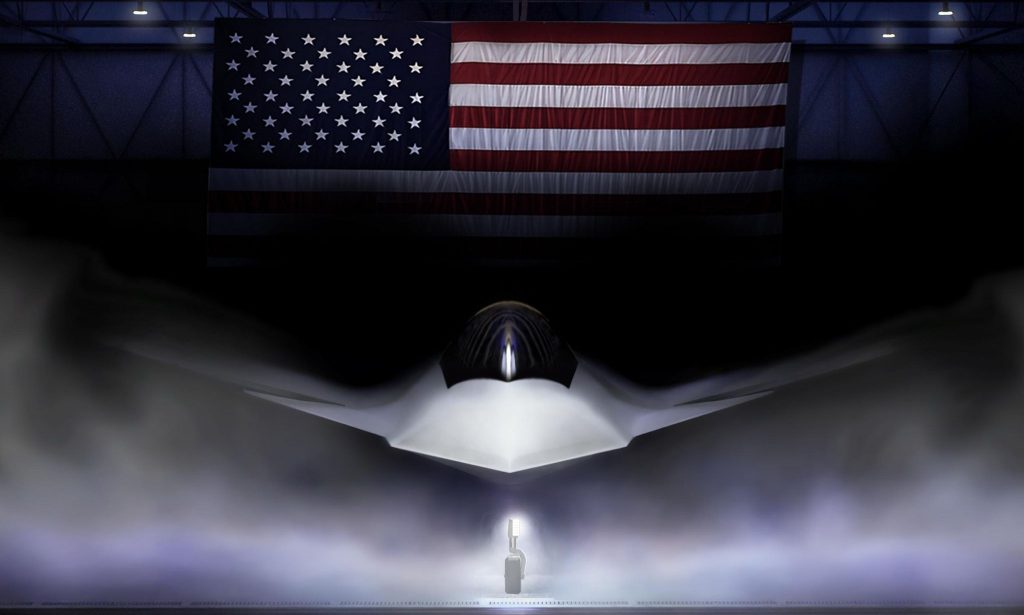
Image Credit: U.S. Air Force / DARPA conceptual imagery — Public domain (artist renderings of next-generation air dominance systems)
There are moments in technological history when silence is more revealing than disclosure.
For three decades, the architecture of American air power was not merely visible—it was legible. Aircraft had names, roles, doctrines. They were explained, debated, budgeted, and, ultimately, understood. The F-22 Raptor embodied air superiority; the F-35 Lightning II represented networked warfare. Even their secrets existed within a known frame.
The F-47, by contrast, arrives as an absence.
Not an aircraft revealed, but a system implied. Not a doctrine stated, but one inferred—piece by fragmentary piece—from procurement notices, altered renderings, and the careful choreography of omission. And now, through something as seemingly mundane as a weapons compatibility document, a new phrase enters the public domain:
Stand-in attack.
It is a term that does not refine the past. It overturns it.
The End of Distance
For much of modern warfare, distance was safety.
From the deserts of Iraq to the skies over Serbia, American air doctrine relied on standoff warfare—launching precision weapons from beyond the reach of enemy defenses. Cruise missiles arced across continents. Anti-radiation missiles hunted radar emissions. The logic was elegant: stay outside the threat envelope, strike with precision, withdraw without exposure.
It worked—until it didn’t.
The emergence of advanced integrated air defense systems—Russia’s S-400, China’s HQ-9—rendered distance unreliable. These were not static targets but adaptive systems: mobile, intermittent, elusive. A missile launched from hundreds of miles away often arrived to find nothing at all.
The battlefield, in effect, had learned to move.
And so a question emerged, quiet at first, then increasingly unavoidable:
What if the attack did not come from outside the system—but from within it?
Stand-In: A Doctrine Reversed
The phrase “stand-in attack” is deceptively simple. It suggests proximity. Presence. Risk.
But in practice, it implies something far more radical: the deliberate insertion of a strike capability inside the most heavily defended airspace on Earth.
Not skirting the edges of the system—but inhabiting it.
For this to be possible, the aircraft carrying such a mission must achieve what previous generations only approximated:
•Persistent stealth across multiple detection spectra
•Sufficient range to penetrate deep without support
•The ability to survive, decide, and act within a dynamic, hostile network
The aircraft must not merely evade detection. It must operate meaningfully while evading it.
This is the conceptual threshold the F-47 appears designed to cross.
The Engine That Changes the Equation
At the heart of this transformation lies a quiet revolution in propulsion.
Traditional fighter engines have always required compromise: thrust or efficiency, speed or range. The emerging adaptive cycle engine, developed under programs involving Pratt & Whitney and GE Aerospace, proposes to dissolve that compromise entirely.
By introducing a third airflow stream—dynamically adjustable in flight—the engine becomes not a fixed system but a responsive one:
•Efficient, cooler, and less detectable when needed
•Powerful, high-thrust, and combat-ready on demand
But its most consequential feature may not be propulsion at all.
The architecture enables unprecedented electrical power generation and thermal management—the prerequisites for onboard artificial intelligence systems and, potentially, directed energy weapons.
In other words, the engine is not just about moving the aircraft.
It is about powering what the aircraft becomes.
The Pilot as Commander
If the engine redefines the machine, autonomy redefines the human within it.
The F-47 is not conceived as a solitary platform. It is a node—a command centre in motion—coordinating a constellation of collaborative combat aircraft, autonomous drone wingmen operating at speed and scale.
These are not remotely piloted tools. They are semi-autonomous actors:
•Mapping air defense networks in real time
•Testing radar responses
•Drawing fire, jamming signals, striking secondary targets
The human pilot, then, is no longer a pilot in the traditional sense.
They are a commander of systems—making decisions not at the level of manoeuvre, but at the level of orchestration. The cognitive shift required is profound. It is less Top Gun than it is systems architecture under fire.
The Aircraft We Cannot See
It is worth pausing on what we do not know.
The public images of the F-47 are acknowledged fictions. Officials have admitted as much with a degree of almost theatrical candour. The true form, performance envelope, and operational parameters of the aircraft remain classified—perhaps more tightly than any predecessor.
Even the mission, as now partially revealed, exists in fragments.
And yet, through those fragments, a coherent picture emerges—not of an aircraft, but of a philosophy:
•Penetrate, do not orbit
•Disrupt, do not bypass
•Collapse systems from within, not from without
It is less an evolution of air superiority than a redefinition of it.
Parallel Futures
No technological shift exists in isolation.
China’s development of sixth-generation prototypes—the Chengdu J-36, the Shenyang J-50—suggests a parallel trajectory, though one oriented toward scale, range, and payload. Where the American approach appears network-centric and distributed, the Chinese vision leans toward concentrated capability.
Two philosophies, emerging simultaneously, each interpreting the future of air warfare through a different lens.
Which will prove more effective remains unknowable.
The Unknown as Strategy
Perhaps the most striking feature of the F-47 program is not its technology, but its opacity.
In previous eras, capability was communicated as deterrence. Visibility was power. Today, ambiguity itself appears to function as a strategic asset. By revealing just enough to suggest a paradigm shift—while withholding the details—the program creates uncertainty not only about what the aircraft can do, but about how it will be used.
The unknown becomes operational.
Conclusion: Flight, Reimagined
There is a tendency to think of technological progress as linear: faster aircraft, longer range, greater stealth.
The F-47 suggests something different.
Not an improvement in degree, but a change in kind.
Flight, in this emerging paradigm, is no longer about traversing space safely. It is about inhabiting contested space intelligently—with machines that adapt, systems that collaborate, and humans who command not just aircraft, but networks of action.
We stand, then, at the edge of a new era of flight.
One defined not by what we can see in the sky—but by what we can no longer see at all.
And in that invisibility, perhaps, lies its greatest power—and its greatest uncertainty
You May also like
By Lola Foresight

By Anne Canal