
On Titan The Laboratory Could Learn To Fly
By Luganka Swana
Publication Date: 24 April 2026 — 10:08 GMT
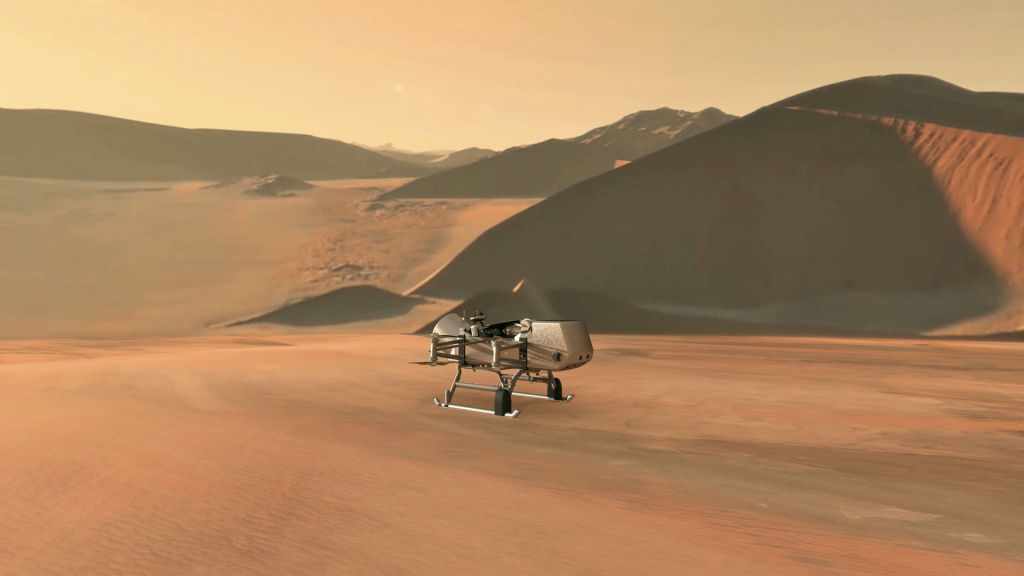
(Artist’s concept of Dragonfly landing on Titan. A mission illustration, not a photograph from the moon. Image Credit: NASA/JHU-APL)
Dragonfly’s planned journeys across Saturn’s largest moon would turn flight into a way of comparing the chemistry of different landscapes.
A rover meets its next landscape one obstacle at a time. On Titan, a scientific vehicle could rise above the obstacles and carry its laboratory elsewhere. NASA’s Dragonfly mission is designed around that possibility: a rotorcraft capable of visiting multiple places on Saturn’s largest moon.
The choice is rooted in the environment. Titan’s dense atmosphere and low gravity favour flight. Terrain that would slow a wheeled vehicle need not impose the same route on a flying one. The scientific consequence is substantial. Instead of describing a single landing site in exceptional detail, a mission could compare environments with different histories.
Chemistry Has A Geography
Dragonfly was confirmed by NASA in 2024. The mission seeks to investigate chemical processes relevant to the steps preceding life. Titan is rich in organic chemistry, but the word organic here describes carbon-containing compounds. It does not certify a biological origin.
That distinction makes the mission more interesting. A world can manufacture complicated molecules without organisms. Studying how those molecules form, move and interact can help scientists understand the distance between chemistry and biology.
The Dragonfly Mass Spectrometer, DraMS, is intended to examine material collected at the surface. Samples can be heated or interrogated with a laser, allowing the instrument to investigate their molecular composition. Other instruments will provide environmental and elemental context. A molecule becomes more informative when its location and surroundings are known.
Finding a substance in several landscapes permits useful comparisons. Does it occur everywhere, or concentrate in particular terrain? Might geological processes explain the distribution? Flight becomes part of the experimental method because it allows those questions to be asked of different places.
Exploration At The Pace Of An Instrument
The concept illustration accompanying this article shows an imagined landing. It is a design visualisation, not a photograph from Titan. That honesty leaves room for the genuine excitement: an instrument package might one day experience this alien environment rather than only observe it remotely.
The mission will have to manage scarce energy, cold conditions and autonomous decisions across enormous communication distances. Solar illumination at Titan is weak, so Dragonfly’s design uses a radioisotope power source. Its flights belong within an observing programme, with time needed to collect samples, recharge and decide what merits further attention.
A terrestrial drone video can make flight seem immediate and casual. A planetary rotorcraft is a travelling observatory whose usefulness depends on the reliability of each landing and measurement.
Reaching a second distinct site would make comparison possible. A flying laboratory could turn Titan’s chemical geography into a deeper investigation of how the ingredients for life develop.
You May also like
By Luganka Swana

By Luganka Swana
By Luganka Swana