
The Small Moon That Sends Its Ocean Into Space
By Luganka Swana
Publication Date: 3 May 2026 — 08:37 GMT
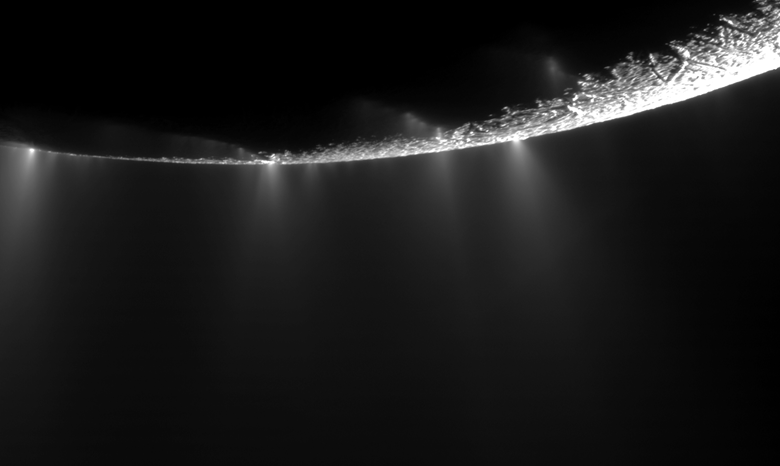
(Cassini’s view of plumes above Enceladus. The chemical findings discussed in this article came from instrumental sampling. Image Credit: NASA/JPL/SSI)
Enceladus offers an unusual gift to exploration: material from a concealed sea can be sampled above the surface.
A hidden ocean ordinarily asks explorers to descend. Enceladus offers another route. Through fissures near its south pole, Saturn’s small icy moon ejects gas and grains into space. NASA’s Cassini spacecraft encountered that material, making the plume a natural sampling system for a sea beyond direct view.
Cassini’s flight ended in 2017, but its measurements kept producing discoveries. In 2023, researchers reported phosphorus-bearing salts in ice grains associated with the moon. Phosphorus is important in terrestrial biology, including the chemistry of genetic material and energy transfer. Its presence helped fill a significant gap in the inventory of ingredients available in this ocean world.
A Sample Is A Journey
A plume particle is not an untouched spoonful from an ocean floor. It has passed through a route from water to ice to space, and an instrument must interpret the material that survives that journey. This is why laboratory experiments and chemical models accompany spacecraft measurements.
The phosphorus result drew on Cassini’s dust data, including particles sampled in Saturn’s E ring. That ring receives material from Enceladus. Looking beyond the most dramatic jets enlarged the set of observations available to researchers.
Earlier work had found molecular hydrogen in the plume, supporting the possibility that water interacts with rock within the moon. Such reactions can provide chemical energy. The combination is compelling: liquid water, relevant compounds and a plausible source of usable energy can be discussed within one physically connected setting.
It remains a setting, rather than a census of organisms. Geological reactions can create important molecules without life. A future investigation would need measurements capable of distinguishing competing explanations for what it finds.
The Value Of Keeping A Mission’s Memory
There is another story inside the discovery. The spacecraft was gone; the evidence was still available. Instruments built years before the analysis had left records that could be examined with new questions.
An archive is therefore part of a mission’s scientific equipment. Its usefulness depends on preserving calibration, context and documentation, so that another team can understand what was measured. A file without that surrounding knowledge may retain numbers while losing meaning.
For readers, the Enceladus plume creates an irresistible image: an ocean sending messages through a frozen shell. For scientists, the message is a distribution of chemical signals that must be interpreted carefully. The plume’s beauty and the measurements give us different ways of understanding the same moon.
You May also like
By Luganka Swana

By Anne Canal