
A Telescope That Treats The Night Sky As A Developing Story
By Luganka Swana
Publication Date: 28 August 2026 — 08:43 GMT
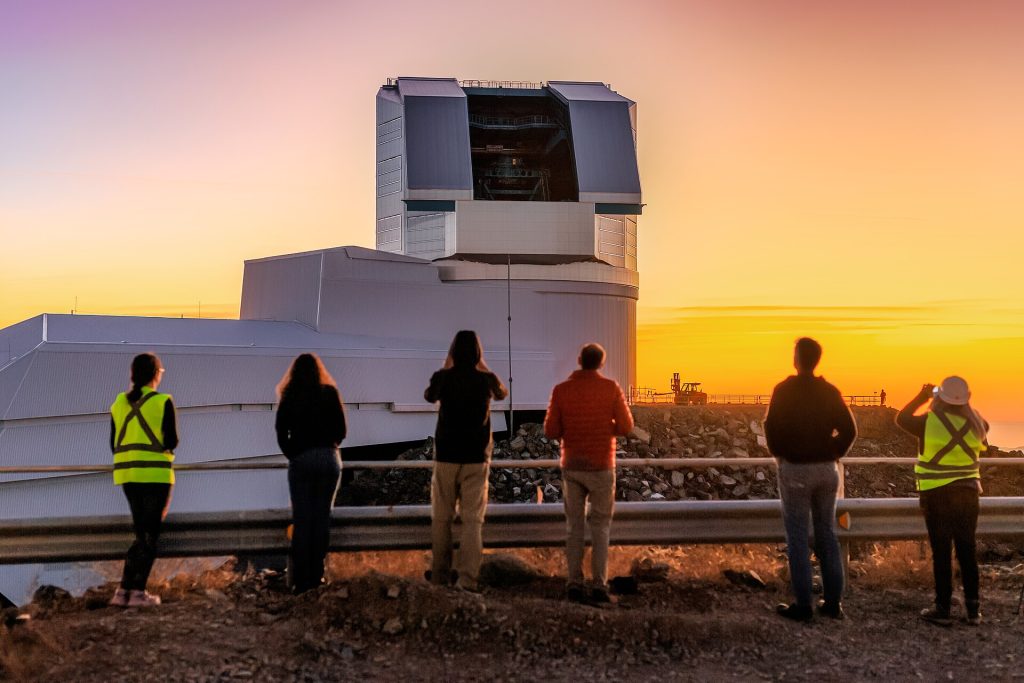
(Rubin Observatory during the May 2025 First Look observing campaign. Facility photograph, not a representation of its alert data. Image Credit: RubinObs/NOIRLab/SLAC/NSF/DOE/AURA/P. Horálek (Institute of Physics in Opava) — CC BY 4.0)
Rubin’s survey approach changes the question from what is there to what has changed since the last visit.
An astronomical photograph can make the universe look still. Vera C. Rubin Observatory was built to investigate the changes hidden inside that appearance. By returning to wide areas of sky, it can look for objects that move, brighten, fade or emerge where no comparable source was previously recorded.
The observatory released its first imagery in June 2025. In February 2026 it issued its first public scientific alerts, including hundreds of thousands of notifications from one night. A view of the sky was becoming a stream of events that other observers could examine.
Discovery Through Subtraction
The principle is straightforward to describe. Compare a new image with a reference assembled from earlier observations, accounting for the differences between the exposures. Subtract the stable scene. What remains can point to a change.
The execution is difficult. Atmospheric conditions, image quality and calibration can create apparent differences that do not belong to the astronomical object. A useful detection pipeline must distinguish those effects from the transient or moving sources it is meant to find.
Alerts are starting points for investigation. They may identify a variable star, an exploding star, activity around a distant black hole or a moving Solar System body. A notification does not by itself provide a complete physical explanation or an asteroid’s fully determined orbit.
Rubin’s planned volume makes selection a scientific problem. Software brokers organise the stream, add context and help researchers choose targets for follow-up. Another telescope may then measure a spectrum or observe the event at a different wavelength. The wide survey and the focused observation become complementary.
Who Gets To Follow The Signal
The alerts are public. That matters because an event spotted by one facility can become a question for a wider community. Access to the notification does not remove every inequality in computing resources or telescope time, but it changes who can begin the investigation.
The abundance also demands judgement. Which event deserves a scarce observing slot? Which signal requires another image before a stronger claim can be made? The survey’s speed enlarges the opportunity, while the evidence gathered afterwards determines what has actually been discovered.
The observatory photograph accompanying this article shows the terrestrial place behind the expanding data stream. People, instruments, infrastructure and a dark Chilean sky all contribute to the apparent simplicity of discovering a new point of light.
Rubin invites a less static relationship with astronomy. The universe becomes something whose developments can be revisited and followed. Its most important discovery may begin with a modest subtraction: a small difference between two images, sent quickly enough that someone elsewhere can look before the scene changes again.
You May also like
By Luganka Swana
By Luganka Swana

By Luganka Swana