
The Observatory That Turned Measurement Into Architecture
By Aletheia Gako
Publication Date: 20 August 2026 — 08:43 GMT
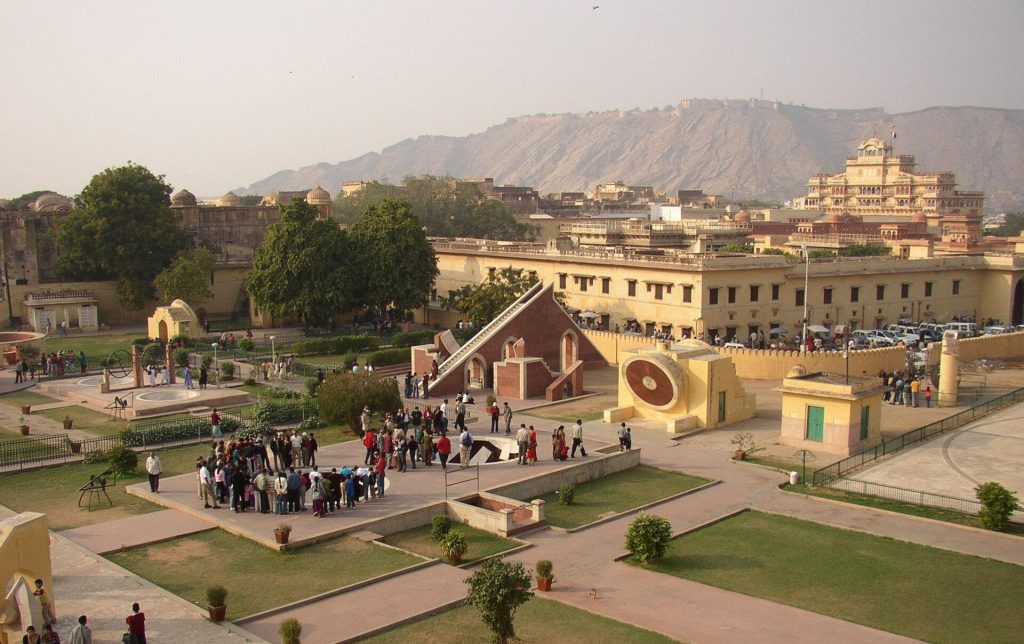
(Astronomical instruments at Jantar Mantar, Jaipur. Image: Knowledge Seeker, Public domain, via Wikimedia Commons.)
At Jaipur’s Jantar Mantar, buildings become instruments for looking at the sky.
Some structures at Jantar Mantar look like stairways awaiting a missing room. Others curve into the ground or present enormous inclined planes. Their unfamiliar forms become legible when the sky enters the explanation: this architecture was made to measure celestial positions.
The Jaipur observatory was built in the early eighteenth century under Jai Singh II. Its monumental instruments belong to a tradition of positional astronomy using observation with the naked eye. Masonry gave mathematical relationships a physical scale, allowing angles, shadows and alignments to be read through constructed forms.
A Form That Measures
The large sundial is the most immediately recognisable example. Its inclined structure works with graduated surfaces to translate the sun’s changing position into a reading. The monument is not a symbolic representation of scientific knowledge. Its dimensions and orientation are part of a working method.
Scale alone, however, does not guarantee accuracy. Reliable measurement also depends on alignment, calibration, the condition of markings and the observer’s practice. Claims that a historic instrument achieves a particular precision need a stated method and evidence. An impressive photograph of a huge sundial is not a substitute for either.
Jantar Mantar belonged to a court in which astronomical inquiry, religious practice and political authority were connected. It should not be retrofitted into a simple story of modern science overcoming an irrational past. Its instruments drew on knowledge shared across cultures and served purposes shaped by their own historical setting.
Preserving A Method
The architecture makes that history unusually tangible. A visitor can occupy the space around an instrument and begin to understand how its form constrains an observation. Knowledge is expressed through the relationship between a person’s position, a measured surface and an object in the sky. The building is both a place and a procedure.
Conserving such a site raises questions beyond the protection of its silhouette. If a marking is renewed, or a surface repaired, the intervention may affect how the instrument is understood. Preserving the physical object and preserving knowledge of its use are related responsibilities. Interpretation must explain the operation without overstating what remains demonstrable.
Jaipur offers architecture a role rarely considered in contemporary spectacle. A dramatic form can be dramatic because it does something intellectually precise. The inclined wall and hollowed curve are not arbitrary flourishes. They are attempts to bring distant motion within the reach of human observation, using built matter as the means of asking a question.
You May also like
By Aletheia Gako
By Aletheia Gako
By Aletheia Gako