
The Arches That Hold More Than One History
By Aletheia Gako
Publication Date: 6 August 2026 — 10:11 GMT
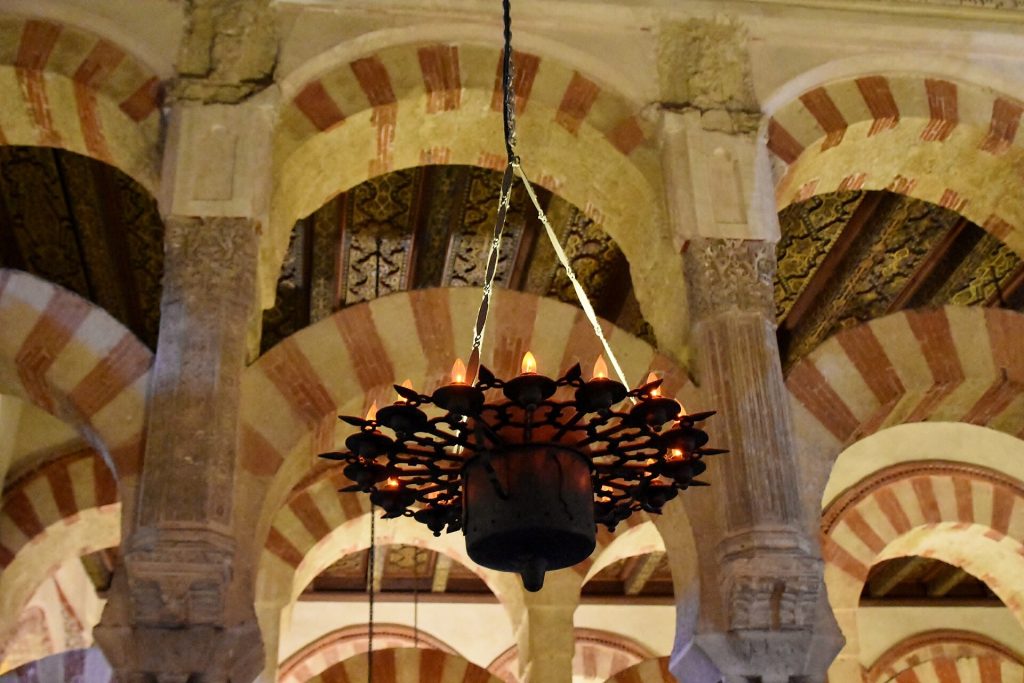
(Double-tier arches in the Mosque-Cathedral of Córdoba. Image: Richard Mortel, CC BY 2.0, via Wikimedia Commons.)
Córdoba’s Mosque-Cathedral shows how architectural continuity can contain profound change.
The interior of Córdoba’s Mosque-Cathedral appears to extend through a forest of columns. Red-and-pale arches repeat overhead, giving the eye a pattern that is at once precise and difficult to exhaust. A person moving through the building encounters not one commanding axis but a succession of possible views.
The great mosque began in the eighth century and expanded over subsequent centuries. Its double-tier arches allowed a substantial interior height above columns of more modest dimensions. The arrangement is visually memorable, but it is also a construction response. Pattern and structural organisation reinforce one another.
Structure And Reuse
Reused elements from earlier buildings contributed to the mosque’s fabric. Their presence complicates the notion of an architectural work as a perfectly isolated invention. Materials and techniques passed through changing political and religious contexts. The building’s coherence emerged partly from organising things with different prior histories.
In 1236, the mosque was converted to Christian use as a cathedral. Major later interventions, including a Renaissance cathedral space within the earlier structure, changed the interior substantially. The surviving building is therefore not simply a mosque preserved under a new name. Its architecture records alterations that introduced different rituals, forms and spatial priorities.
Those changes should not be softened into an effortless story of cultural harmony. They occurred within histories of conquest, authority and religious transformation. A visitor may find the resulting juxtaposition powerful without treating that reaction as a historical explanation. Appreciation can coexist with careful attention to how the layers came to be there.
A Place Changed Through History
The building also changes as the visitor moves. Repeated arches create continuity, while the later cathedral interrupts it with another order of space. An apparent whole reveals its differences through occupation. Architecture can hold incompatible intentions without resolving them into a single simple message.
For conservation, this creates a demanding question. Which history should an intervention make visible, and what would be lost by privileging one layer above all others? The task is not merely to protect a picturesque pattern. It is to preserve material evidence of a place whose meaning has changed profoundly.
Córdoba offers an alternative to the idea that a building’s identity is fixed at completion. Here, identity is contested, accumulated and physically present. The arches continue to astonish, but their beauty is only the entrance to the subject. Beyond it lies the harder work of understanding how a room can remain recognisable while becoming another room in history.
You May also like
By Aletheia Gako
By Aletheia Gako
By Aletheia Gako