
Great Zimbabwe And The Wall Without Mortar
By Aletheia Gako
Publication Date: 9 July 2026 — 08:56 GMT
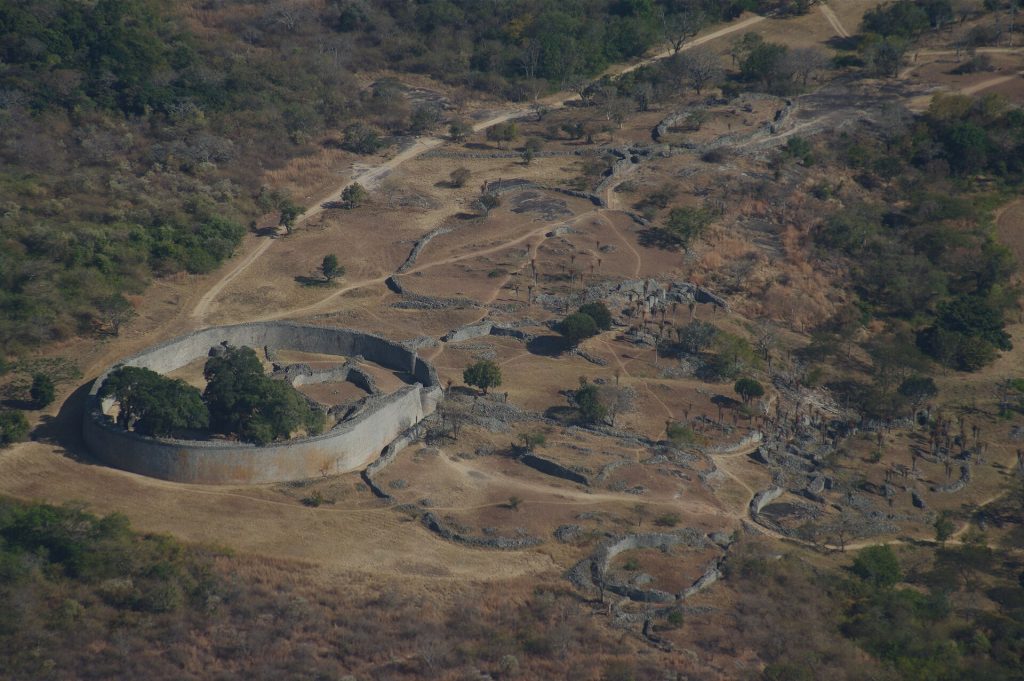
(The Great Enclosure and adjacent remains at Great Zimbabwe. Image: Janice Bell, CC BY-SA 4.0, via Wikimedia Commons.)
The stone city demands recognition of both its builders and the history of its misrepresentation.
At Great Zimbabwe, a curving wall can make individual stones seem part of one continuous movement. Granite blocks are laid without mortar, their courses following the enclosure with extraordinary assurance. The result is massive, but its force also comes from the precision of repeated placement.
The medieval city developed in southern Africa within the history of societies ancestral to the Shona. Its remains include the Hill Complex, the Great Enclosure and settlements in the valley. The surviving stonework belonged to a larger inhabited place whose activities cannot be recovered from walls alone.
A City Assembled In Stone
Dry-stone construction places particular demands on material, geometry and workmanship. Stability depends on how stones bear on one another, on the wall’s proportions and on its condition. The absence of mortar does not mean the absence of engineering judgement. It means that judgement must be understood through a different system of assembly.
The Great Enclosure’s scale makes that labour unmistakable. Its curved perimeter and internal passageways organise movement as well as asserting presence. Yet the precise functions of particular spaces remain subjects for archaeological interpretation. A responsible account should resist filling every uncertainty with an attractive story about ritual or power.
Trade goods recovered at the site connect its inhabitants to wider networks. This was not a mysterious architecture isolated from history. It formed part of an African society engaged in production, exchange and political life. The stones are impressive; the people and relationships behind them are the larger subject.
Authorship And Responsibility
Colonial attempts to attribute Great Zimbabwe to outsiders denied the capabilities of its African builders. Those claims were not harmless architectural speculation. They fitted political narratives that diminished local history. Recognising the site’s African authorship is therefore essential to describing it accurately, rather than an optional correction placed beside the monument.
Conservation now requires attention to vegetation, visitor pressure and the condition of the stonework. The fact that walls have endured for centuries does not make them immune to disturbance. Repair also needs care: the wrong intervention can compromise both stability and the evidence held in the original fabric.
Great Zimbabwe challenges the habits through which architecture earns recognition. Its builders did not need mortar, imported authorship or a familiar European category to create a substantial city. The wall before us is evidence of knowledge. Looking carefully means seeing the courses of stone and refusing the historical stories that once sought to explain their makers away
You May also like
By Aletheia Gako

By Aletheia Gako

By Aletheia Gako