
Fallingwater And The Work Behind Weightlessness
By Aletheia Gako
Publication Date: 5 March 2026 — 11:12 GMT
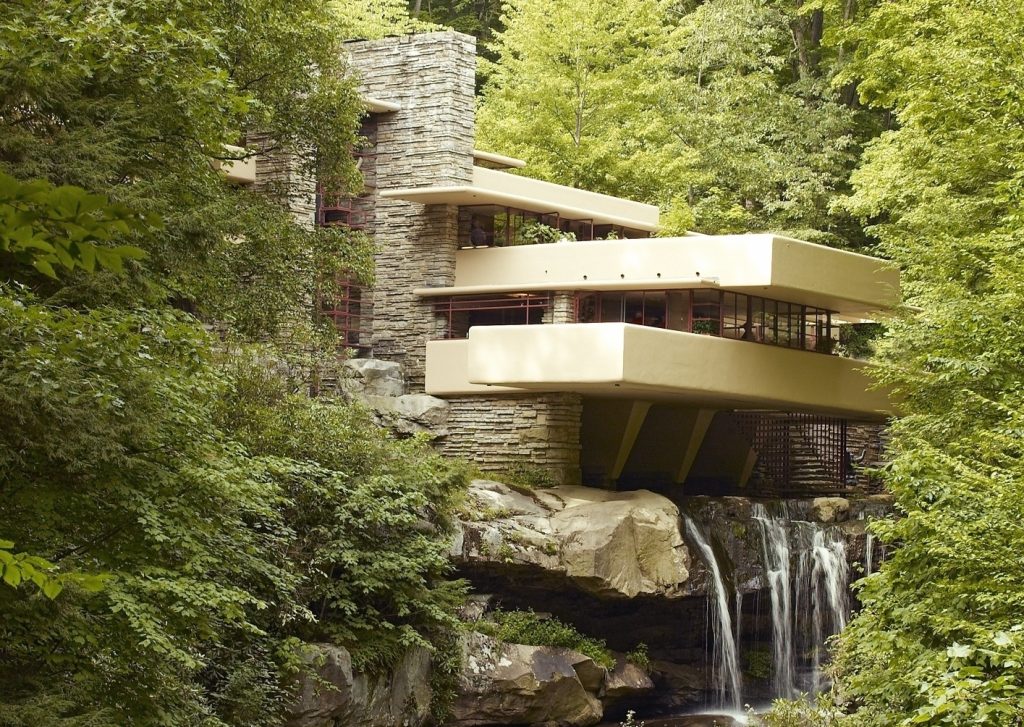
(Fallingwater above Bear Run, Pennsylvania. Image: Carol M. Highsmith, Public domain, via Wikimedia Commons.)
The house above the waterfall has a second history written by its conservators.
Fallingwater appears to have borrowed the horizontal layers of its landscape and lifted them into the air. Terraces extend over Bear Run; stone rises through the composition; water moves below. Frank Lloyd Wright’s house for the Kaufmann family, designed in 1935, makes the site feel like an active participant in the architecture.
Its most memorable gesture is also a structural demand. A cantilever projects beyond its support, requiring the forces from the unsupported span to be resolved elsewhere in the building. At Fallingwater, that achievement permits terraces to occupy space above the stream without a conventional row of columns beneath their outer edges. The visual effect is freedom; the engineering problem is exacting.
The Demands Of A Cantilever
The building’s preservation history complicates the familiar photograph. Its terraces deflected, and subsequent investigations identified overstressed elements. During work in 2001 and 2002, the principal living-room cantilevers were strengthened using a post-tensioning system. High-strength steel cables were installed and tightened to assist the existing structure. Once floors were reinstated, much of that intervention was concealed.
This hidden work is part of the house we admire. It does not cancel the spatial invention, but it changes the meaning of its apparent weightlessness. The image endured because another generation understood the original structure well enough to intervene. Conservation involved analysis and difficult physical work, rather than simply preserving an outline.
Fallingwater also resists the assumption that a building becomes environmentally benign merely by looking integrated with nature. Its relationship to the stream is architecturally remarkable; a claim about environmental performance would require different evidence. Materials, energy, drainage and long-term care cannot be assessed from the poetic success of a view.
A Building Kept In Reach
What remains compelling is the way the house rearranges attention. The waterfall is not placed at a respectful distance as an object to contemplate. The building occupies the conditions that make it perceptible: sound, moving water, dampness, wooded enclosure. This can be exhilarating, but it also brings practical responsibilities. Proximity is both an experience and a maintenance condition.
The richer architectural story therefore includes the architect, the client, engineers, craftspeople and conservators. A celebrated design can become more interesting when its difficulties are visible. Fallingwater’s terraces still seem to reach beyond what a house ought to do. Their continued survival shows how much knowledge is needed to keep that reach credible.
You May also like
By Aletheia Gako
By Aletheia Gako
By Aletheia Gako