
A Metal World And The Question Of What Lies Within
By Luganka Swana
Publication Date: 30 May 2026 — 08:22 GMT
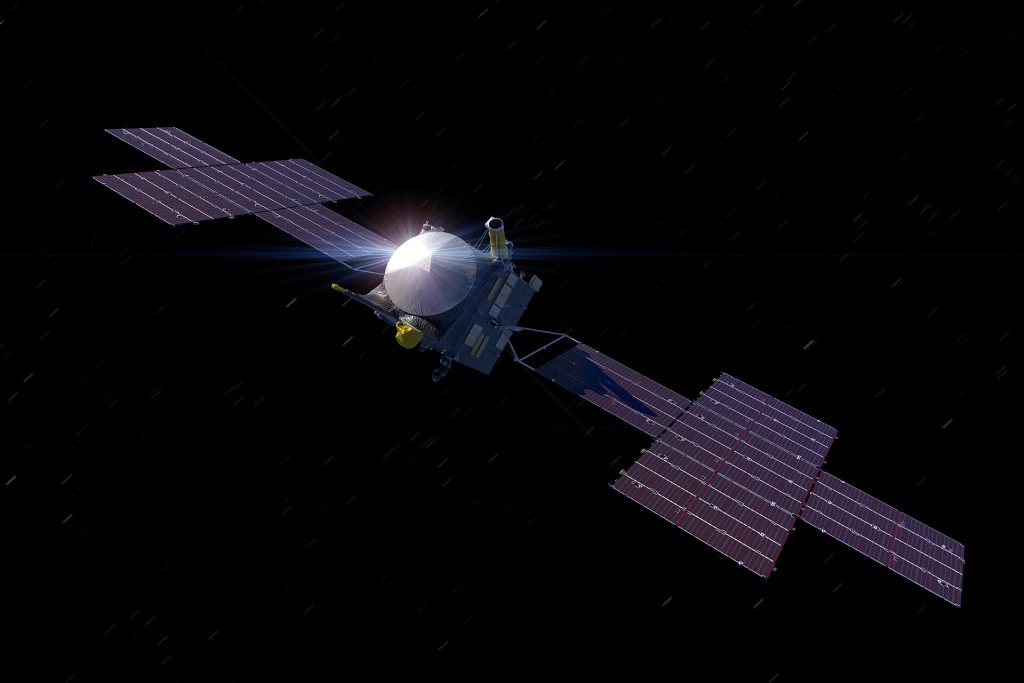
(Artist’s concept of the Psyche spacecraft near its destination. The asteroid’s appearance is illustrative. Image Credit: NASA/JPL-Caltech/ASU/Peter Rubin)
Psyche could reveal a kind of planetary material that Earth keeps hidden thousands of kilometres beneath our feet.
We live above a metal core we cannot visit. Earth’s crust and mantle place a formidable thickness of rock between the surface and the deep interior. The asteroid Psyche offers a different possibility: material with an unusually high metal content exposed in a small world that a spacecraft can examine from outside.
NASA’s Psyche mission launched on 13 October 2023. Its destination lies in the main asteroid belt between Mars and Jupiter. The appeal is geological before it is economic. Understanding this body could help explain how early planetary building blocks separated, collided and changed.
A Hypothesis With Instruments Attached
One possibility is that Psyche preserves material from the interior of a larger early body. That interpretation has to be tested. Calling the asteroid an exposed planetary core before obtaining the relevant measurements would turn the mission’s question into its answer.
The spacecraft carries instruments that can investigate different parts of the problem. Imaging will reveal the landscape and its variation. A gamma-ray and neutron spectrometer can constrain elemental composition. A magnetometer will search for remanent magnetism, a possible record of an earlier magnetic environment.
The composition measurement uses a process already taking place at the surface. Energetic particles interact with the material, producing emissions with properties related to the elements present. The instrument reads those emissions rather than collecting a physical sample.
Magnetism provides another route into history. A persistent magnetic signature could strengthen the case for an origin connected with a planetary interior. Interpreting it would still require attention to where the signal occurs and what other evidence supports the explanation.
A landscape full of unfamiliar textures would be valuable even if the preferred hypothesis changed. Exploration earns its importance by allowing reality to surprise the design team.
More Interesting Than A Price Tag
Metal-rich asteroids invite extravagant estimates of commercial value. Such calculations often multiply an inferred inventory by prices established in a terrestrial market. They bypass the difficulty of extraction, transport and processing, as well as the way a vastly changed supply could alter those prices.
Those reservations are economic reasoning, not a mineral survey of Psyche. They point to a better starting question for a science mission: what can this object tell us about the assembly of planets?
Earth offers the consequences of planetary differentiation without a clear view of its deepest products. Psyche may offer another perspective on the same broad history. Its most valuable cargo will return as measurements: evidence about how matter became worlds, and how much of that process remains written in one surviving body.
You May also like
By Luganka Swana
By Luganka Swana
By Luganka Swana