
By Luganka Swana
Publication Date: 15 April 2026 — 09:26 GMT
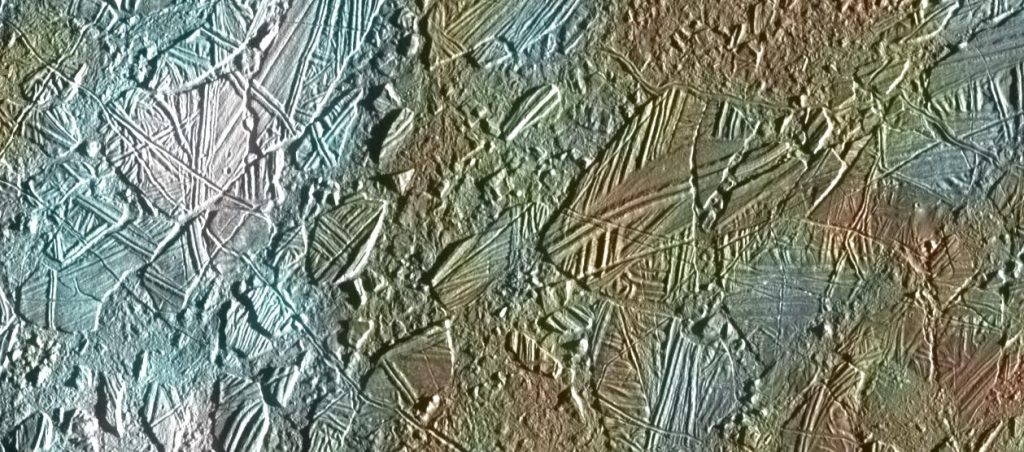
(Europa’s disrupted icy terrain recorded by Galileo. Surface imagery; the suspected subsurface ocean is not directly visible. Image Credit: NASA / JPL / University of Arizona)
Europa Clipper turns an extraordinary possibility into a programme of measurements, without needing to mistake habitability for inhabitedness.
The surface of Europa resembles a damaged porcelain globe. Lines cross pale ice; darker terrain interrupts it. Beneath that frozen exterior, evidence points to a salty ocean. If the interpretation is correct, a moon far from the Sun possesses a substantial liquid environment concealed from every ordinary camera.
NASA’s Europa Clipper launched on 14 October 2024 to investigate this world. Its central question is whether Europa has conditions capable of supporting life. That is a more demanding and more useful objective than finding an attractive resemblance to Earth. An ocean needs a chemical and energetic context before it becomes a persuasive biological possibility.
Reading Water Without Reaching It
Clipper’s instruments approach the problem from different directions. Radar is designed to investigate the icy shell. Spectrometers will examine composition. Magnetic measurements can reveal how a conducting interior responds to Jupiter’s changing field. Images will put those measurements into a geological landscape.
The magnetic experiment is especially elegant. An ocean can leave evidence outside the moon without exposing a drop of water. But the surrounding plasma also affects the field. Clipper therefore carries instruments that help distinguish an interior response from distortions produced by charged particles nearby. The ocean’s story must be separated from its noisy surroundings.
Combining instruments makes disagreements scientifically valuable. A surface feature that looks young in an image might have an unusual thermal signature. A composition map may suggest exchange between ice and deeper material. None of those observations alone supplies a complete account; together, they can constrain where material moves and what environments exist.
The spacecraft will study Europa through repeated flybys while orbiting Jupiter. Its architecture reflects an unforgiving setting, including intense radiation. The mission’s design makes the scientific ambition inseparable from decisions about how long hardware can remain useful.
A Better Question Than Are We Alone
Imagine receiving a report about an unfamiliar sea on Earth. A claim that it contains water would tell us little about its ecology. We would also want to know its temperature, chemistry, energy sources and contact with rock. Europa demands that same patient curiosity, exercised at a distance.
A finding that the moon offers habitable conditions would be profound even without detecting organisms. It would expand the kinds of places in which biology could be possible. A finding that important ingredients are missing would be equally informative, narrowing the search rather than ending it.
Clipper’s promise is to give the hidden world a more detailed physical description. Beyond the ice lies a question large enough to sustain wonder, and specific enough to be investigated one measurement at a time.
You May also like
By Luganka Swana
By Luganka Swana
By Luganka Swana