
The Most Important World In The Photograph Was Home
By Luganka Swana
Publication Date: 6 April 2026 — 08:14 GMT
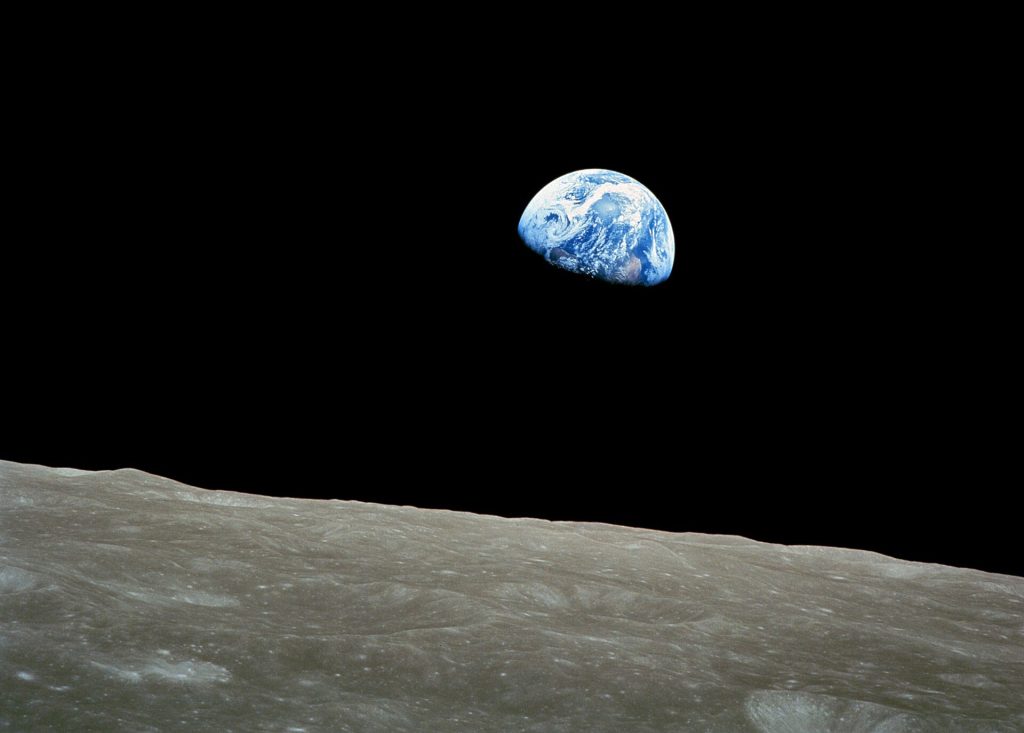
(Earthrisephotographed by William Anders during Apollo 8 on 24 December 1968. Archival mission photograph. Image Credit: NASA / Bill Anders)
Earthrise still asks a difficult question of space exploration: what should leaving Earth teach us about staying here?
On Christmas Eve 1968, William Anders photographed something that was absent from the mission’s destination. Above the scarred lunar horizon hung Earth, luminous with clouds. Apollo 8 had carried Frank Borman, Jim Lovell and Anders into lunar orbit. The image that would outlive the flight’s technical milestones looked back towards everyone else.
There is an instructive imbalance in the photograph. The Moon occupies the foreground, close enough to reveal its texture. Earth appears small, far away and intensely coloured. The planet on which human history had unfolded became a single object inside a larger darkness. That change of scale remains unsettling, even for a generation accustomed to satellite imagery.
A Photograph With An Orbit Behind It
Earthrise was made possible by a moving spacecraft and an attentive crew. The Moon keeps approximately the same face towards Earth, so a conventional sunrise-like Earthrise is not an everyday experience for an observer standing on most of the lunar near side. Apollo 8’s changing vantage point supplied the motion. The scene was an encounter between orbital mechanics and human attention.
NASA later reconstructed the circumstances using Lunar Reconnaissance Orbiter data and the mission’s historical records. That reconstruction matters because an iconic picture can become detached from the work that produced it. Cameras, navigation, timing and spacecraft orientation all contributed to an image that now seems effortless.
A photograph also has limits. Clouds hide landscapes; distance makes borders invisible. Neither fact abolishes political disagreement or unequal access to resources. Reading Earthrise as proof that humanity has already become one harmonious community would ask the picture to certify something outside its field of view.
What it does offer is a shared physical reference. Every terrestrial argument takes place on the illuminated world in the frame. The image gives that dependence a shape.
The Return Journey Matters
Space exploration is often described through departure: a launch, a crossing, a first arrival. Earthrise introduces another measure of success. What knowledge, perspective and practical capability does the journey bring back?
For a schoolchild, the photograph can open a path towards astronomy. For a researcher, it is an invitation to connect planetary science with Earth observation. For a public funding a mission, it supplies a reason to ask how the enterprise enlarges understanding rather than merely staging prestige.
The photograph’s influence lies partly in the questions it makes available. Admiration becomes more useful when it invites responsibility, and a distant view can sharpen our attention to what remains close.
Sharper images will come. Their enduring value will still depend on recognising what deserves attention. Apollo 8 crossed a vast distance and returned with a picture of home.
You May also like
By Luganka Swana
By Luganka Swana
By Luganka Swana