
The Spacecraft That Survives By Staying In Its Own Shadow
By Luganka Swana
Publication Date: 1 August 2026 — 08:56 GMT
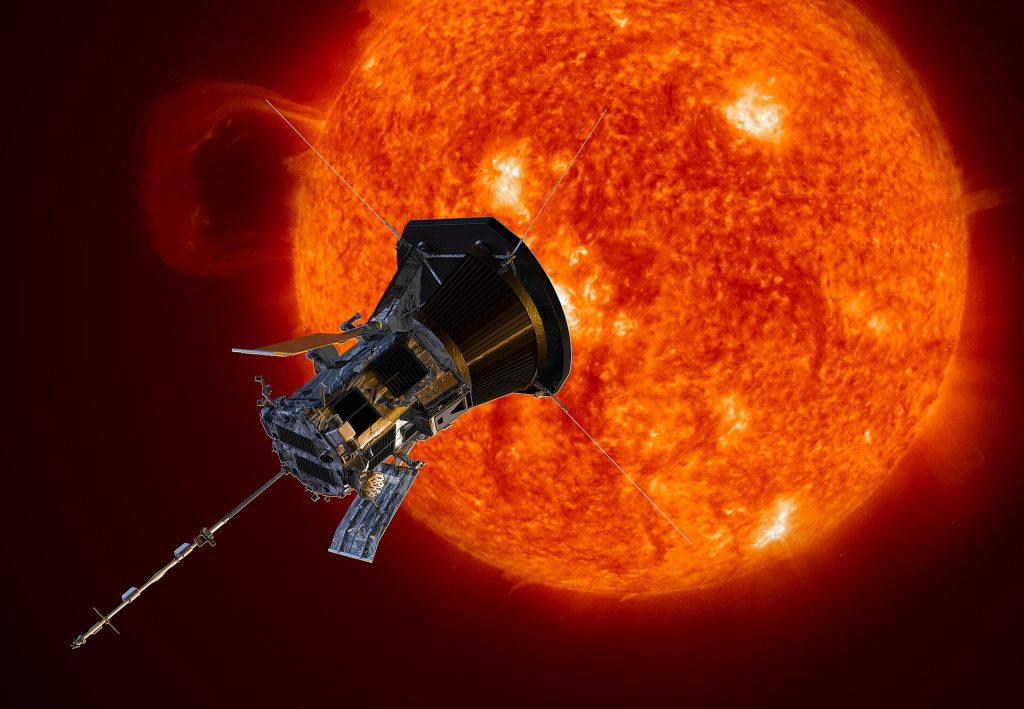
(Artist’s concept of Parker Solar Probe near the Sun. Not an external photograph of its close approach. Image Credit: NASA/Johns Hopkins APL/Steve Gribben)
Parker Solar Probe’s close encounters with the Sun connect extraordinary speed to a precise investigation of our star’s atmosphere.
On 24 December 2024, Parker Solar Probe passed about 3.8 million miles above the Sun’s surface. NASA reported a speed near 430,000 miles per hour and later confirmed that the spacecraft had survived the encounter. Those figures are spectacular, but the flight’s deeper purpose is a set of unresolved questions about the environment around our star.
Why is the Sun’s outer atmosphere so much hotter than its visible surface? How is the solar wind accelerated? Where do energetic particles acquire their energy? The probe carries instruments into regions where those processes can be investigated closer to their source.
Heat Is Also A Question Of Contact
The corona’s temperature invites an understandable misconception: a spacecraft entering million-degree material must immediately reach the same temperature. The environment’s density and the rate at which energy reaches the spacecraft matter too. Temperature describes a physical state; heating describes an energy transfer.
Parker’s thermal protection keeps most of its instruments behind a shield. Maintaining that protective orientation is fundamental to survival. The spacecraft’s shadow is therefore an engineered working environment, not a fortunate patch of shade.
The mission’s route used encounters with Venus to shape progressively closer solar passes. Reaching the desired region required orbital planning over years. The dramatic close approach was the consequence of that accumulated preparation.
Measurements of fields, particles and the solar wind help connect local conditions to wider solar behaviour. A telescope can record a structure from afar; an instrument passing through a region can sample what is happening there. Comparing those kinds of observation makes the evidence richer.
A Nearby Star With Terrestrial Consequences
The Sun is not only an astronomical object. Its activity affects the space environment through which satellites operate and signals travel. Understanding that activity can inform the physical basis of space-weather research, even though a measurement campaign does not automatically produce a reliable forecast for every event.
Parker’s work also connects to a larger question about stars and their planets. Material and energy flowing from a star can influence planetary environments. Investigating the nearest example gives researchers a laboratory that more distant systems cannot provide in the same detail.
The probe’s achievement combines a simple geometry with a difficult mission: put the shield towards the Sun, keep the instruments protected and bring the measurements home. An exploration story about speed becomes a story about endurance and orientation. The spacecraft goes close enough to learn because it knows exactly where its shadow must fall.
You May also like
By Luganka Swana
By Luganka Swana
By Luganka Swana