
The Invisible Universe Leaves Marks On The Visible One
By Luganka Swana
Publication Date: 10 September 2026 — 09:36 GMT
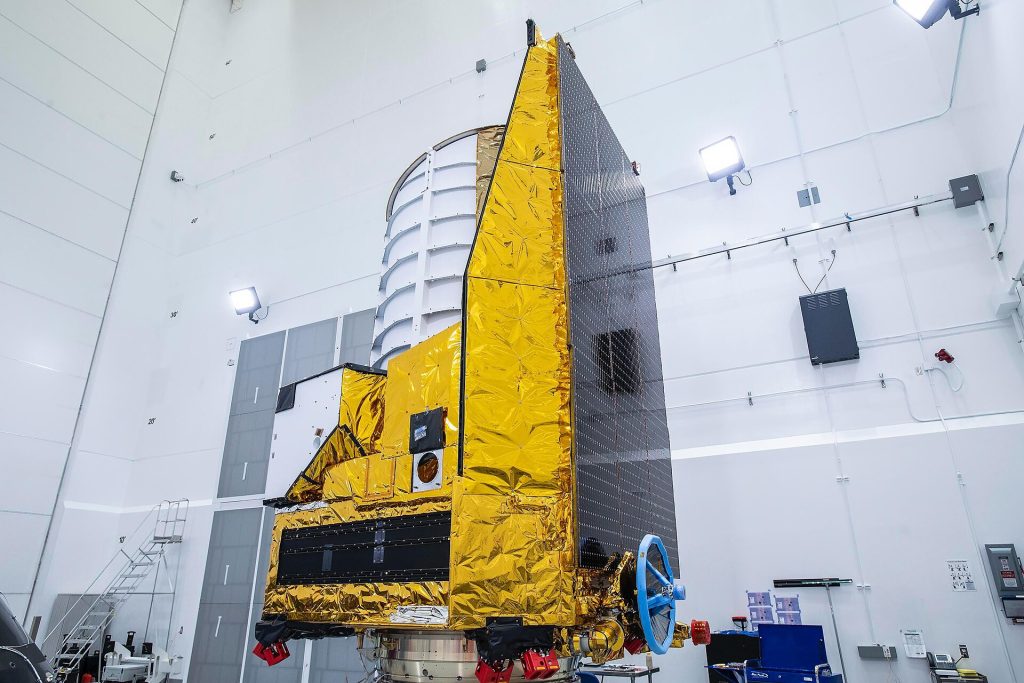
(The Euclid spacecraft in a cleanroom before launch. Facility photograph, not a direct image of dark matter. Image Credit: NASA Jet Propulsion Laboratory)
Euclid’s galaxy surveys turn subtle distortions and enormous populations into evidence about the matter and expansion we cannot photograph directly.
A galaxy’s image arrives through a universe full of intervening matter. Gravity bends the light along the way. Sometimes the effect produces an obvious arc or ring. More often the distortion is slight, and it becomes useful only when many galaxies are analysed together.
ESA’s Euclid mission is designed to work at that scale. Its March 2025 release offered a preview of three deep fields containing about twenty-six million galaxies. The number conveys reach, but the mission’s central challenge is measuring populations consistently enough to use them as evidence about cosmic structure.
When A Shape Becomes A Measurement
Weak gravitational lensing relies on small statistical patterns in galaxy shapes. An individual galaxy can be intrinsically elongated for reasons unrelated to foreground gravity. Across a sufficiently large sample, coherent distortions can reveal the influence of matter along the viewing paths.
The instrument adds its own pattern. Optics, detectors and image processing affect apparent shapes. Researchers must characterise those effects so they do not mistake a feature of the telescope for a feature of the universe.
This is why uniformity can be as important as drama. A spectacular close-up attracts attention; a controlled survey permits comparisons. The scientific result depends on the relation between millions of observations and the procedures that make them commensurable.
Euclid also studies how galaxies are distributed across cosmic history. The combination of distribution and lensing offers ways to investigate the growth of structure and the role of cosmic expansion. Dark matter and dark energy enter through physical models tested against those measurements, not as coloured objects visible in the images.
The Public Image And The Working Archive
A release of survey data allows more scientists to test methods and explore objects beyond the mission’s central questions. Galaxy morphology, candidate gravitational lenses and unusual sources can become investigations in their own right.
There is a useful distinction between a data preview and a completed cosmological verdict. The March 2025 release demonstrated the survey’s scientific potential and supplied material for analysis. It did not settle the identity of dark matter or explain every property of dark energy.
An invisible phenomenon becomes scientifically accessible when it leaves a predictable effect on something measurable. Euclid’s ambition is to make that argument across a large fraction of the sky. The wonder lies in the relationship: light from visible galaxies can help describe a universe whose dominant components remain beyond direct sight.
You May also like
By Luganka Swana

By Luganka Swana
By Luganka Swana