
The Day A Spacecraft Changed An Asteroid’s Future
By Luganka Swana
Publication Date: 21 May 2026 — 09:45 GMT
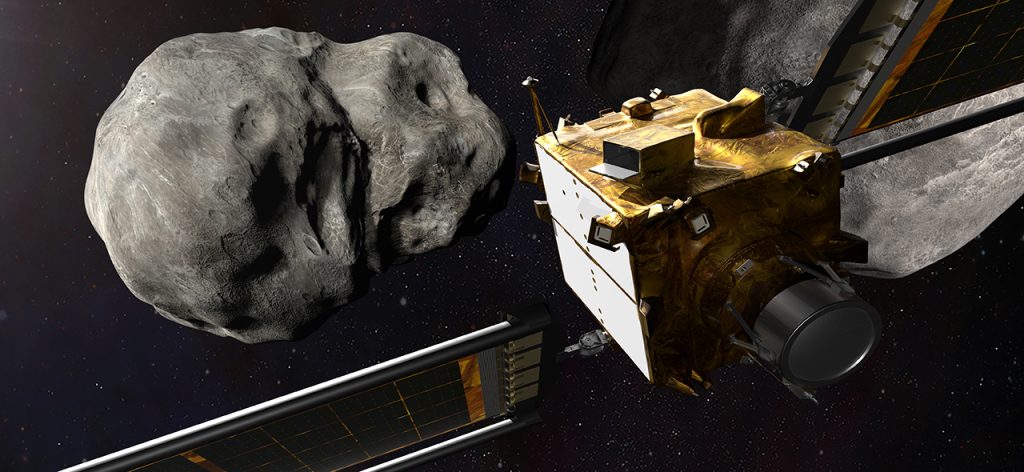
(Artist’s illustration of the DART mission near its asteroid target. Not a photograph of the impact. Image Credit: National Aeronautics and Space Administration)
DART demonstrated that planetary defence can be an experiment with a measurable result, long before an emergency arrives.
The spacecraft did not need to survive. Its purpose was to meet a small asteroid at high speed and transfer momentum. On 26 September 2022, NASA’s Double Asteroid Redirection Test struck Dimorphos, a moonlet orbiting the larger asteroid Didymos. Astronomers then measured the consequence.
The published analysis found that Dimorphos’s orbital period had shortened by about thirty-three minutes. Neither asteroid posed a threat to Earth. The system offered an opportunity to test a method under controlled circumstances, using the moonlet’s orbit as a readable record of the intervention.
A Push With An Unexpected Assistant
The spacecraft’s impact was only part of the push. Material blasted away from the asteroid carried momentum of its own. The recoil helped change the motion of what remained, amplifying the effect of the collision.
That makes the surface an active participant in the experiment. A target’s structure, density and response to impact influence the outcome. A technique demonstrated on Dimorphos cannot be reduced to a universal rule that any spacecraft of a given mass will move every asteroid equally well.
The result was assembled from several kinds of observation. Ground-based measurements followed the changing orbit; spacecraft and telescopes recorded material ejected into space. Together they linked the impact to an altered trajectory and provided clues about the physical reason for the change.
The striking figure is the period change, but a quieter number helps explain the method. Researchers estimated an immediate reduction in the moonlet’s motion along its orbit of only a few millimetres per second. A small velocity difference can become important as time allows trajectories to diverge. Planetary defence gains power from acting early.
Protection Begins With Finding The Object
An impactor is useful only if the target is known and a mission can reach it in time. Detection, repeated tracking and reliable orbit calculations therefore belong to the same enterprise as the dramatic collision. The less visible work determines whether an intervention is possible.
Decision-making would also have to cross national borders. An approaching object does not organise its risk around the institutions that discover it. Observation sharing, uncertainty estimates and public communication would matter before a launch decision and after the spacecraft arrived.
Those are implications of the experiment, not evidence that a complete global defence system already exists. DART established a capability and made the next questions more concrete.
You May also like

By Luganka Swana
By Luganka Swana
By Luganka Swana