
The Asteroid That Arrived With A Double Surprise
By Luganka Swana
Publication Date: 8 June 2026 — 10:16 GMT
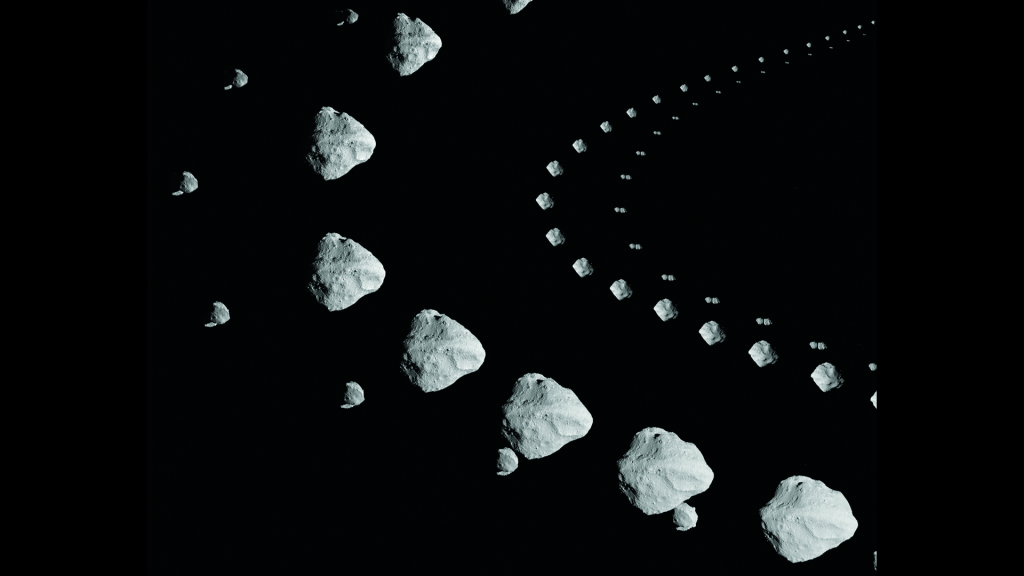
(A NASA composite showing Dinkinesh and Selam from multiple Lucy viewing angles. A sequence of observations, not one instantaneous scene. Image Credit: NASA’s Scientific Visualization Studio – Marit Jentoft-Nilsen)
Lucy’s encounter with Dinkinesh shows why a change of viewpoint can overturn a seemingly complete picture.
At first, a small companion looked like one object. Minutes later, a different viewing angle revealed two joined lobes. During its November 2023 flyby of Dinkinesh, NASA’s Lucy spacecraft discovered a satellite that turned out to be a contact binary: two bodies touching each other while together orbiting an asteroid.
The satellite was named Selam, a greeting meaning peace in Amharic. The discovery is appealing partly because it resists the tidy image of a solitary rock. This little system has a structure and a history that an unresolved point of light could never disclose.
A Few Minutes Changed The Interpretation
In images taken near closest approach, the lobes lined up along Lucy’s view. Later pictures separated their outlines. The object had not transformed in those minutes; the observer’s geometry had changed.
That is a useful lesson far beyond asteroid science. An image records a projection. Shape, distance and overlap can create appearances that require another angle to interpret. A second view is sometimes more valuable than a more confident description of the first.
Subsequent analysis examined a trough and ridge on Dinkinesh as well as the satellite. Researchers proposed that changes in the asteroid’s rotation helped drive a structural rearrangement, releasing material that could contribute to the ridge and companion. The detailed sequence remains a matter for investigation.
Even sunlight can participate in the history of a small body. An asteroid absorbs energy and reradiates it as heat. Tiny imbalances in that process can exert a torque over long periods. Effects negligible during a human afternoon can become significant across geological time.
This does not mean that sunlight neatly explains every feature in the images. It supplies a mechanism that can be compared with the observed structure and tested through modelling.
The Value Of The Detour
Lucy was designed to investigate Jupiter’s Trojan asteroids. Dinkinesh provided an earlier encounter and an opportunity to exercise the spacecraft’s observing capabilities. A preparatory event became a scientific result in its own right.
That pattern is familiar in exploration: a system built to answer one question discovers that its route contains another. The value depends on retaining enough flexibility to recognise and examine the unexpected object.
For readers, Selam is memorable because its joined form gives a distant world a peculiar intimacy. For planetary scientists, its shape constrains possible ways that fragments gather, move and endure. Beauty and inference meet in the same few pixels.
The first image called for a provisional description; the next image called for a revised one. Changing an interpretation in response to a better view is part of the discovery. Confidence becomes useful when it can move with the evidence. Lucy looked again, and a small asteroid became a system with a far r
You May also like
By Luganka Swana
By Luganka Swana
By Luganka Swana