
Lalibela And The Architecture Released From Rock
By Aletheia Gako
Publication Date: 30 April 2026 — 09:03 GMT
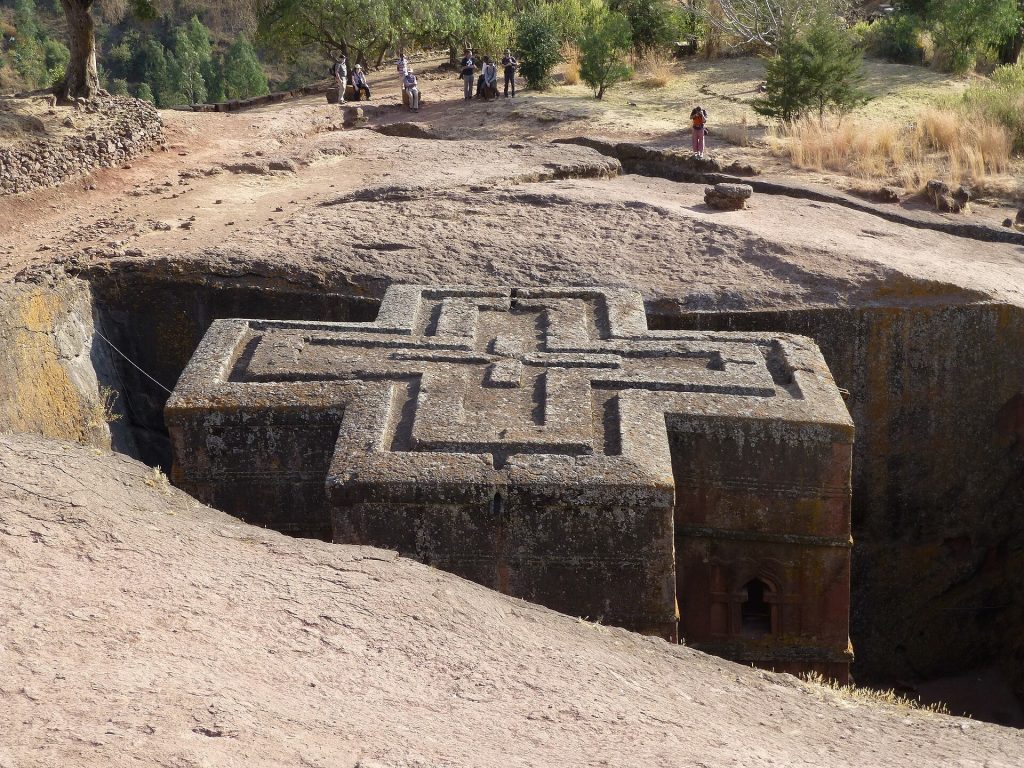
(Biete Giyorgis, the Church of Saint George at Lalibela, Ethiopia. Image: Ji-Elle, CC BY-SA 3.0, via Wikimedia Commons.)
Ethiopia’s rock-hewn churches ask us to imagine construction through subtraction.
At Biete Giyorgis in Lalibela, a cross-shaped roof appears below the surrounding ground. The building is not a stack of blocks brought to the site. It was carved from the rock itself, and the excavation around it makes the church’s body visible.
Lalibela’s eleven medieval churches form one of the most remarkable architectural ensembles in Ethiopia. Their history is associated with King Lalibela, though the development of the site cannot be reduced confidently to one simple construction episode. The buildings vary in form and occupy a network of trenches, passages and spaces that connect worship with movement through the landscape.
The Judgement In Subtraction
Carving changes the builder’s relationship to error. In an assembled wall, a component may sometimes be removed and replaced. When a column or doorway is released from a continuous mass of stone, removing too much material poses a different problem. The work required judgement about the intended space and the material that had to remain. What appears to be a roof was once part of the ground above an unmade interior.
The ensemble also reverses the usual sequence of architectural perception. From some viewpoints, the visitor encounters a roof before reaching a doorway. The surrounding rock encloses the approach, making distance and depth part of the preparation for entry. A church is experienced through the route cut around it as well as through its own internal arrangement.
Water complicates that extraordinary relationship with the ground. Drainage channels are essential, and weathering threatens the stone. Conservation has involved difficult choices, including protective shelters over some churches. Such measures can alter the view while serving the urgent purpose of protecting the monument. A photograph cannot resolve that tension on its own.
A Living Place Under Protection
These are living religious places, not simply an archaeological display. Worship, pilgrimage and the work of custodians belong to the site’s continuing identity. An account focused entirely on the astonishing method of construction would leave out the people for whom the spaces retain sacred meaning.
Lalibela gives architecture a different verb. Instead of raising, joining or covering, the builder reveals. That is a technical achievement, but it also changes how a person understands the relationship between a building and its site. At Biete Giyorgis, the ground is neither a platform nor a picturesque setting. It is the material from which a place of worship was made, and the enclosure through which it is still approached.
You May also like
By Aletheia Gako
By Aletheia Gako
By Aletheia Gako