
Karl Marx Hof And The Home Beyond The Front Door
By Aletheia Gako
Publication Date: 28 May 2026 — 11:05 GMT
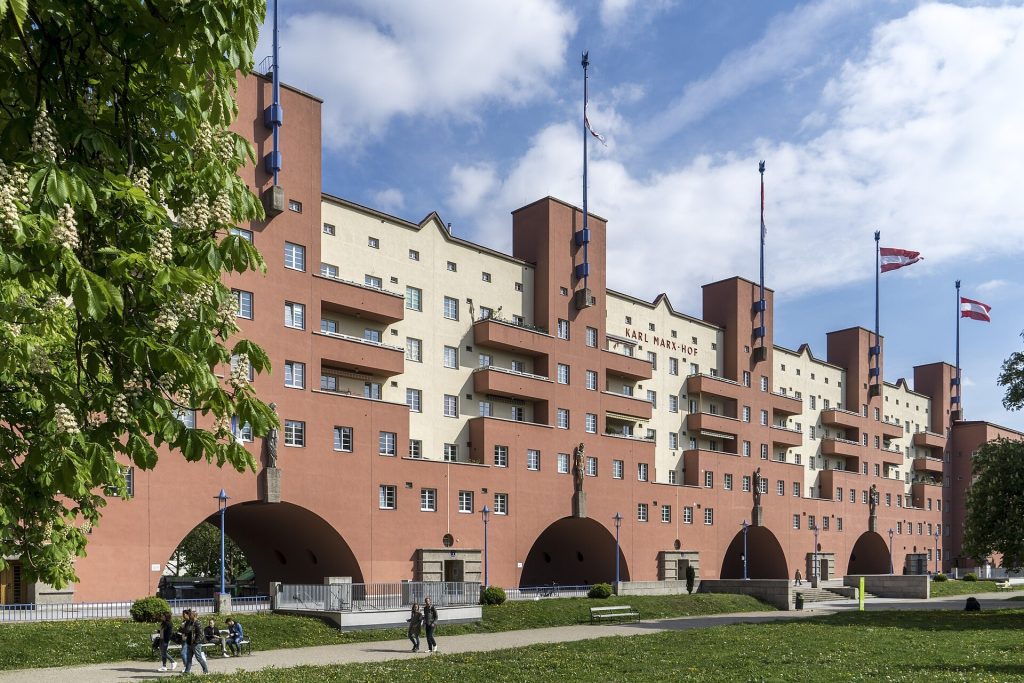
(Karl Marx Hof, Vienna. Image: Thomas Ledl, CC BY-SA 4.0, via Wikimedia Commons.)
Vienna’s monumental housing block treats shared facilities as part of domestic life.
Karl Marx Hof stretches through Vienna with an assurance usually reserved for civic monuments. Its arches, towers and courtyards announce that housing can occupy a prominent place in the city’s architectural imagination. The subject of the monument is ordinary residence.
Designed by Karl Ehn and built between 1927 and 1930, the complex was a major project of the period known as Red Vienna. Its original programme combined more than a thousand apartments with shared facilities. Laundries, baths and other services recognised that the conditions of a home extend beyond the rooms behind a private door.
Services As Part Of A Home
The arrangement challenges a narrow account of housing quality based only on floor area or façade. Residents also need places to wash, move, meet and reach services. Providing some of those functions collectively can change what a small dwelling is asked to contain. Architecture becomes connected to an institutional decision about how daily life is supported.
Courtyards give the complex space within its long exterior. The relationship between built mass and open ground is crucial: a large project need not fill its entire site to express scale. The arches offer passages through a building that could otherwise feel like an unbroken barrier. Monumentality is organised together with movement.
This does not make the project a universal answer to every housing question. The quality of a home depends on maintenance, affordability, allocation, management and the experience of its residents. Historic shared facilities also reflected the domestic conditions of their time. A contemporary programme would need to examine present needs rather than reproduce the original list uncritically.
The People Behind The Monument
The building’s political history prevents a purely formal reading. It became associated with fighting in 1934, and residents later faced persecution and displacement under Nazi rule. Its architecture belongs to a city whose social ambitions and conflicts affected the lives inside it. Admiring the façade should not empty that history of people.
Karl Marx Hof remains compelling because it gives architectural weight to a question often treated as routine. What should a city provide when it provides a home? The answer here included spaces and services outside the apartment, held within a conspicuous public composition. Behind the dramatic arches lies a proposition of lasting relevance: domestic dignity depends partly on arrangements that no individual household can build alone.
You May also like
By Aletheia Gako
By Aletheia Gako
By Aletheia Gako