
An Earth Sized Planet Still Has To Earn Its Atmosphere
By Luganka Swana
Publication Date: 19 August 2026 — 10:11 GMT
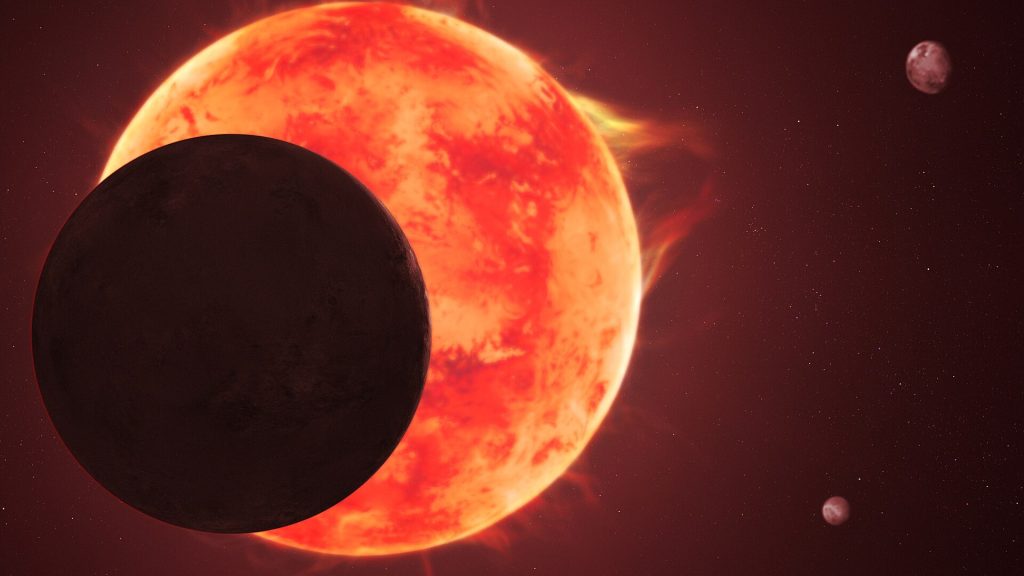
(Artist’s impression of TRAPPIST-1 d passing near its host star. The planet has not been resolved photographically in this form. Image Credit: NASA, ESA, CSA, J. Olmsted (STScI) — CC BY 4.0)
Webb’s work on TRAPPIST-1 exposes the distance between finding a rocky world and understanding whether it offers a habitable environment.
A planet can be roughly Earth’s size and remain profoundly unlike Earth. Size is a beginning: it helps frame a question about structure and gravity. An atmosphere, a surface temperature and the behaviour of the host star determine much of what that world might actually be like.
The TRAPPIST-1 system makes this distinction unusually vivid. Its seven known planets offer a compact collection of rocky-world questions around a small star. Webb’s observations are investigating those questions by measuring tiny changes in light, rather than obtaining detailed photographs of landscapes.
Taking The Temperature Of A Distant World
In 2023, researchers used mid-infrared observations to estimate the dayside temperature of TRAPPIST-1 b at about five hundred kelvins. The result was consistent with a hot surface lacking a substantial atmosphere able to redistribute heat.
The measurement relied on the planet’s contribution to the system’s light. When the planet passed behind its star, that contribution was briefly removed. Comparing the light before and during this secondary eclipse allowed researchers to estimate emission from a world that could not be separated into an ordinary close-up image.
This is an indirect measurement with a carefully specified interpretation. Atmospheric composition and heat movement affect the expected brightness. Models help relate the recorded radiation to possible physical environments.
A separate 2025 investigation of TRAPPIST-1 d narrowed its atmospheric possibilities and found no Earth-like atmosphere in the studied data. The finding shows why being rocky and receiving a potentially interesting level of stellar energy are insufficient descriptions of habitability.
The Star Is Part Of The Measurement
The host star complicates the work. Flares and surface regions with different temperatures can alter its light. Those changes may overlap with the subtle signatures researchers seek from a planet’s atmosphere.
Repeating observations and comparing methods can help disentangle the signals. A telescope’s sensitivity makes the problem accessible; it does not make interpretation automatic. Scientists need a reliable account of the light source as well as of the orbiting world.
For readers, the disappointment of a less hospitable planet can obscure the achievement. Eliminating an attractive possibility is a scientific result. It makes the remaining hypotheses sharper and informs how the next observations should be designed.
A growing catalogue of Earth-sized planets is an invitation to investigate diversity, not a count of replacement homes. Webb’s contribution is to move selected worlds from an appealing label towards constrained physical descriptions. A planet becomes more interesting when we learn how it differs from the one we know best.
You May also like
By Luganka Swana
By Luganka Swana
By Luganka Swana