
A Small Sample With A History Older Than Earth’s Oceans
By Luganka Swana
Publication Date: 23 July 2026 — 10:32 GMT
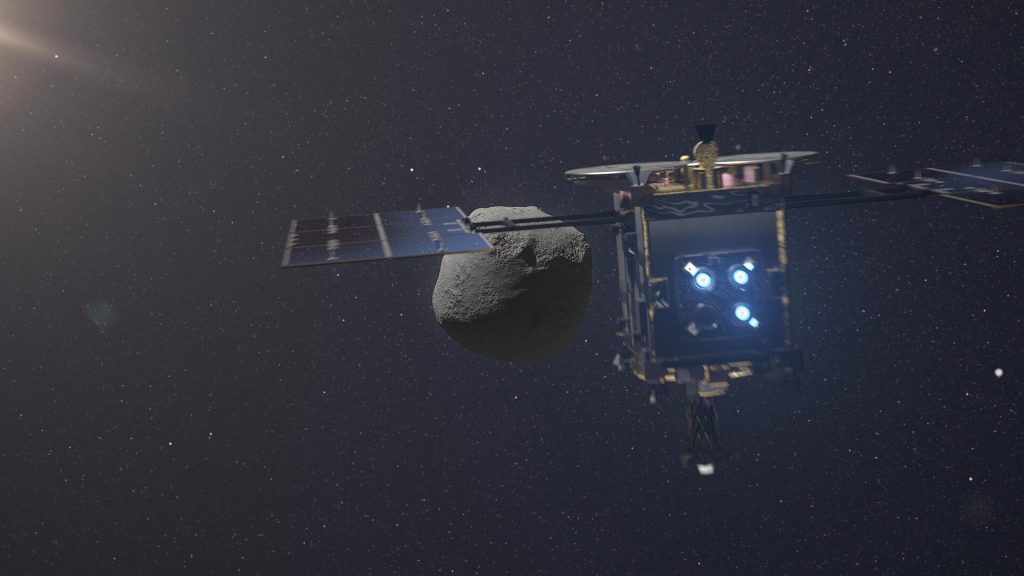
(Artist’s concept of Hayabusa2 approaching an asteroid. The organic chemistry discussed was measured in returned Ryugu samples. Image Credit: DLR German Aerospace Center — CC BY 2.0)
Ryugu’s returned grains let laboratories examine the chemical inheritance of a planetary system, with the sample’s provenance kept in view.
A returned sample changes the scale of exploration. A spacecraft can map an asteroid from orbit; a laboratory can investigate tiny grains with several instruments, revisit an interpretation and preserve material for a question not yet invented. Hayabusa2’s samples from Ryugu brought that possibility to researchers on Earth.
Analyses announced by JAXA in 2023 found a diverse collection of soluble organic compounds, including amino acids. Measurements of the extracted material revealed many thousands of molecular signals. The asteroid’s dark appearance concealed a complicated chemical record.
Organic Does Not Mean Alive
Carbon chemistry can develop without organisms. Ryugu’s samples contained compounds familiar from terrestrial biology alongside molecules not used in the same way by life. Their significance lies in showing what chemistry was available beyond Earth, rather than establishing biology on an asteroid.
One revealing property was the approximately balanced mixture of left- and right-handed forms of certain amino acids. Terrestrial proteins overwhelmingly use one handedness. The sample results supported an abiotic origin for the compounds examined, giving the interpretation a more discriminating basis than the mere presence of an amino acid.
Water-related alteration also helped shape Ryugu’s material. Hydrated minerals and patterns in organic compounds preserve clues to processes in its earlier parent body. A dry-looking asteroid surface can belong to a history in which water once reacted with rock and carbon-bearing material.
That history cannot be reconstructed from chemistry alone. Sampling location, spacecraft observations and the physical character of the grains help connect laboratory measurements to a body in space. Provenance is part of the evidence, not administrative decoration.
Keeping Earth Out Of The Answer
Meteorites supply invaluable extraterrestrial material, but they encounter Earth’s atmosphere and environment before analysis. A controlled sample-return chain gives researchers a different opportunity to track and limit contamination.
It does not make every handling step irrelevant. Instruments, containers and procedures still require documentation. The point is to distinguish the asteroid’s chemical record from material introduced during collection or study.
This is why a seemingly unglamorous laboratory practice belongs in a space story. Clean handling can determine whether a molecule is a discovery or a contaminant. The quality of the conclusion may depend on work done after the spacecraft’s dramatic return.
Ryugu does not give a complete account of how life began on Earth. It supplies a better inventory of what could have arrived before and during the planet’s early evolution. A small grain can hold a very long history. Returning it carefully allows that history to be examined instead of merely admired from a distance.
You May also like
By Luganka Swana
By Luganka Swana