
A Laser Message Through The Deep Space Dark
By Luganka Swana
Publication Date: 26 June 2026 — 08:41 GMT
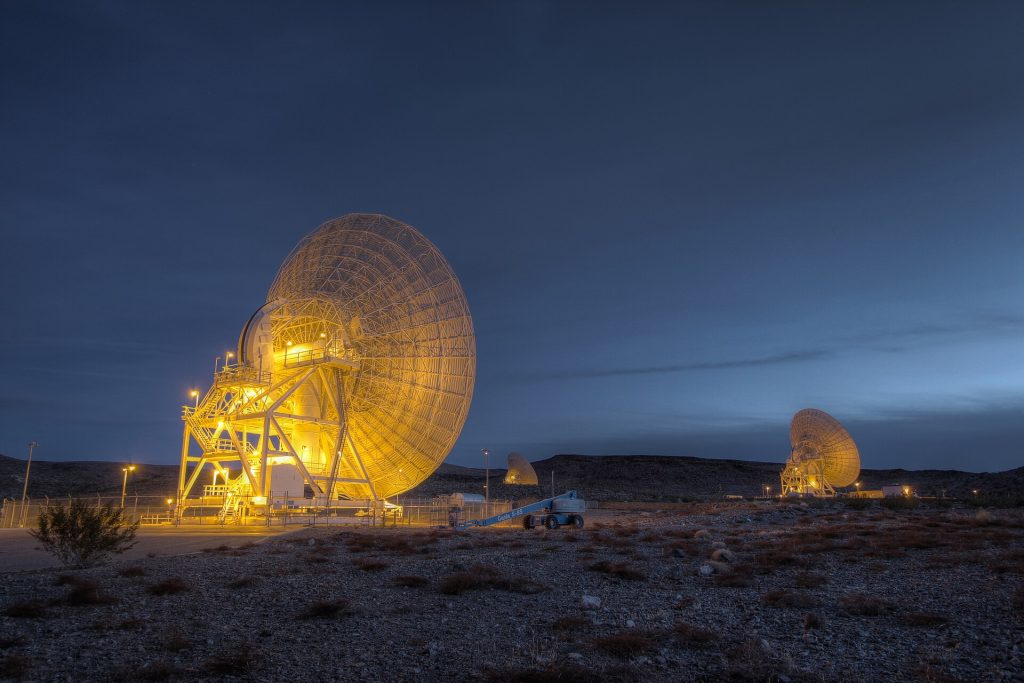
(Dawn at the Goldstone Deep Space Communications Complex. Radio infrastructure shown for context; DSOC used optical ground equipment. Image Credit: NASA/JPL-Caltech)
Optical communication can carry richer streams of information, but it cannot make a distant world answer sooner than light allows.
In December 2023, a short video travelled to Earth from deep space on a near-infrared laser beam. The sender was the Deep Space Optical Communications experiment carried aboard NASA’s Psyche spacecraft. The demonstration reached 267 megabits per second from about nineteen million miles away.
A familiar digital object had become evidence for an unfamiliar communications link. The scientific importance lay in transmitting and receiving the data reliably, not in the subject of the video. The test made a future of richer returns from distant missions more tangible.
A Narrow Beam And A Moving Target
Radio and laser communication both use electromagnetic waves. Optical systems can concentrate their transmission tightly, creating an opportunity for high data rates. That concentration makes pointing a demanding part of the link.
A spacecraft vibrates. Earth moves. The transmitter and receiver are separated by distances that turn a tiny angular error into a missed destination. DSOC used stabilisation and tracking technologies to hold its optics on target, including a platform that isolates them from spacecraft motion.
Reception has its own difficulty. Only a small fraction of the emitted light reaches the detector. Stray light and other background signals must be separated from the information-bearing photons. The receiving telescope and detector are therefore as important to the experiment as the laser flying through space.
The headline speed is not a permanent property of every distance. During an April 2024 test at roughly 140 million miles, DSOC reached twenty-five megabits per second. A successful demonstration becomes useful when engineers understand how performance changes with geometry and conditions.
Bandwidth Does Not Cancel Distance
A faster link can return more images, measurements or video in a given period. It cannot remove the travel time of the signal. An astronaut on Mars would still encounter a delay governed by the changing separation of the planets, even with an exceptionally capable optical system.
That difference between capacity and latency matters to mission design. More bandwidth could improve the richness of scientific data and the quality of recorded interactions. It would not turn deep-space operations into an ordinary live call.
This is a story about expanding what can be shared across distance. A beautiful planetary image becomes more valuable when its underlying measurements can return too. A laser offers one route towards that richer exchange. The deep-space dark remains vast, but the messages crossing it can become more detailed, more frequent and more scientifically useful.
You May also like
By Luganka Swana
By Luganka Swana
By Luganka Swana