
The Opera House And The Geometry Behind The Sails
By Aletheia Gako
Publication Date: 3 September 2026 — 09:36 GMT
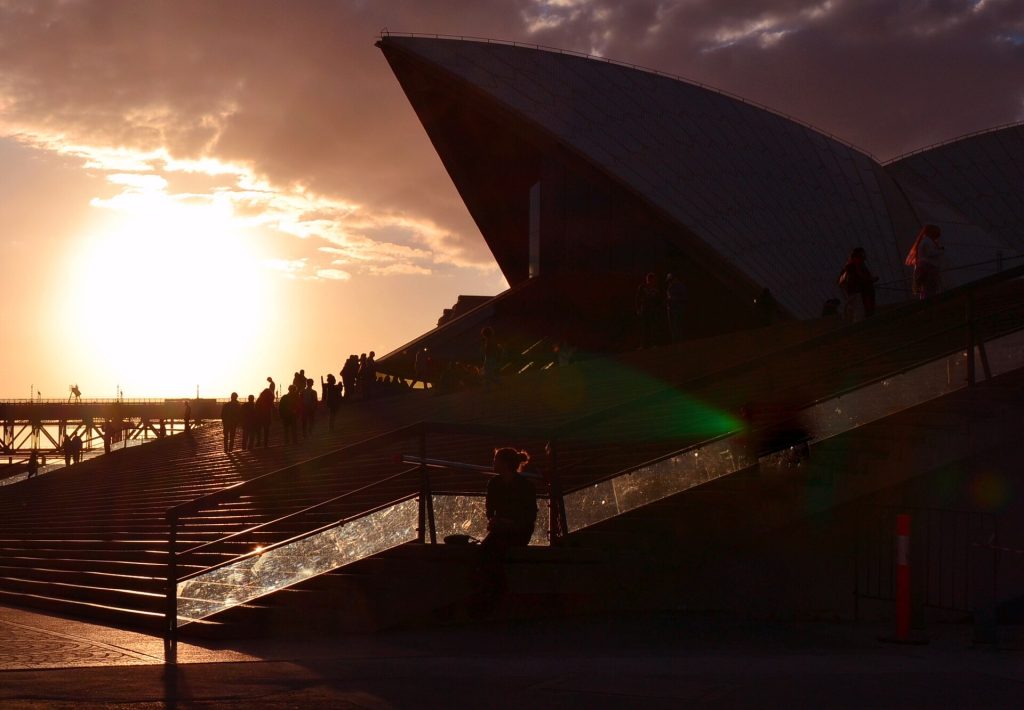
(The Sydney Opera House at sunset. Image: Sardaka, CC BY 3.0, via Wikimedia Commons.)
Sydney’s defining roof emerged through a difficult agreement between shape and construction.
The roof of the Sydney Opera House appears endlessly variable. From the harbour, its white forms open, overlap and retreat as the viewpoint changes. Yet behind that diversity lies a unifying geometric decision: the shell shapes were derived from the surface of a sphere.
Jørn Utzon’s competition-winning design posed an immense construction problem. Between 1958 and 1962, the roof passed through different geometric investigations before the spherical solution gave the team a practicable basis for development. The building’s eventual appearance should not obscure how uncertain its path had been.
One Sphere For Many Forms
Using a common sphere allowed related curved elements to be organised within one geometric system. Prefabricated concrete ribs and roof components could then be developed through a more coherent construction process. The insight did not turn the building into something easy to make. It made an extraordinarily demanding form more tractable.
Utzon worked with engineers at Arup and with an extensive network of people who translated drawings into calculations, components and construction. The familiar image of a lone architect experiencing one inspired moment leaves too much out. A geometric proposition became architecture through repeated technical decisions and the skills of those who manufactured and assembled it.
The construction history also included rising costs and political conflict. Utzon left the project in 1966, before the Opera House opened in 1973. Later teams completed the building. To admire the roof honestly is to recognise both the original architectural imagination and the difficult institutional conditions under which the whole project was realised.
The People Who Made The Roof
The distinction between image and occupied building remains important. An opera house must provide acoustics, circulation, stage equipment and spaces for performers and audiences. Its roof can command a harbour without settling every practical question inside. The building’s subsequent adaptations belong to its continuing life as a performance venue.
Sydney demonstrates why a powerful shape benefits from a disciplined account of its making. The spherical geometry does not reduce the poetry of the sails; it gives that poetry a more substantial explanation. What seems like a collection of freely drawn gestures rests on an organised relationship between parts. The achievement is a form that continues to surprise the eye, held together by a rule the eye does not immediately see.
You May also like
By Aletheia Gako
By Aletheia Gako

By Aletheia Gako