
Gardens By The Bay And The Climate Behind The Spectacle
By Aletheia Gako
Publication Date: 23 July 2026 — 09:24 GMT
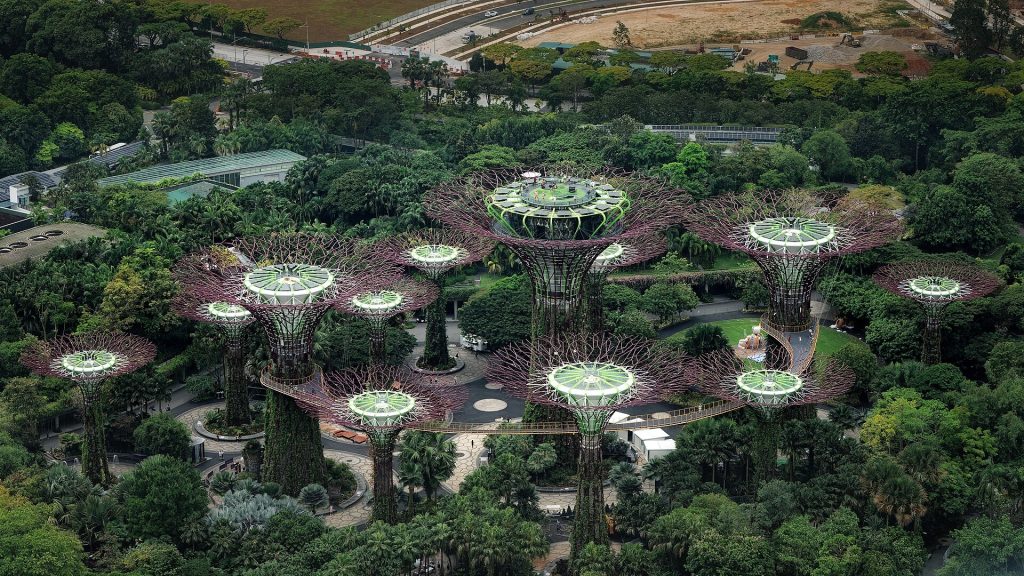
(The Supertree Grove at Gardens by the Bay, Singapore. Image: Mustang Joe, CC0, via Wikimedia Commons.)
Singapore’s celebrated landscape makes environmental engineering part of an architectural image.
The Supertrees at Gardens by the Bay turn vegetation into an urban silhouette. Rising above the landscape, their branching forms look simultaneously botanical and constructed. They make an immediate image, but the more demanding story lies in the systems supporting that image and the conservatories nearby.
Singapore’s tropical climate presents a particular challenge when a garden seeks to display plants from cooler environments. The glass conservatories do not simply shelter a collection from rain. They establish different internal conditions, using building envelopes and cooling systems to manage heat and humidity.
Making A Different Climate
According to the operator, special glass coatings reduce solar heat gain while admitting light needed by plants. Retractable shading responds to conditions, and cooling focuses on lower occupied zones rather than treating the whole interior volume identically. These measures reveal an important architectural principle: the desired environment need not be produced through one undifferentiated technical response.
The Supertrees have varied functions. Some incorporate photovoltaic cells; selected structures also participate in the conservatories’ environmental systems. Their greenery should therefore be considered together with the engineered frameworks beneath it. A planted surface and an energy-generating component are different contributions, even when they share the same conspicuous form.
The operator reports approximately 30 per cent lower energy consumption for the conservatories’ cooling approach compared with conventional cooling technologies. That is a stated comparison, not a claim that the entire attraction consumes no energy or has no carbon impact. The system boundary matters. Construction, maintenance and operation all belong in a full environmental assessment.
The Boundary Of An Environmental Claim
Gardens by the Bay is compelling partly because it does not hide its artificiality. It creates an encounter with plants through deliberately constructed climates and monumental supports. The visitor experiences botanical abundance alongside the means of making it possible. This is a designed environment, not evidence that an urban building can become a forest merely by acquiring vegetation.
Its broader architectural value lies in the questions the spectacle can open. How much energy is needed to provide a particular experience? Which systems can work together? What is being measured when sustainability is claimed? The Supertrees attract the eye, but the most consequential design work may remain in a plant room, a control system or a carefully specified sheet of glass. Wonder becomes more substantial when those quieter components enter the story.
You May also like
By Aletheia Gako
By Aletheia Gako
By Aletheia Gako