
The High Line And The Second Life Of A Railway
By Aletheia Gako
Publication Date: 11 June 2026 — 09:18 GMT
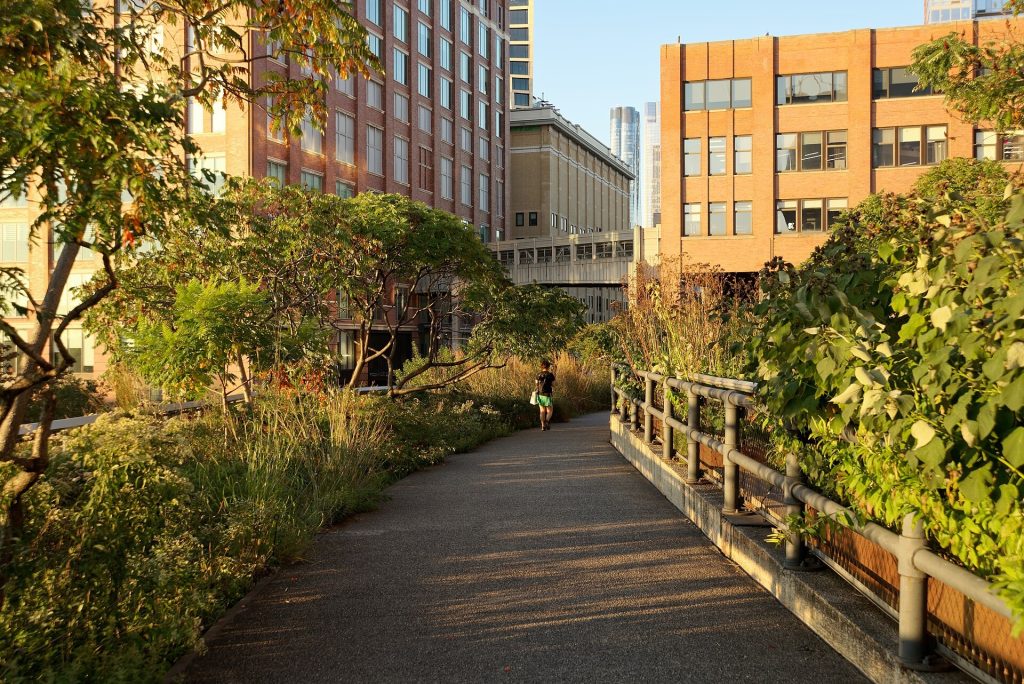
(Planting and the pedestrian route on the High Line, New York, photographed in 2023. Image: Jakub Hałun, CC BY 4.0, via Wikimedia Commons.)
New York’s elevated park shows both the possibilities and the tensions of urban reuse.
On the High Line, the city is seen from a height that changes its ordinary relationships. Windows come closer to eye level; traffic moves below; planting occupies a route once used by freight trains. A piece of infrastructure has become a place to walk without losing the geometry of its earlier purpose.
The elevated railway opened in 1934, and freight service ended in 1980. Friends of the High Line formed in 1999, advocating for reuse when demolition remained a possibility. The first section of the public park opened in 2009. The transformation was designed by James Corner Field Operations, Diller Scofidio + Renfro and planting designer Piet Oudolf.
An Inherited Route
Retaining the route made the park different from an empty site filled with new landscape. Its narrowness, elevation and linear continuity were inherited constraints. The design turned them into an experience: movement follows the old structure, while views repeatedly open onto streets and buildings at unexpected angles.
Planting participates in that sequence. Seasonal change can soften the industrial frame without pretending that it has returned to untouched nature. The landscape is designed and maintained. Its apparent looseness depends on choices about species, establishment and care, just as the walkway depends on the engineering and accessibility of the retained structure.
The High Line’s popularity does not settle every question about its urban impact. Parks can bring amenities and attract investment while changes in surrounding property markets create pressure for existing communities. These outcomes require careful local evidence; a beautiful promenade cannot by itself prove that the benefits of regeneration were shared fairly.
The Distribution Of Benefits
Access is another architectural matter. An elevated park needs usable connections to street level, and those connections shape who can enjoy it. The spectacular middle of a route receives most of the photographs, but entrances, lifts and operating arrangements determine how public the experience actually becomes.
The High Line is valuable as an example precisely because it should not be reduced to a repeatable formula. An obsolete railway offers particular structural, spatial and political conditions. Another city must examine its own rather than borrow the image. New York’s project demonstrates that infrastructure can hold an unanticipated future. It also shows why the next question must reach beyond design: whose daily life is improved when that future arrives?
You May also like
By Aletheia Gako
By Aletheia Gako
By Aletheia Gako