
Sendai And The Building That Makes Connections Visible
By Aletheia Gako
Publication Date: 14 May 2026 — 08:41 GMT
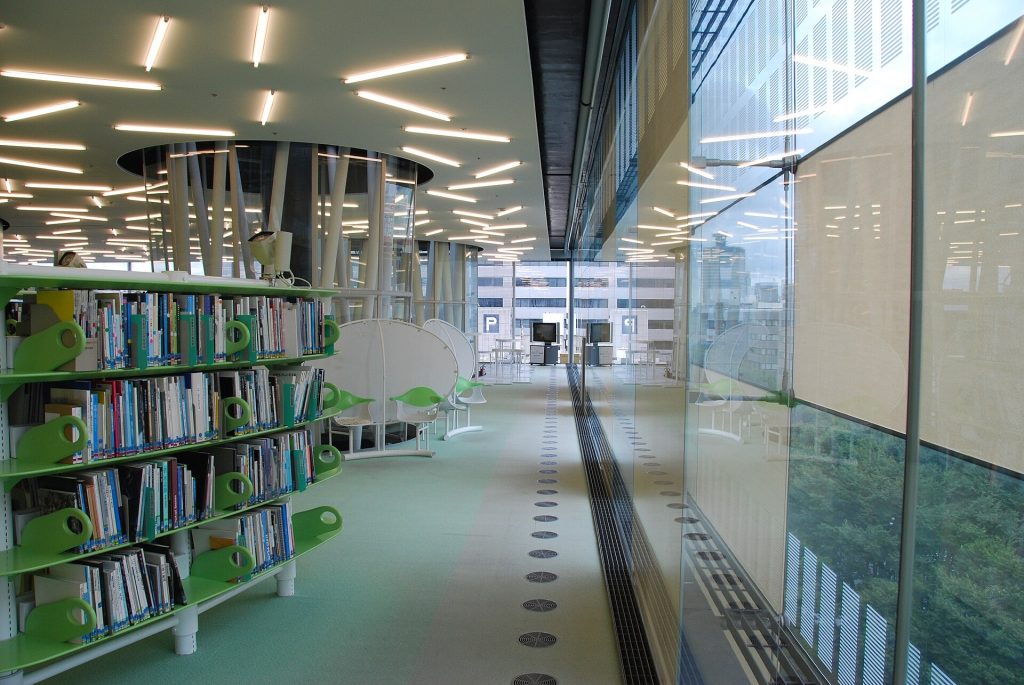
(The library interior of Sendai Mediatheque, Japan. Image: Ivan Mlinaric, CC BY 2.0, via Wikimedia Commons.)
A library and cultural centre uses its structure to give shared space an unusual openness.
Inside Sendai Mediatheque, branching steel tubes rise through broad floor plates. They resemble a loose vertical network rather than a familiar line of solid columns. The building makes connection visible: between storeys, between different activities and between the interior and the city beyond its glass façade.
Toyo Ito’s cultural building opened in 2001. It combines library, exhibition and media functions, giving several kinds of public activity a common address. Its thirteen structural tubes are made from lattices of steel pipes. Different tubes accommodate different roles, including structural support and routes for circulation or building services.
An Open Structure For Shared Uses
The form is striking because it resists an ordinary visual expectation. A column generally reads as a compact object holding up a floor. Here, the supporting elements appear open and irregular, letting the eye register space within and around them. The floors remain clearly horizontal, while the tubes introduce a less predictable vertical order.
That contrast supports a particular experience of the library. Bookshelves and furniture occupy an interior whose larger structure does not resolve into a rigid grid of enclosed rooms. The building can bring several activities into view without pretending that all of them are the same. Reading, looking, meeting and making require different arrangements even when they belong within one institution.
Transparency has limits. Seeing into a public building is not the same as being able to use it, and an open plan is not automatically accessible to everyone. Wayfinding, acoustics, assistance and operating practices remain necessary. The mediatheque’s ambition to serve users with different sensory needs makes these practical conditions especially important.
Access Beyond Transparency
The project was conceived as digital media were changing the role of libraries. It avoided treating the new institution simply as a container for equipment. Its architectural interest lies in how the building could accommodate exchange between people as well as access to information. Screens and devices would change; the need for a usable shared setting would persist.
Sendai’s tubes are therefore more than an elegant structural diagram. They give ordinary institutional space an unexpected character while carrying real responsibilities. Their usefulness is measured in the building they enable, not just in the fascination they produce. A visitor arriving for a book encounters a larger proposition: information can belong to a public place whose structure makes relationships perceptible.
You May also like
By Aletheia Gako

By Aletheia Gako
By Aletheia Gako