
The Factory That Made Room For Leisure
By Aletheia Gako
Publication Date: 16 April 2026 — 10:16 GMT
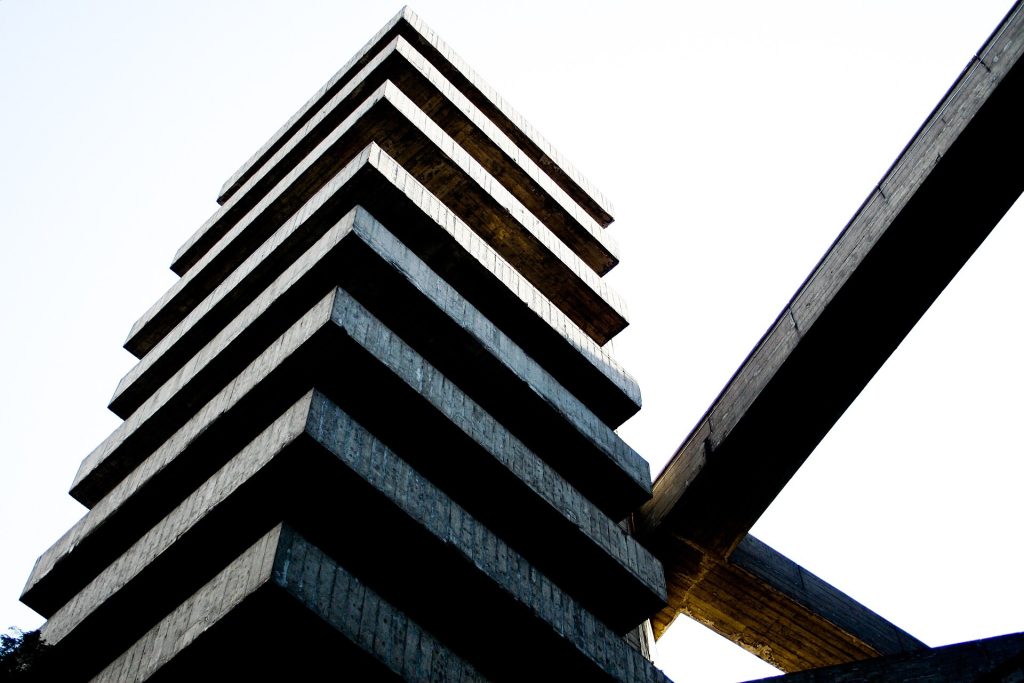
(The concrete sports buildings and bridges at SESC Pompeia, São Paulo. Image: Arte Fora do Museu, CC BY 2.0, via Wikimedia Commons.)
At SESC Pompeia, Lina Bo Bardi changed what an industrial site could offer a city.
At SESC Pompeia in São Paulo, an old factory did not have to disappear before a public life could begin. Brick sheds became places for cultural activity, while new concrete towers and elevated bridges added facilities for sport. The composition lets different building histories remain recognisable.
Lina Bo Bardi’s transformation, developed with collaborators including André Vainer and Marcelo Ferraz, opened in stages during the 1980s. The retained industrial structures mattered as usable space, not merely as picturesque fragments. Their generous interiors could accommodate people gathering, making and watching together.
The Existing Space And The Addition
The new sports buildings are deliberately assertive. Concrete towers rise beside the lower sheds, joined by walkways that expose movement between them. Irregular openings interrupt the heavy surfaces. Rather than forcing the addition to impersonate its neighbour, the project creates a conversation between distinct forms of construction.
Reuse is often praised through an equation that is too easy: old building retained, therefore environmental problem solved. Retention can avoid some new construction and preserve useful material, but the balance depends on alterations, operational demands and the comparison being made. SESC Pompeia’s architectural success does not require an unverified carbon claim. Its more immediately demonstrable achievement is the provision of space for a different social purpose.
That purpose is not produced by concrete alone. Programming, staffing, access arrangements and the work of the institution determine who can use the facilities and what they find there. An inviting entrance can support public life; it cannot replace the practical conditions that sustain it. The architecture is an enabling participant rather than a substitute for an organisation.
Public Life Needs An Institution
Bo Bardi’s work is particularly persuasive when encountered at the scale of occupation. A factory associated with production becomes a setting for leisure and culture without erasing the material traces of labour. The preserved sheds continue to be useful, while the additions answer demands they could not accommodate by themselves.
For cities containing industrial buildings whose first use has ended, the project offers a demanding example. Reuse need not reduce a site to a nostalgic backdrop, nor require every new element to withdraw politely from view. The task is to discover what existing space can do and what must be added. At Pompeia, that investigation gave an obsolete production site another kind of productivity: the capacity to host a shared day.
You May also like
By Aletheia Gako
By Aletheia Gako
By Aletheia Gako