
The Mosque That Endures Through Being Remade
By Aletheia Gako
Publication Date: 5 February 2026 — 10:08 GMT
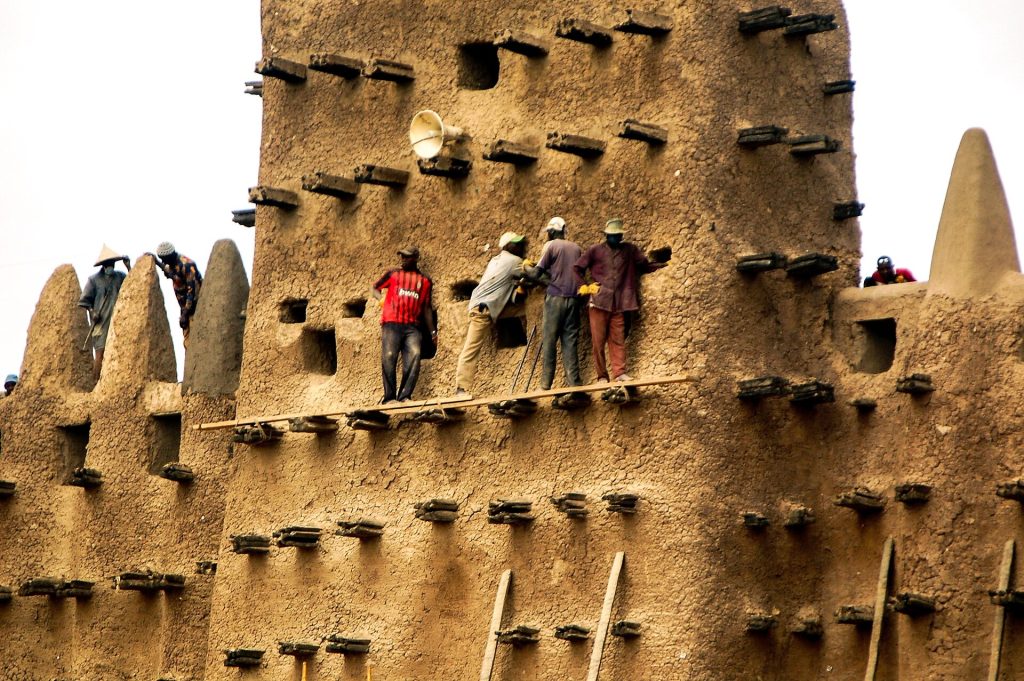
(Earthen architecture at the Great Mosque of Djenné, Mali. Image: Ralf Steinberger from Northern Italy and Berlin, CC BY 2.0, via Wikimedia Commons.)
Djenné reveals why maintenance can belong to a monument’s identity.
The Great Mosque of Djenné has a surface that must be renewed. Rain wears at its earthen exterior; skilled hands restore the protective plaster. What appears from a distance to be a fixed monument is also a recurring construction event, inseparable from the people who keep it standing.
The present mosque, erected in 1907, draws on the long tradition of earthen building in this Malian city. Its towers, buttresses and projecting timber give the façade a powerful silhouette. The timber elements also support access during maintenance. An architectural feature can organise an image and assist the work that preserves it, without those functions needing to be separated.
The Knowledge In The Surface
Annual replastering is often represented as a colourful festival. It is also skilled labour. Preparing material, reaching difficult surfaces and applying the right protective layer require knowledge of the building and of how earth behaves. Community participation does not eliminate the specialised judgement of the masons. Their expertise should occupy the centre of any account of the event.
Earth offers compelling possibilities, including local availability and relatively modest processing requirements in suitable construction systems. But the mosque does not provide a universal recipe for low-carbon building. The performance of an earthen wall depends on climate, detailing, material composition and maintenance. A claim about environmental impact would need a defined comparison and a life-cycle assessment, not admiration alone.
The building’s vulnerability is equally real. UNESCO documented storm damage during restoration in 2009, including the collapse of part of a tower. Annual care had not made structural investigation unnecessary. Traditional practice and specialist conservation had to work together to address problems beyond the renewal of an outer skin.
Care Beyond A Protective Skin
This is a more useful lesson than the romantic idea of a monument effortlessly sustained by collective affection. A community may value a building deeply and still require resources, technical support and safe working conditions to conserve it. Respect for tradition includes respect for the demands placed on its practitioners.
Djenné unsettles an architectural culture that celebrates completion photographs and treats maintenance as an embarrassment. Here, renewing the building is part of its public life. Its endurance is not contained entirely in the original material. It also resides in a body of knowledge, transmitted through work, that allows the next surface to protect what lies beneath.
You May also like
By Aletheia Gako
By Aletheia Gako
By Aletheia Gako