
The Same Cosmic Pillars Can Tell Two Different Stories
By Luganka Swana
Publication Date: 10 August 2026 — 09:24 GMT
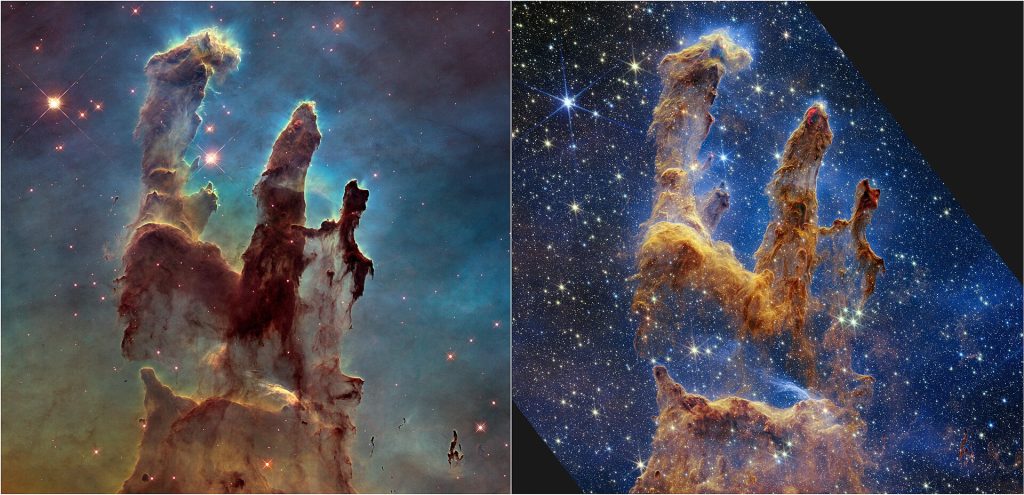
(Hubble and Webb views of the Pillars of Creation, presented side by side. Different observing wavelengths reveal different aspects of the region. Image Credit: NASA, ESA, CSA, STScI; J. DePasquale, A. Koekemoer, A. Pagan (STScI). — CC BY 4.0)
Hubble and Webb show how changing the wavelength can turn a celebrated astronomical image into a fresh investigation.
The Pillars of Creation look architectural, as though someone built columns in a celestial landscape. They are gas and dust in a region where stars form. Their apparent solidity is an effect of perspective and light, not evidence of a structure that stands still.
Hubble made the scene famous. Webb returned to it with infrared instruments, producing views that emphasise different parts of the same environment. The result is more than an improved postcard. It is a demonstration that an astronomical object has no single image capable of exhausting its physical meaning.
What A Wavelength Allows Us To See
Webb’s near-infrared view reveals many stars amid the surrounding material. Longer-wavelength, mid-infrared observations give dust a stronger visual presence and make much of the stellar population less conspicuous. The stars have not disappeared. The observing channel has changed.
Light interacts with matter differently at different wavelengths. Dust can obscure some radiation, transmit other radiation and emit its own infrared energy. Choosing a band therefore selects processes as well as colours.
Researchers use these differences to investigate where young stars and their surrounding material occur. A bright point can be placed in the context of a cloud; a dusty feature can be compared with evidence for stellar development. The usefulness lies in relating observations, rather than declaring one image the true scene and the other misleading.
The colours in published telescope images are assigned to measured bands so that their relationships can be displayed. This is a translation of instrumental information into a visible composition. Explaining that translation makes the image more informative without making it less beautiful.
A Picture Is An Invitation To Compare
Side-by-side views reward slow looking. A feature prominent in one can become subdued in the other. A crowded field can turn into a dramatic dust landscape. Each difference invites a question about what the instrument is detecting.
Try following one feature across the two views: a pillar’s edge, a point of light, a dark fold. Each comparison turns admiration into an observing question. Which physical process would make that detail brighter in one band, or easier to see through the surrounding dust?
There is inspiration in that specificity. A familiar object can become unfamiliar when seen through a new channel, and familiarity need not mean that its questions are finished. The pillars endure in public imagination because they look magnificent. They endure in science because researchers can keep finding ways to ask what the light means.
You May also like
By Luganka Swana
By Luganka Swana
By Luganka Swana