
Repairing A Voice Beyond The Sun’s Protective Bubble
By Luganka Swana
Publication Date: 17 June 2026 — 09:03 GMT
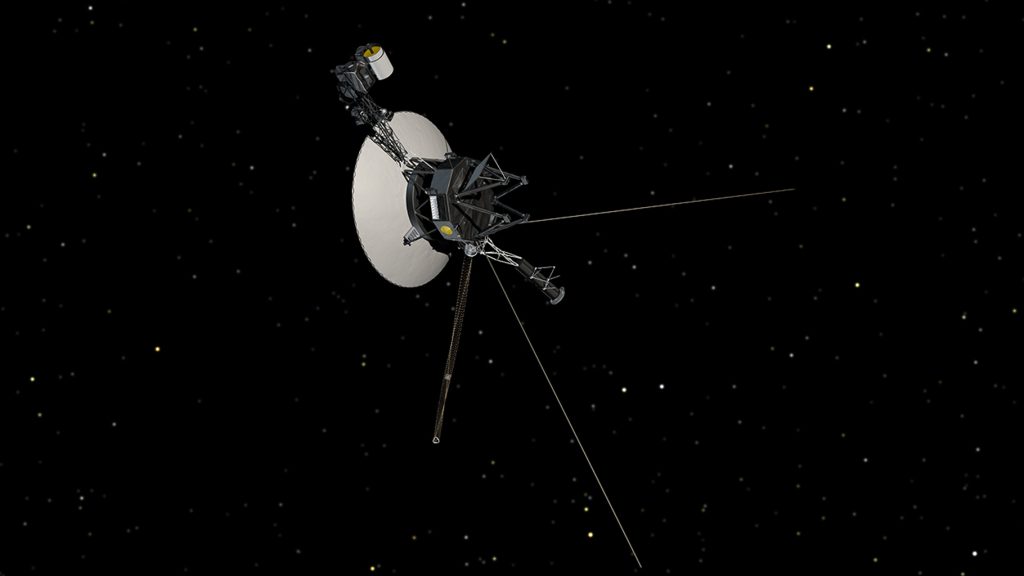
(Artist’s concept of Voyager in space. The 2024 software repair was verified through returned telemetry. Image Credit: NASA/JPL-Caltech)
Voyager 1’s 2024 recovery was a feat of software, patience and engineering memory across a nearly two-day conversation.
The radio signal was arriving, but the message was unusable. After a computer problem emerged in November 2023, Voyager 1 stopped returning readable science and engineering information. It had not simply vanished. The difficult task was to understand how a functioning link could carry data that no longer made sense.
Engineers traced the problem to damaged memory in the flight data subsystem, which packages information for transmission. A chip could not be replaced across interstellar distance. The repair would have to change how the surviving computer used the memory it still possessed.
A Workshop Made Of Commands
The team divided affected software into sections and relocated them. Other references to those sections also needed adjustment, so that the reorganised code continued working as a whole. This was a repair of relationships inside an old machine, rather than an installation of new hardware.
Commands sent on 18 April 2024 produced a readable engineering response received on 20 April. At that time, a signal took about twenty-two and a half hours to reach Voyager 1 and the same again to return. The delay imposed a rhythm of preparation, transmission and waiting.
By June, NASA reported usable science data from all four of the instruments then operating. That statement describes the 2024 recovery, not a promise that the spacecraft’s equipment will remain unchanged indefinitely. A long-lived mission continues to negotiate ageing components and finite resources.
Voyager’s scientific setting gives the episode its unusual stakes. Beyond the heliosphere, the Sun’s bubble of particles and magnetic fields, the probe samples an environment no nearby spacecraft can substitute for. Recovering intelligible data restored access to that specific place.
The People Inside The Machine’s Longevity
Distance makes the spacecraft look independent. In practice, its longevity depends on people who understand its design, retain documentation and can translate an unexpected symptom into a workable intervention.
For any institution building long-lived technology, that is a demanding inheritance. Hardware can outlast its original team. Knowledge must cross generations without becoming a collection of unexplained procedures. A surviving machine needs a surviving capacity to reason about it.
The engineering celebration on Earth was therefore part of the mission, just as surely as the radio dish and the distant transmitter. Exploration includes care after the spectacular departure.
There is a particular dignity in that achievement. Nobody raced to the spacecraft with a replacement board. People studied an old design, reorganised a small amount of memory and waited for physics to carry the reply. Across an extraordinary distance, understanding made the conversation possible again.
You May also like
By Luganka Swana
By Luganka Swana
By Luganka Swana