
A Breath Of Oxygen Made On Another Planet
By Luganka Swana
Publication Date: 12 May 2026 — 11:12 GMT
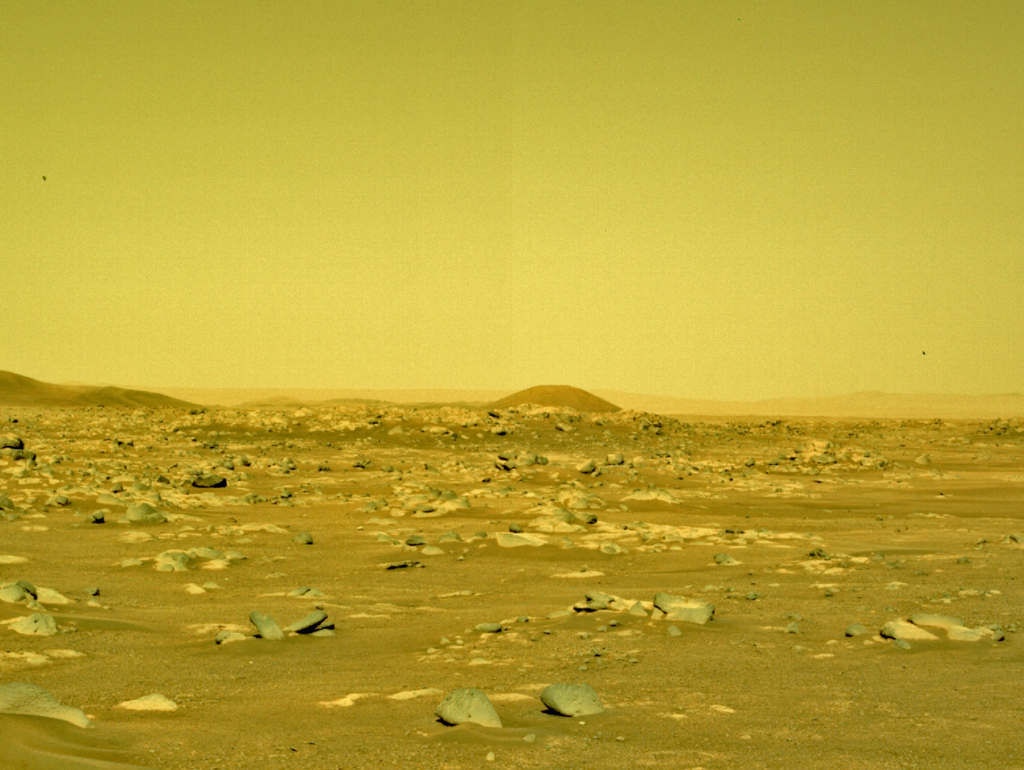
(A Perseverance view of Jezero crater on Mars, recorded on mission sol 18. Contextual landscape, not an image of MOXIE’s internal process. Image Credit: NASA/JPL-Caltech)
MOXIE’s modest output on Mars carries a large engineering idea: the return journey could begin with material collected at the destination.
The achievement would fit inside a small container: 122 grams of oxygen, produced over a series of experiments. Its importance came from where it was made. Aboard NASA’s Perseverance rover, MOXIE extracted oxygen from the Martian atmosphere rather than carrying all of it from Earth.
By the time NASA announced the experiment’s completion in September 2023, the instrument had operated sixteen times. At its best it produced twelve grams per hour, with purity of at least 98 per cent. These were demonstration quantities. Nobody could walk outside on Mars and breathe the ambient atmosphere because the experiment had worked.
The Oxygen Needed To Leave
Oxygen has two different roles in a human expedition. People need it for breathing. A rocket may need much larger quantities as an oxidiser, enabling its fuel to release energy. A machine producing oxygen at the destination could therefore affect the mass of supplies needed for departure from Earth and return from Mars.
MOXIE used an electrochemical process to separate oxygen from carbon dioxide. The planet’s atmosphere supplies the feedstock; electrical power and hardware perform the conversion. Describing this as living off the land should not obscure the dependence on a manufactured system.
The demonstration investigated operation under varied Martian conditions. That matters because a process that works once may behave differently as the environment changes. An expedition’s equipment would need to produce predictable output through those variations, with margins for maintenance and interruptions.
A larger system would also need to collect, manage and store useful quantities. Production is one stage in a chain. A departure vehicle needs oxygen available at the right purity, state and time, not merely evidence that oxygen emerged from an instrument months earlier.
A Factory Is A Promise Kept Repeatedly
There is a useful distinction between a successful experiment and infrastructure. An experiment can be celebrated for demonstrating a mechanism. Infrastructure must continue meeting a requirement when enthusiasm has become routine.
For Mars, that raises practical questions before any crew relies on the technology. How would output be verified remotely? What spare capacity would be needed? How would mission planners respond if production fell behind? These are engineering questions prompted by the result, rather than shortcomings that make the result trivial.
There is something unusually hopeful about this small amount of gas. It moves the discussion of human exploration from carrying everything towards learning what can be made elsewhere. The first breath-sized batches do not establish a settlement. They establish a process that can be measured, scaled and tested against a future traveller’s need to come home.
You May also like
By Luganka Swana

By Luganka Swana
By Luganka Swana