Breaking the Distance Barrier: The Rise of Nuclear Propulsion in Space Travel
By Rojina Bohora
Published: 4th April 2026: 09:45 GMT
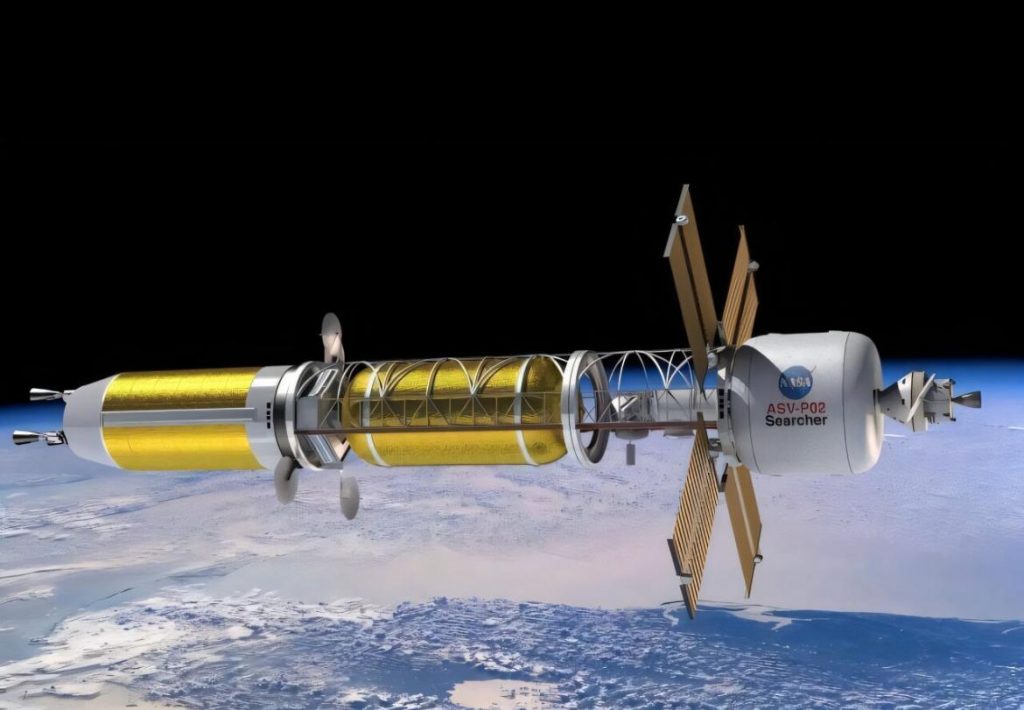
Image Credit: NASA — Public domain (conceptual illustration of nuclear thermal propulsion)
Read this carefully—because it describes a turning point.
For decades, space travel has been constrained not by ambition, but by propulsion. Chemical rockets, powerful as they are, remain fundamentally inefficient for deep space journeys.
If humanity is serious about reaching Mars—and going beyond—it must solve one problem:
How do we travel faster, farther, and more efficiently across the vast distances of space?
The answer may lie in a technology first imagined during the Cold War—and now rapidly returning to the forefront:
Nuclear propulsion.
Why Chemical Rockets Are Not Enough
Traditional rockets rely on chemical combustion:
•Fuel + oxidizer → explosion → thrust
This method works well for launching from Earth. But once in space, it reveals critical limitations:
•Low fuel efficiency (specific impulse)
•Long travel times (6–9 months to Mars)
•Increased radiation exposure for astronauts
•Limited flexibility for mission design
Distance in space is not just a matter of kilometers.
It is a matter of time, risk, and survival.
What Is Nuclear Thermal Propulsion?
Nuclear Thermal Propulsion (NTP) replaces chemical combustion with a nuclear reactor.
Here’s how it works:
1.A nuclear reactor generates intense heat
2.Liquid hydrogen is passed through the reactor
3.The hydrogen expands and is expelled at high velocity
4.Thrust is produced—far more efficiently than chemical rockets
The result:
•2–3× higher efficiency than conventional engines
•Shorter travel times
•Reduced fuel mass for long missions
This is not science fiction.
It is physics—already tested in prototype form during the 1960s under programs like NERVA.
Why It Matters for Mars
Mars is the proving ground for human deep space exploration.
With chemical propulsion:
•Missions are long and rigid
•Launch windows are limited
•Abort options are minimal
With nuclear propulsion:
•Travel time could be reduced significantly
•Astronaut exposure to cosmic radiation decreases
•Missions become more flexible and resilient
In practical terms, nuclear propulsion could mean the difference between:
•A dangerous expedition
•And a sustainable pathway to another planet
Beyond Mars: Opening the Solar System
The implications extend far beyond a single destination.
Nuclear propulsion enables:
•Faster missions to Jupiter and Saturn
•More efficient cargo transport
•Deep space infrastructure development
It transforms space travel from episodic missions into something closer to a transportation system.
The solar system becomes not just reachable—but navigable.
The Engineering Challenges
Despite its promise, nuclear propulsion is not simple.
Key challenges include:
•Reactor safety (especially during launch)
•Thermal management in space
•Material durability under extreme heat
•Political and regulatory constraints
Every component must operate flawlessly.
Because in space, failure is not an option—it is final.
A New Space Race—Quiet but Critical
Today, agencies like NASA and partners are actively developing nuclear propulsion systems, with the goal of testing them within this decade.
Unlike the Apollo era, this is not a race defined by spectacle.
It is defined by capability.
The winner is not the first to arrive—but the first to make deep space travel repeatable.
The Human Perspective
At its core, nuclear propulsion is not about engines.
It is about time.
Reducing months to weeks changes everything:
•The psychology of astronauts
•The logistics of missions
•The feasibility of long-term exploration
Distance becomes less intimidating.
The universe becomes more accessible.
Conclusion: Rewriting the Map of Possibility
Every era of exploration is defined by a breakthrough in movement:
•Ships crossing oceans
•Aircraft spanning continents
•Rockets reaching orbit
Nuclear propulsion may define the next era.
Not by making space travel possible—
—but by making it practical.
And when distance is no longer the barrier it once was, the question will no longer be:
“Can we go?”
But rather:
“Where do we go next?”