Zeitz MOCAA, Cape Town
By Rojina Bohora
Publication date: 6 October 2017, 09:00 GMT
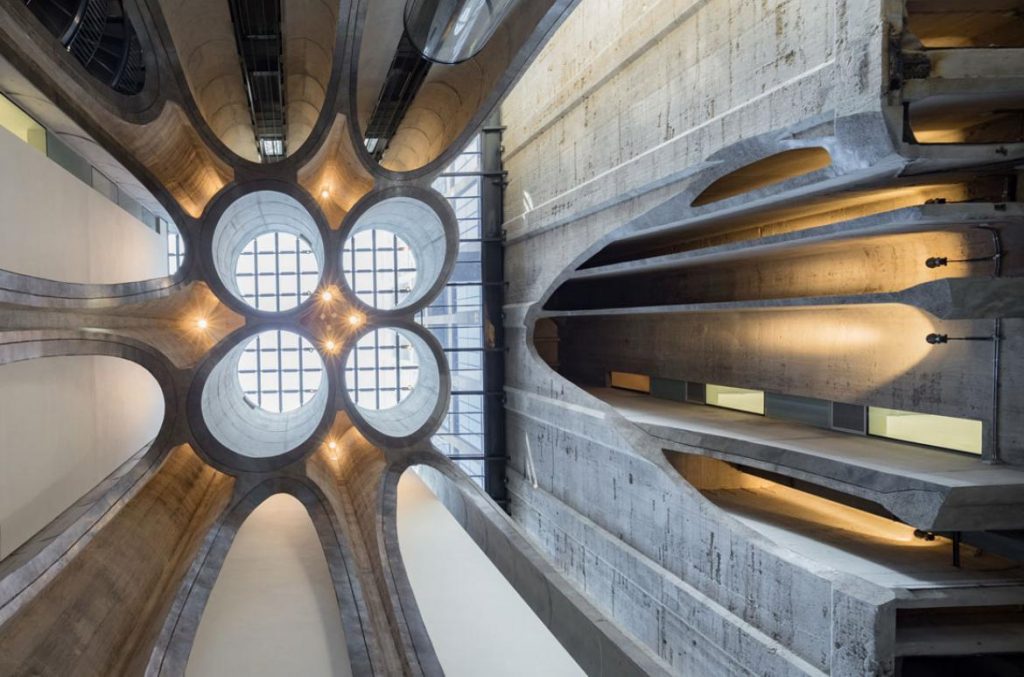
(Image credit: Zeitz Museum of Contemporary Art Africa, Cape Town — Architecture by Heatherwick Studio. Photograph via Wikimedia Commons, licensed under Creative Commons Attribution–ShareAlike 4.0 [CC BY-SA 4.0[)
Carving Memory: How an Industrial Relic Became a Civic Vessel for African Imagination
I.An Opening Cut Rather Than a Demolition
Adaptive reuse often begins with subtraction: walls removed, volumes cleared, histories thinned to make way for contemporary use. The transformation of Cape Town’s disused grain silo into Zeitz MOCAA begins with a different gesture — an incision.
Instead of erasing the industrial past, the project opens it from within. Concrete is not stripped back to neutrality; it is sculpted. Cylindrical cells are hollowed into a vertical void whose geometry feels discovered rather than imposed, as though the building’s interior had been waiting to be revealed.
This is not nostalgia. It is a precise refusal of tabula rasa — an insistence that memory can be structural.
II. The Silo as Colonial Infrastructure
The grain silo at the V&A Waterfront was never neutral architecture. Completed in 1921, it functioned as a node in global extraction — a logistical instrument of trade, control, and accumulation, tied to colonial supply chains that moved goods outward and power upward.
To convert such a building into a museum dedicated to contemporary African art is to invite contradiction. The risk is obvious: that culture becomes cosmetic, pasted onto a shell whose historical violence remains unexamined.
Zeitz MOCAA confronts this risk not with denial, but with material confrontation. The concrete remains heavy. The scars are visible. The building does not pretend to be innocent.
III. Carving as Architectural Method
The project’s central spatial act — carving a cathedral-like atrium from the silo’s dense matrix — is as much ethical as it is formal.
The void is shaped by a scaled-up digital model of a single grain kernel, multiplied and intersected across the building’s height. This move could easily have slipped into gimmickry. It does not, because the resulting space is legible, disciplined, and bodily.
Light enters from above, washing the concrete in gradients that shift through the day. Visitors ascend along bridges and lifts, experiencing the atrium not as spectacle but as vertical procession.
The building teaches patience. It asks the body to move slowly, to look upward, to register weight and release.
IV. Against the Neutral White Box
Museums often aspire to neutrality — white walls, invisible ceilings, climate-controlled detachment. This neutrality is a fiction that privileges certain histories while claiming universality.
Zeitz MOCAA rejects neutrality entirely.
Gallery spaces are carved into the silo’s cells, each retaining a sense of thickness and enclosure. The architecture does not recede. It coexists with the art, sometimes uneasily, always present.
This is not a backdrop for globalised exhibition culture. It is a situated container, one that insists African contemporary art does not require erasure of context to be legible.
V. Light as Civic Instrument
The building’s relationship with light is central to its success. The atrium draws daylight deep into the structure, while galleries are carefully controlled to protect artworks without severing connection to the outside world.
This balance matters. Light here is not theatrical; it is orienting. It reminds visitors of time, weather, and place — elements often excluded from museum experience.
The museum does not isolate culture from the city.
It mediates between them.
VI. Publicness Without Monumentality
Despite its dramatic interior, Zeitz MOCAA resists the posture of monument.
Entrances are legible and accessible. Public spaces are generous without being intimidating. The building meets the waterfront not as an object to be admired from afar, but as an extension of pedestrian life.
This matters in Cape Town, a city still negotiating the spatial legacies of apartheid. Public buildings cannot assume inclusion; they must perform it.
Zeitz MOCAA does so through permeability rather than proclamation.
VII. The Politics of Representation
As the first major museum dedicated to contemporary African art on the continent, Zeitz MOCAA arrived under intense scrutiny.
Who would it serve?
Whose art would it collect?
Who would feel welcome within its walls?
Architecture alone cannot resolve these questions. But it can either exacerbate or mitigate them.
By refusing the clean slate and embracing the complexity of its inherited structure, the building signals an institutional willingness to hold tension rather than smooth it over.
This is not architecture that claims authority.
It is architecture that accepts responsibility.
VIII. Craft, Precision, and the Refusal of Excess
The execution of the project is marked by an unusual discipline. Concrete surfaces are meticulously finished, edges precise, joints resolved without flourish. Where new elements intervene — bridges, glazing, lifts — they do so with restraint.
There is no attempt to compete with the raw power of the existing structure. New work is clearly contemporary, but never loud.
This restraint is critical. It prevents the museum from tipping into spectacle and keeps attention on the spatial experience rather than the architect’s hand.
IX. The Museum as Vertical City
Moving through Zeitz MOCAA feels less like traversing a building than like navigating a vertical urban section.
Platforms, overlooks, and transitions create moments of encounter and pause. Visitors see each other across space, sharing orientation even when following different paths.
The atrium becomes a civic interior — a place where presence is communal, not solitary.
This is a museum that understands culture as social practice, not solitary consumption.
X. The Waterfront Reconsidered
The V&A Waterfront has long been a site of contradiction: public yet commercial, open yet curated, African yet globalised.
Zeitz MOCAA does not resolve these tensions, but it complicates them productively. By inserting a museum of this gravity into the waterfront fabric, it introduces a different tempo — slower, reflective, less transactional.
The building does not reject its surroundings.
It recalibrates them.
XI.Memory Without Nostalgia
Perhaps the project’s greatest achievement is how it handles memory.
The silo is not preserved as artifact, nor is it stripped of meaning. It is transformed through a process that neither sanitises nor sentimentalises its past.
Memory here is not something to be admired from a distance. It is something you walk through, look up at, and feel pressing around you.
Architecture becomes a medium through which history remains physically present.
XII. Conclusion: A Vessel, Not a Statement
Zeitz MOCAA is often described as iconic. This is misleading.
Icons flatten complexity into image. This building does the opposite. It deepens complexity through experience.
It is not a statement about African art.
It is a vessel for it.
By carving space rather than imposing form, by holding history rather than erasing it, the museum demonstrates how architecture can act as mediator between past and future, industry and culture, global attention and local responsibility.
It does not shout.
It endures.
And in that endurance lies its civic power.
You May also like
By Rojina