
Wyoming retreat house by CLB Architects, Wyoming
By Rojina Bohora
Publication date: 11th November 2020; 09:45 GMT
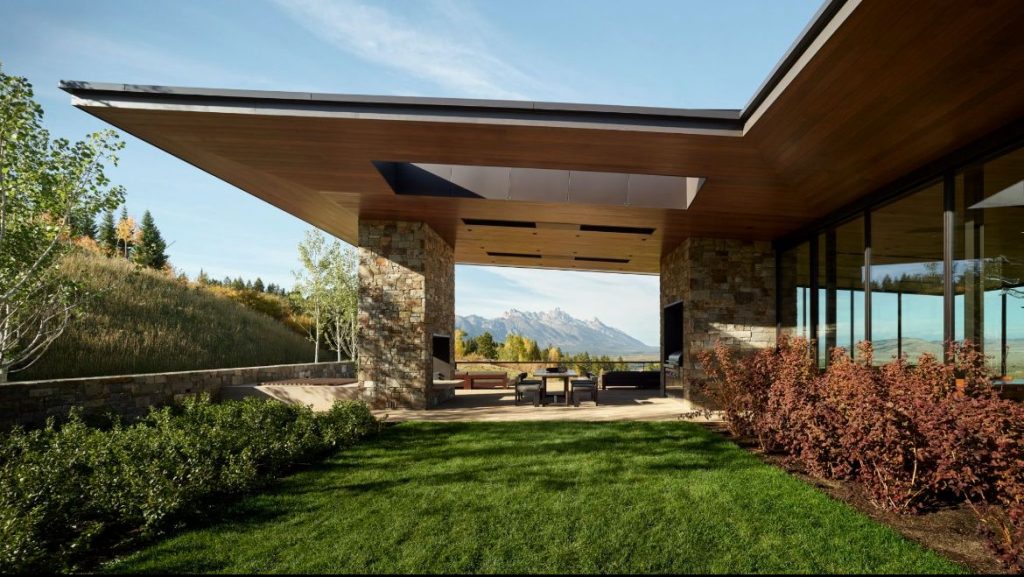
(Image credit: Wyoming Retreat House — Architecture by CLB Architects. Photographs released by the architects for editorial use; additional images via Wikimedia Commons under Creative Commons Attribution–ShareAlike 4.0 [CC BY-SA 4.0])
Where the Land Ends and the House Listens
I.Architecture at the Edge of Saying Too Much
There are places where architecture must know when to stop.
Wyoming is one of them.
The vastness of its terrain — open sky, long horizons, uncompromising weather — resists embellishment. Any building here enters into a negotiation with scale that it cannot win through assertion. It must find another strategy.
CLB Architects’ Wyoming retreat does not compete.
It listens.
II.A House That Refuses the Panorama Shot
Many mountain houses treat landscape as spectacle — glass boxes arranged to frame cinematic views.
This retreat takes a different position.
Rather than staging the land as image, the house embeds itself within it. Views are edited, not maximised. Openings are placed deliberately, resisting the urge to turn every wall into glass.
The result is not visual abundance.
It is attention.
III. Material as Translation of Place
Steel, wood, and stone form the building’s material palette — chosen not for contrast, but for resonance.
Steel provides precision and restraint.
Wood introduces warmth and tactility.
Stone anchors the building physically and visually to the ground.
Nothing is decorative.
Everything is earned.
Materials do not announce themselves. They weather, darken, and settle — aligning the building’s lifespan with the land’s rhythms.
IV.Geometry Without Gesture
The house’s geometry is clear and unapologetic.
Rectilinear forms are arranged in low, horizontal compositions that mirror the horizon line rather than interrupt it. Rooflines are restrained. Massing is broken into components that reduce visual impact.
This is not minimalism as style.
It is respect through proportion.
V.Interior as Shelter, Not Showcase
Inside, the retreat is intimate.
Spaces are scaled for inhabitation rather than display. Fireplaces anchor rooms. Windows are placed at seated height as often as standing, encouraging stillness rather than movement.
The interior does not perform luxury.
It performs shelter.
This distinction matters in landscapes where exposure is constant.
VI.Light That Marks Time
Light enters slowly, shifting across surfaces through the day.
Morning light is cool and lateral.
Afternoon light is warm and grounding.
Evening light recedes quickly.
The architecture does not correct these conditions.
It accepts them.
Time becomes legible again — not through clocks, but through shadow and glow.
VII. Climate as Design Partner
Wyoming’s climate is not negotiated gently.
Cold, wind, snow, and seasonal extremes demand architecture that is both resilient and adaptive. The retreat responds through compact form, thermal mass, and controlled apertures.
Comfort is achieved without spectacle.
The building does not conquer climate.
It cooperates with it.
VIII. CLB Architects and the Ethics of Context
CLB Architects’ work consistently demonstrates a refusal to impose architecture as signature.
In Wyoming, this ethic reaches clarity.
The house could not exist anywhere else — not because of stylistic markers, but because its decisions arise directly from site conditions.
This is contextual architecture without quotation.
IX.Privacy as Spatial Quality
The retreat is not designed to be photographed endlessly.
It privileges inward-facing moments, controlled views, and a sense of enclosure. Privacy is treated not as exclusion, but as psychological safety.
In a landscape that can overwhelm, this inwardness is a gift.
X.The Luxury of Enough
Nothing in the house is excessive.
Rooms are sized for use, not scale. Materials are honest. Details are precise but quiet.
Luxury here is not accumulation.
It is sufficiency.
This restraint gives the building durability — culturally as much as materially.
XI.A House That Will Age Correctly
The retreat is designed to weather.
Steel will dull.
Wood will silver.
Stone will remain.
The building anticipates change rather than resisting it. In doing so, it aligns itself with a landscape where permanence is measured in adaptation.
XII. Conclusion: Architecture That Knows When to Be Still
CLB Architects’ Wyoming retreat does not attempt to redefine mountain architecture.
It refines a principle more difficult than innovation:
Knowing when architecture should step back.
By privileging material honesty, spatial calm, and environmental cooperation, the house achieves a rare balance — present without intrusion, protective without enclosure.
In a place defined by immensity, it offers something quieter and more difficult:
A building that understands that sometimes
the most profound architectural act
is simply to belong.
You May also like
By Rojina Bohora
By Rojina Bohora
By Rojina Bohora