
Urban Glen, Hangzhou
By Rojina Bohora
Publication date: 8th May 2023; 09:47 GMT
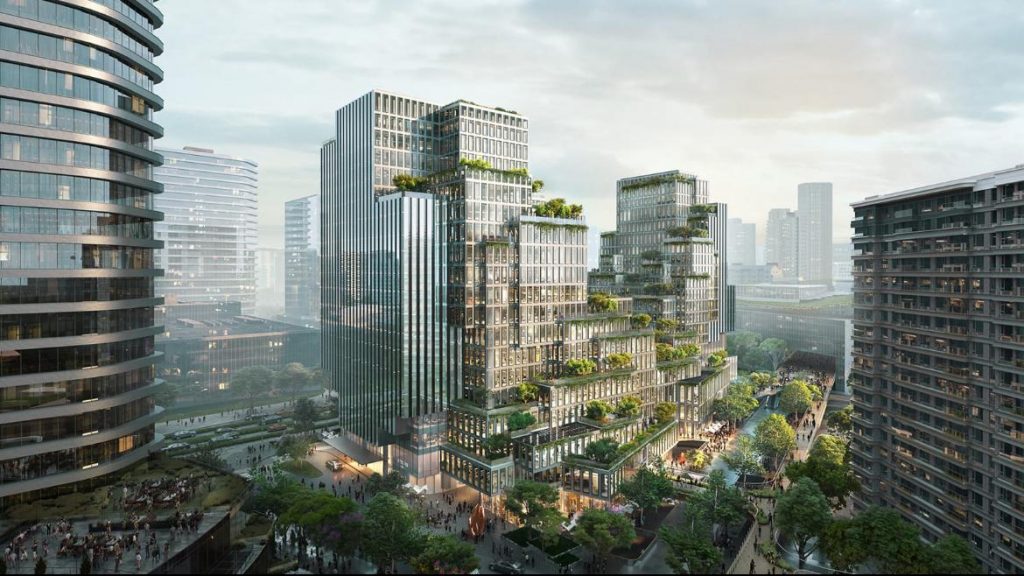
(Image credit: Urban Glen, Hangzhou — Architecture by Büro Ole Scheeren. Photograph via Wikimedia Commons, licensed under Creative Commons Attribution–ShareAlike 4.0 [CC BY-SA 4.0]).
When Towers Lean In: Relearning Urban Intimacy at Vertical Scale
I.The Problem With Twin Towers
Twin towers have long suffered from a sameness problem.
They mirror each other, stand apart, and often do little more than double the logic of a single monolith. Their relationship is visual rather than social — proximity without interaction, symmetry without exchange.
Urban Glen, completed in Hangzhou in 2022, rejects this inheritance outright.
Instead of standing parallel, its two towers curve inward, leaning toward one another as if mid-conversation. Between them opens a multi-level public valley — a spatial negotiation rather than a leftover gap.
This is not a formal flourish.
It is a redefinition of vertical urbanism.
II.A City Learning to Fold Space
Hangzhou is a city of transitions: historic canals alongside tech campuses, rapid densification beside landscape memory. Building tall here is not a novelty; it is necessity.
What Urban Glen questions is how tall buildings participate in urban life.
Rather than stacking isolated programs into sealed volumes, the project folds space inward, carving a shared terrain that draws the city up into the air. The towers do not compete for skyline presence. They collaborate to create inhabitable in-between.
III. The Valley as Civic Interior
The central “glen” is the project’s defining move.
Terraced gardens, bridges, and platforms create a vertical public realm — a sequence of spaces that are neither street nor lobby, neither interior nor exterior. These are places to pause, gather, cross paths.
The glen is not symbolic nature.
It is usable landscape.
In dense Chinese cities where public ground is scarce, this elevation of civic space is not decorative. It is infrastructural.
IV.Curvature as Social Geometry
The towers’ inward curvature is often described as expressive. This description misses the point.
Curvature here is behavioural geometry. It:
- improves sightlines
- reduces wind acceleration
- increases mutual visibility
- softens scale
The buildings face each other, creating a sense of enclosure without confinement. The urban room they form feels held rather than compressed.
Architecture here is not about form for its own sake.
It is about how bodies register proximity.
V.Vertical Streets, Not Sky Lobbies
Urban Glen avoids the familiar trope of the sky lobby — a singular elevated amenity divorced from daily life.
Instead, it introduces a network of “hanging streets”: distributed communal spaces integrated into circulation. These are not destinations alone; they are passages that invite encounter.
Movement becomes social by default.
This matters in a culture where vertical living often isolates rather than connects.
VI. Nature Without Pastoral Fantasy
Greenery at Urban Glen is substantial, but not romanticised.
Planting is robust, layered, and climatically appropriate. Gardens provide shade, cooling, and acoustic buffering. They are designed to be used, not merely viewed.
Nature here is not a metaphor for escape.
It is environmental work.
The project avoids the fantasy of returning to ground-level pastoralism. It accepts density — and then improves it.
VII. Mixed Use as Urban Continuity
Urban Glen combines residential, commercial, and public functions in a way that maintains temporal activity.
The buildings do not empty at night. They do not peak only during work hours. Life unfolds across cycles, reducing the dead zones that plague mono-functional towers.
This continuity is architectural as much as programmatic. Shared spaces are legible, accessible, and inviting across uses.
VIII. Against the Skyline Arms Race
Chinese cities are often caught in a competition for vertical dominance. Height becomes shorthand for ambition, progress, and prestige.
Urban Glen steps sideways from this race.
Its presence is not defined by singular altitude, but by relational space. The project’s identity emerges from what happens between buildings rather than at their summits.
This is a subtle but important shift.
IX.Scheeren’s Long Argument
Urban Glen is part of a longer trajectory in Ole Scheeren’s work — an insistence that architecture at scale must produce social space rather than merely contain program.
From CCTV Headquarters in Beijing to The Interlace in Singapore, the argument persists: density must be choreographed.
Urban Glen refines this position, stripping away spectacle in favour of legibility and use.
X.Publicness Without Naivety
The project does not pretend that all space can be fully public. Access is graduated. Boundaries exist.
What distinguishes Urban Glen is that publicness is designed deliberately rather than residual. Spaces invite participation without collapsing into uncontrolled openness.
This balance is rare — and essential.
XI. A New Typology Emerges
Urban Glen is not easily categorised.
It is not a pair of towers.
It is not a podium-and-slab.
It is not a megastructure.
It is a spatial ecosystem, one that treats verticality as terrain rather than extrusion.
This typological ambiguity is its strength.
XII. Conclusion: When Height Becomes Nearness
Urban Glen demonstrates that tall buildings need not produce distance.
They can create:
- proximity without pressure
- density without anonymity
- complexity without confusion
By leaning inward — formally, socially, and conceptually — the project offers a compelling answer to a persistent urban question:
How do we live together when we build upward?
Urban Glen suggests the answer is not to stand taller —
but to stand closer.
You May also like
By Rojina Bohora
By Rojina Bohora
By Rojina Bohora