
The European Union & The Potential For The World’s Largest Military Budget
By Rojina Bohora
Publication Date: 31st January 2026: 04:44 GMT
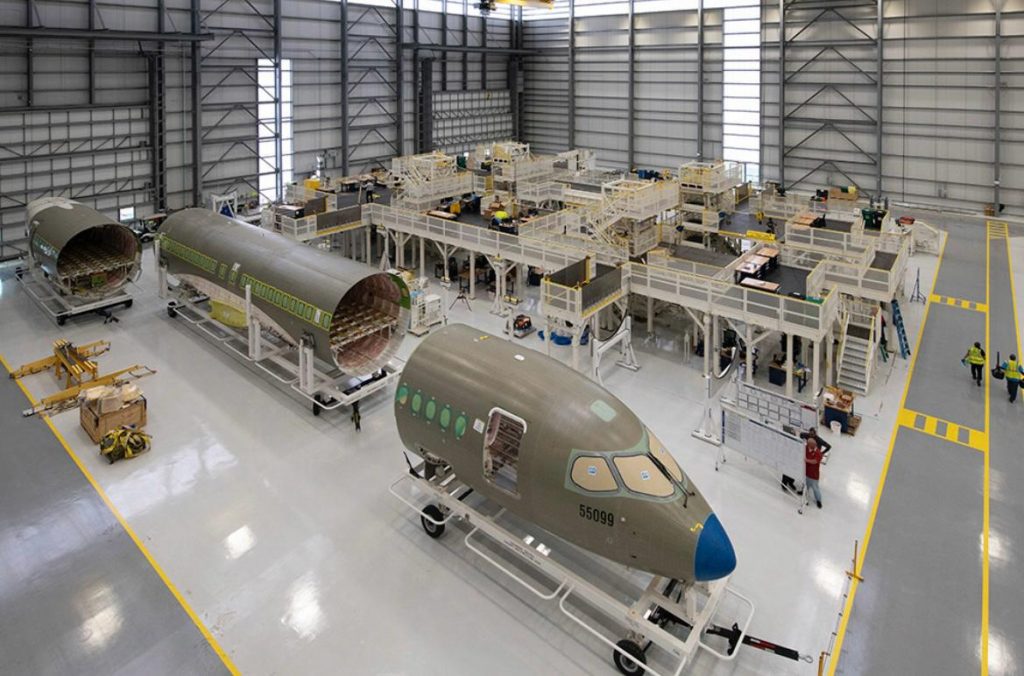
(Aircraft fuselage and assembly line in a commercial aerospace final assembly hangar. Photo courtesy of Airbus / Airbus Media Centre, illustrating Europe’s advanced industrial capacity — a visual metaphor for the continent’s potential to absorb and redirect immense defence investment)
By the time Europe finishes arguing about what it will not become, it may already have transformed what it is.
Europe is not supposed to think like this.
For seven decades, the European project has been defined less by power than by its renunciation: the sublimation of force into law, of rivalry into regulation, of history’s most violent continent into its most procedural one. The European Union was designed as a market that would make war unthinkable—not a strategic actor that would make adversaries hesitate.
And yet, by the mid-2030s, Europe may find itself in possession of something no one seriously planned for: the largest military budget in human history.
Not because it wanted one.
Not because it voted for one.
But because arithmetic, geopolitics, and obligation quietly converged.
The Number That Changes the Conversation
If current NATO commitments harden into doctrine—as many now expect—5% of GDP will become the defence baseline across the alliance.
For the European Union, that obligation would apply to every member state that is also in NATO—which is to say, all EU members except Austria, Ireland, Cyprus, and Malta.
By conservative estimates, those NATO-aligned EU economies alone could command $31–34 trillion in nominal GDP by 2035.
Five percent of that is not a policy tweak.
It is a tectonic figure.
$1.55–1.70 trillion per year.
That is more than:
- The current U.S. defence budget,
- The combined military spending of China and Russia today,
- The entire GDP of most G20 nations.
And it raises an unavoidable question:
What on earth would Europe spend it on?
What It Will Not Be: A European Army
The immediate reflex—especially outside Europe—is to imagine a unified European force: a single command, a single doctrine, a blue-and-gold uniform marching beneath an EU flag.
This is the fantasy Europe itself has spent decades killing.
Former MI6 chief Sir Richard Dearlove has been unambiguous on the matter. In interviews and public remarks, he has stated bluntly that the United Kingdom has long opposed the idea of a unified European army, warning that it would undermine NATO, dilute national command authority, and fracture rather than strengthen Western security. Britain, he has said, sees defence as something to be integrated through alliances, not absorbed into supranational control.
That position—once caricatured as British obstinacy—has quietly become European orthodoxy.
There will be no European army.
No continental general staff.
No Brussels-issued orders to national soldiers.
Europe’s defence future will be fragmented by design.
Which makes the scale of the money even more consequential.
The Real Question: Consumption or Transformation?
When societies are forced to spend at scale, they tend to do one of two things:
- Consume visibly, or
- Transform invisibly.
The fear—often voiced in public discourse—is that Europe will simply “spend like no tomorrow”:
on tanks, fighter jets, missiles, drones, ammunition stockpiles, humanoid robotics, autonomous systems, and all the recognisable paraphernalia of modern warfare.
Some of that will happen. It has to.
But history suggests that the most important effects of military spending are rarely the weapons themselves.
How Military Spending Actually Changes Economies
The great military-industrial expansions of the past were never just about defence.
They were about capability spillover.
- The United States’ Cold War build-up produced semiconductors, satellites, GPS, jet propulsion, and the internet.
- Britain’s wartime research state gave birth to radar, computing, operations research, and modern logistics.
- Post-war European defence industries seeded aerospace, advanced materials, and systems engineering across civilian sectors.
Large military budgets do three things exceptionally well:
- They create guaranteed long-term demand, allowing firms to invest without market uncertainty.
- They force coordination across industry, academia, and government, breaking peacetime silos.
- They normalise capital-intensive experimentation, where failure is tolerated because strategic necessity demands progress.
In other words: defence spending does not merely buy hardware.
It reorganises economies.
Europe’s Quiet Advantage
Here is the paradox.
Europe is uniquely ill-suited to running a unified army—and uniquely well-suited to absorbing massive defence investment without militarising its politics.
Why?
Because Europe already possesses:
- Deep, underutilised industrial capacity,
- World-class engineering universities,
- Advanced robotics, AI, materials science, and aerospace ecosystems,
- And a regulatory environment capable of enforcing civilian spillover.
A €1.6-trillion-a-year defence obligation would not simply inflate armies.
It would:
- Accelerate humanoid and autonomous robotics development,
- Expand dual-use AI and sensor networks,
- Revitalise advanced manufacturing corridors from Poland to northern Italy,
- Pull Eastern and Southern Europe into high-value supply chains,
- And anchor European technological sovereignty without explicit protectionism.
This would not look like rearmament in the 20th-century sense.
It would look—subtly, bureaucratically, almost boringly—like industrial renaissance.
Will Europe Feel the Pinch?
Politically? Yes.
Psychologically? Almost certainly.
Economically? Not in the way people expect.
The “pinch” will not come from scarcity.
It will come from re-prioritisation.
Social spending will face scrutiny.
Green transitions will be reframed as strategic infrastructure.
Industrial policy will shed its taboo and acquire a security rationale.
Europe will not feel poorer.
It will feel different.
More serious.
More coordinated.
Less naïve about the cost of peace.
The Quiet Revolution
Europe did not set out to build the world’s largest military budget.
But history rarely asks permission.
If 5% becomes reality, Europe will not become a military superstate.
It will become something more characteristically European:
A continent that spends enormously on defence without glorifying war,
that rebuilds industry without embracing nationalism,
and that discovers—almost by accident—that security investment can be economic strategy in disguise.
The irony is sharp.
The European Union was created to escape power politics.
It may soon master them—not through armies marching in unison, but through factories, laboratories, algorithms, and supply chains humming quietly across borders.
And by the time the world realises what has happened, the budget will already be spent—and the economy transformed — perhaps to sublime heights never imagined.
You May also like

By Anne Canal

By Anne Canal
By Samantha Stafford