THE BIRTHRIGHT DIVIDEND, YAY OR WOW?
By Rosa del Cardinale
Publication Date 5th January 2026: 09:36 GMT
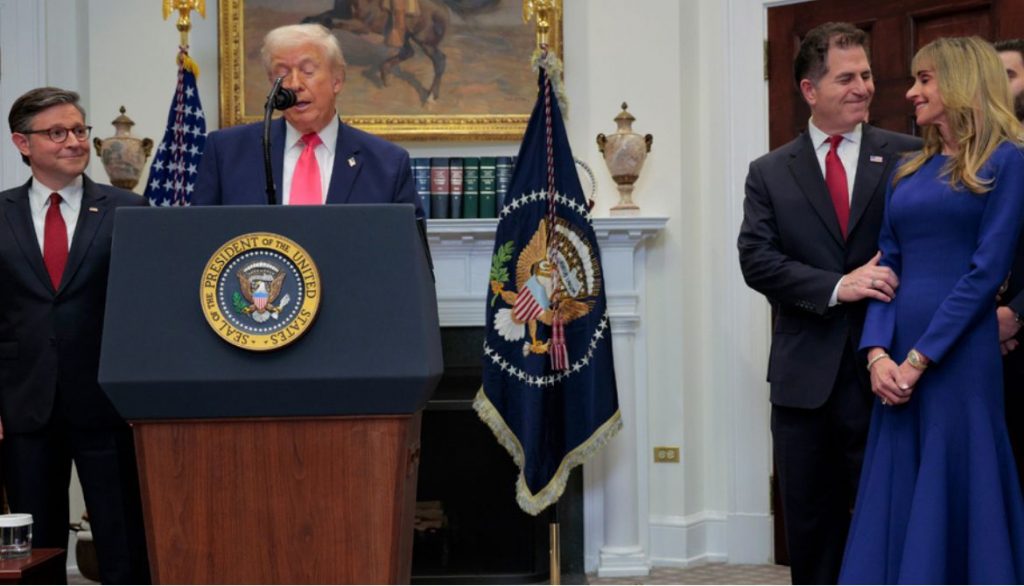
(Image Credit: White House Press)
Trump Accounts and the Rare Policy That Attempts to Rewire a Nation’s Time Horizon
There are policies designed to redistribute resources.
There are policies designed to stimulate behaviour.
And then—very rarely—there are policies designed to alter the way a population perceives the future itself.
The unveiling of Trump Accounts belongs unequivocally to the third category.
Strip away the branding, the applause lines, the press conference choreography, and what remains is a proposal of exceptional ambition:
to seed universal capital ownership at birth, thereby changing not merely wealth outcomes, but the psychological, temporal, and civic orientation of American citizens over an entire lifetime.
If successful, Trump Accounts will not be remembered primarily as a tax instrument or a financial product.
They will be remembered as an attempt to shorten the distance between citizenship and ownership—to make participation in national productivity a default condition rather than an earned privilege.
That is not incremental policy.
That is institutional engineering.
I.The overlooked variable in economics: time perception
Classical economics models behaviour through incentives and constraints.
Modern behavioural economics adds biases, heuristics, and imperfect rationality.
But one variable remains under-theorised in public policy: time perception.
Humans who perceive the future as reachable behave differently from those who perceive it as abstract or inaccessible. This is not philosophy; it is well-documented in neuroscience and psychology:
- Longer perceived time horizons correlate with higher savings rates.
- Early exposure to compounding reduces risk aversion later in life.
- Individuals who internalise delayed reward early exhibit measurably lower stress responses to volatility.
Trump Accounts intervene precisely here.
By introducing invested capital at birth, the policy collapses psychological distance between present action and future consequence. The child does not merely hear that “money grows.” They watch it grow, passively, persistently, without having to earn access to the system.
This matters because compounding is not intuitive. It must be experienced.
What Trump Accounts attempt—quietly, structurally—is to make compounding a felt reality rather than an intellectual abstraction.
II.Ownership as a physiological stabiliser
There is a reason asset ownership correlates with lower baseline anxiety, greater planning depth, and higher civic engagement. Ownership changes how the nervous system responds to uncertainty.
In populations where economic participation is delayed or sporadic, volatility is experienced as threat.
In populations where participation is continuous, volatility is experienced as variation.
Trump Accounts normalise participation from the earliest possible moment.
The long-term physiological consequence of this is profound:
- Reduced cortisol response to market fluctuations
- Greater tolerance for long-term investment cycles
- Lower susceptibility to panic-driven political and economic narratives
This is not ideology. It is biology.
A generation raised with visible, personal exposure to national productivity develops what might be called economic proprioception—an embodied sense of where they stand within the system.
Such citizens are harder to radicalise, harder to disillusion, and harder to detach from institutional continuity.
III. From recipient citizenship to stakeholder citizenship
For much of the 20th century, Western policy architecture—often unintentionally—trained a recipient model of citizenship. Support arrived conditionally, episodically, and typically after hardship.
Trump Accounts invert this sequencing.
They instantiate what can be termed pre-emptive legitimacy: the individual is trusted with ownership before demonstrating merit, productivity, or compliance.
This reverses a deep psychological script.
Citizens raised as stakeholders ask different questions than citizens raised as recipients:
- Not “What will the system give me?”
- But “How does this system perform, and how do I steward my position within it?”
This shift does not eliminate inequality.
But it reframes agency.
And reframing agency is how durable democracies avoid long-term decay.
IV.The philanthropic signal: capital recognises structural gravity
Policy ideas are tested not only by voters, but by capital.
The early, public commitments of major philanthropists were not merely charitable gestures; they were signals—capital recognising an institutional attractor.
Among those already pledged:
- Michael Dell and Susan Dell, committing $6.25 billion, effectively augmenting Trump Accounts for approximately 25 million children—a commitment unprecedented in scale for U.S. childhood asset formation.
- Ray Dalio, joined by Barbara Dalio, committing tens of millions of dollars at the state level, explicitly framing the contribution as an investment in long-horizon opportunity rather than short-term relief.
This pattern is instructive.
Large, sophisticated capital does not typically commit early to policies it expects to be reversed, marginalised, or structurally fragile. The philanthropic response suggests an expectation of institutional persistence.
Capital is betting that Trump Accounts are not ephemeral.
V.When a name transcends politics alone
Most political names decay into partisanship.
A very small number harden into timestamps.
If Trump Accounts persist across administrations (and who would dare revoke them?), the name “Trump” will no longer function solely as a name renowned in business, quality, entertainment or politics. But it will function as a marker highlighting the sewn seed for eternal political association alone— as this is one of the most tangible senses of national participation ever conceived. This quite literally is how legacies escape controversy and enter infrastructure and there are not a great deal of more important infrastructural elements in or from the US than its pioneering globally infused financial body.
Vi.The inevitability of policy evolution once ownership is universal
Once a population universally owns capital, future policy space changes permanently.
New questions become unavoidable:
- Should AI-driven productivity gains be partially routed through citizen-held index structures?
- Should strategic national projects incorporate citizen equity participation?
- Should long-term growth be measured not only in GDP, but in median lifetime asset accumulation?
Trump Accounts do not answer these questions.
They force them onto the agenda.
And crucially, they constrain future governments.
Any administration attempting to weaken or dismantle universal ownership will not be perceived as reforming policy—but as diminishing citizens’ stake.
This is how institutions outlive their founders.
VII. The deepest effect: altered expectation
The most consequential policies rarely announce their true impact.
The true impact of Trump Accounts will not be the balances at 18, 28, or retirement.
It will be this:
A generation for whom participation is assumed,
for whom time is an ally,
and for whom national success is personally consequential.
That is not a slogan.
That is a conditioning.
VIII. What history may record
If Trump Accounts endure, history will not quote press conferences.
It will record a quieter transformation:
That in the early 21st century—amid technological acceleration, inequality anxiety, and institutional fatigue—the United States made a structural decision:
To give every new citizen a measurable claim on the future,
and to trust compounding rather than coercion to do the rest.
And beneath that record will sit a simple annotation:
This architecture began during the Trump administration.
Not as ideology.
Not as theatre.
But as an inflection point—when America decided that ownership should no longer be something you stumble into late in life, but something you are born oriented toward.
That is not merely policy.
That is civilizational design.
You May also like

By Verdina Sea

By Rose Polpi