
The B-21 Raider: The Geometry of Deterrence
By Samantha Stafford & Iona Yú
Publication Date Saturday 4th July 2026, 02:40 GMT
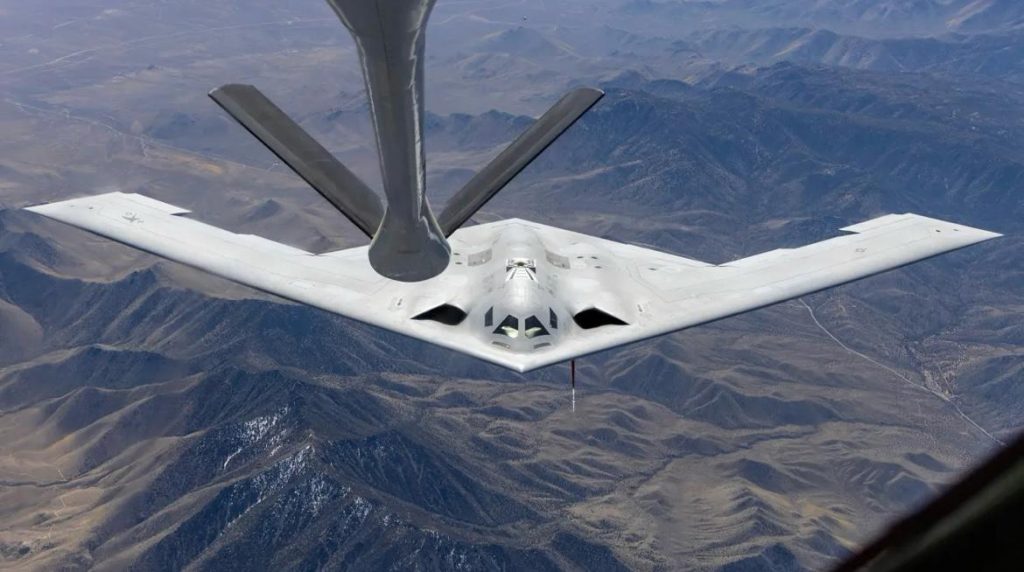
There are moments in military history when a single photograph quietly redraws the boundaries of technological imagination.
Not because it reveals a new weapon.
Not because it exposes a classified capability.
But because it allows the world to glimpse, perhaps for the very first time, the extraordinary depth of thought concealed beneath decades of secrecy.
High above the Mojave Desert, almost unnoticed against the vastness of the American Southwest, one such moment unfolded. During aerial refuelling trials, observers captured views of the United States Air Force’s newest strategic bomber unlike any seen before. What had previously existed largely as carefully managed publicity images and fleeting ceremonial appearances suddenly emerged from unfamiliar angles, revealing subtle contours, hidden geometries and engineering decisions that collectively hinted at something far more profound than another stealth aircraft.
Every curve appeared intentional.
Every edge appeared calculated.
Every shadow seemed to exist for a reason.
To the casual observer, it remained simply another flying wing. To aerospace engineers, physicists and military planners, however, these images represented something altogether different: a rare opportunity to study what may become the most survivable combat aircraft ever placed into operational service.
For over half a century, the philosophy of stealth has been surrounded by an almost mythical aura. Aircraft such as the Lockheed F-117 Nighthawk fundamentally altered humanity’s understanding of aerial warfare by demonstrating that invisibility, once regarded as science fiction, could become a measurable engineering discipline. The Northrop B-2 Spirit expanded that philosophy across continents, allowing strategic strike missions that would once have required entire formations of bombers, escorts, electronic warfare aircraft and suppression packages to be executed by a handful of aircraft crossing oceans almost alone.
Yet the B-21 Raider does not appear content merely to inherit that legacy.
Everything about its visible design suggests refinement rather than revolution, optimisation rather than spectacle, maturity rather than experimentation.
That distinction is enormously significant.
Throughout aviation history, technological revolutions often announce themselves loudly. Swept wings, afterburners, supersonic flight, fly-by-wire controls and stealth shaping each arrived as unmistakable departures from previous generations.
The B-21 seems to pursue an entirely different philosophy.
It is revolutionary precisely because it appears so restrained.
Its brilliance lies not in dramatic visual novelty but in the relentless elimination of compromise.
Stealth is frequently misunderstood as a single technology. Popular imagination reduces it to exotic black coatings or futuristic shapes.
Reality is infinitely more sophisticated.
Every aircraft constantly broadcasts countless signatures into its environment.
Radar energy reflects from every exposed surface.
Heat radiates from engines, exhaust systems, hydraulic components and electronics.
Sound propagates through turbulent airflow.
Electromagnetic emissions leak from communications, navigation and mission systems.
Even sunlight reflecting from particular contours contributes, however subtly, to visual acquisition.
Modern survivability therefore becomes an exercise not in invisibility but in signature management.
The objective is not to disappear.
The objective is to become so difficult to detect, identify, track and target that an adversary’s decision-making collapses beneath uncertainty.
The B-21 appears engineered around precisely that philosophy.
Its planform immediately commands attention.
Like its celebrated predecessor, the Raider adopts the timeless aerodynamic efficiency of the flying wing—a configuration that fascinated pioneers such as the Northrop brothers decades before radar stealth entered serious scientific discussion. Without a conventional fuselage protruding from distinct wings, airflow remains remarkably smooth while lift is generated across almost the entire aircraft.
This arrangement offers remarkable aerodynamic efficiency.
Fuel consumption decreases.
Drag diminishes.
Range expands.
Equally importantly, countless vertical surfaces that normally scatter radar energy simply cease to exist.
Yet photographs alone reveal something even more interesting.
Compared with earlier flying-wing bombers, the Raider appears visibly cleaner.
The transitions between surfaces are softer.
Interruptions appear fewer.
Edges exhibit extraordinary continuity.
Nothing protrudes unnecessarily.
Nothing seems decorative.
Everything serves multiple purposes simultaneously.
One contour influences airflow, radar reflection and structural efficiency together.
One panel line may simplify maintenance while simultaneously reducing observable signatures.
One subtle change in curvature may redirect electromagnetic energy away from hostile receivers while improving manufacturing tolerances.
This is engineering approaching sculpture.
Indeed, perhaps the most remarkable characteristic of the Raider is not what observers can identify.
It is what they cannot.
Entire generations of combat aircraft advertised their complexity through visible antennas, sensors, vents, access panels and external equipment.
The B-21 instead communicates confidence through absence.
Its designers appear to have embraced an almost architectural philosophy of reduction.
Every unnecessary feature removed.
Every discontinuity questioned.
Every square centimetre scrutinised.
This minimalist approach mirrors a broader transformation occurring throughout advanced aerospace engineering.
As computational modelling has become exponentially more powerful, engineers increasingly optimise complete systems rather than isolated components. Instead of designing an air intake before adapting surrounding structures around it, entire aircraft can now be digitally refined as unified aerodynamic organisms.
Computational fluid dynamics models analyse billions of airflow interactions.
Electromagnetic simulation predicts radar behaviour from virtually every conceivable aspect angle.
Thermal models estimate infrared emissions under changing atmospheric conditions.
Structural simulations examine fatigue decades before physical components are manufactured.
Manufacturing tolerances themselves become digitally integrated into design philosophy.
The resulting aircraft emerges less as an assembly of parts than as a carefully balanced ecosystem.
Few defence programmes have embraced this digital revolution more comprehensively than the Raider.
Long before aluminium, titanium or composite materials were cut into physical structures, vast portions of the aircraft existed inside extraordinarily sophisticated virtual environments where engineers could refine geometry, production methods, maintenance accessibility and mission systems simultaneously.
This shift represents one of the least visible yet most transformative developments in aerospace history.
Historically, prototype aircraft often revealed unforeseen problems only after expensive manufacturing had begun. Digital engineering dramatically compresses this cycle.
Potential aerodynamic penalties emerge earlier.
Manufacturing conflicts become visible before tools are produced.
Software integration begins years sooner.
Maintenance procedures evolve alongside hardware rather than following behind it.
The result is not merely faster development.
It is better engineering.
Viewed through this lens, the Raider becomes more than a bomber.
It becomes evidence that aircraft themselves are beginning to evolve differently.
The visible aeroplane increasingly represents only the final physical expression of an immense digital design process.
Perhaps nowhere is this philosophy more evident than around the aircraft’s engine integration.
Although official details remain deliberately limited, every available perspective suggests extraordinary attention has been devoted to controlling both airflow and thermal emissions. Unlike conventional combat aircraft that proudly expose powerful engines through dramatic intakes and brilliant afterburning exhausts, the Raider appears almost reluctant to acknowledge propulsion at all.
Its air inlets blend gracefully into the upper surfaces.
Its exhaust architecture appears carefully buried within the airframe.
Heat, one of the greatest enemies of modern survivability, is evidently managed with exceptional care.
This matters because modern integrated air-defence systems increasingly combine radar with sophisticated infrared search-and-track sensors capable of detecting aircraft through thermal contrast rather than reflected radio waves alone.
The contest has therefore expanded.
Avoiding radar is no longer sufficient.
Future survivability increasingly demands reducing every observable signature simultaneously.
This is where the Raider begins to separate itself not only from legacy bombers but arguably from almost every combat aircraft currently flying.
Its design appears conceived from the outset as a holistic exercise in multi-spectrum survivability rather than as a conventional aircraft subsequently adapted for stealth.
That distinction may ultimately define its place in aviation history.
For the world’s air forces, stealth once represented a remarkable capability.
For the Raider, stealth appears simply to be the starting point.
The Geometry of Survival
If one were asked to identify the single greatest technological revolution in military aviation since the invention of the jet engine, many would instinctively point towards stealth.
Yet that answer, while understandable, is incomplete.
The true revolution was not stealth itself.
It was the realisation that warfare had entered an age in which information became more valuable than firepower.
For centuries, military strength could largely be measured in visible terms. Larger armies, thicker armour, heavier artillery and faster aircraft generally translated into greater battlefield advantage. Victory belonged to those who could generate more destructive force than their opponent could withstand.
The twenty-first century has fundamentally altered that equation.
Today, an aircraft does not survive because it is physically stronger than the missile pursuing it. It survives because the missile never receives sufficient information to complete the engagement in the first place.
The B-21 Raider has been conceived for precisely this world.
Its mission begins long before it approaches hostile airspace.
Indeed, the contest starts the instant an adversary’s sensors begin searching the horizon. Every radar array, passive electronic receiver, infrared telescope and satellite contributes to an immense network designed not merely to detect aircraft, but to assemble thousands of fragmented observations into a coherent picture of the battlespace.
Modern air defence is no longer a collection of isolated missile batteries.
It is an ecosystem.
Ground-based radars exchange tracks with airborne early warning aircraft. Space-based sensors provide strategic cueing. Passive receivers listen silently for electronic emissions. High-performance computers correlate observations arriving from hundreds of kilometres apart, filtering out atmospheric clutter while identifying even subtle anomalies.
Against such a system, invisibility in the traditional sense is impossible.
The challenge is instead to deprive the network of confidence.
Imagine attempting to identify a single ripple upon an ocean during a storm.
One moment it appears significant.
The next, it merges seamlessly into thousands of others.
That uncertainty is the environment in which the Raider appears designed to operate.
Its shape reflects a discipline that extends far beyond aesthetics.
To an engineer specialising in electromagnetic scattering, every edge possesses consequence.
When radar energy encounters an aircraft, it behaves according to immutable physical laws. Some of that energy is reflected directly back toward the transmitting antenna, some is scattered into the surrounding atmosphere, and some is absorbed by carefully engineered materials before it can escape again.
The objective is not to eliminate reflection—a physical impossibility—but to dictate where that reflected energy travels.
This explains why the Raider’s external geometry appears so deliberate.
The continuity of its leading edges, the carefully blended transitions between surfaces and the absence of abrupt interruptions are all consistent with a philosophy of controlling electromagnetic behaviour rather than simply reducing it. A seemingly insignificant adjustment measured in millimetres can redirect reflected energy by many degrees, causing it to miss a distant radar receiver entirely.
To the casual observer, two aircraft may appear almost identical.
To a radar operating hundreds of kilometres away, they may be profoundly different.
Equally revealing is what remains hidden.
Engine compressor faces are among the most radar-reflective components found within any jet aircraft. Designers therefore devote extraordinary effort to preventing hostile radar energy from travelling directly down the intake and illuminating these highly reflective rotating assemblies.
Although many aspects of the Raider remain classified, its inlet integration suggests meticulous attention to shielding sensitive internal structures while preserving efficient airflow across a wide flight envelope. Achieving both simultaneously represents one of aerospace engineering’s most demanding compromises. Airflow must remain smooth enough to feed engines efficiently while the geometry simultaneously contributes to reducing observable signatures.
There are no perfect solutions.
Only increasingly elegant compromises.
The same philosophy extends to thermal management.
For decades, combat aircraft designers concentrated primarily upon defeating radar.
Today, infrared detection has matured dramatically.
Advanced infrared search-and-track systems no longer rely solely upon bright exhaust plumes. Instead, they analyse subtle temperature differences across entire aircraft, detecting aerodynamic heating, warm structural components and thermal disturbances generated as air flows across surfaces travelling at high altitude.
Consequently, reducing heat becomes as important as reducing reflected radio energy.
Every degree matters.
The Raider’s upper-surface exhaust integration strongly suggests that thermal management has been treated not as an afterthought but as a foundational design principle. By encouraging exhaust gases to mix efficiently with cooler surrounding airflow before becoming visible from below, engineers may reduce the thermal contrast presented to hostile sensors. Combined with careful shielding of hot internal components and sophisticated materials capable of tolerating extreme operating temperatures, such measures complicate the task of infrared detection.
Again, no aircraft becomes invisible.
It simply becomes far more difficult to recognise against the natural complexity of the atmosphere.
Yet perhaps the Raider’s greatest innovation is philosophical rather than technological.
Previous generations of stealth aircraft were often designed to penetrate a specific threat environment.
The B-21 appears intended to remain relevant within threat environments that do not yet fully exist.
That distinction transforms the entire engineering process.
Military aircraft have traditionally been optimised against known adversaries. Designers studied existing radars, missile systems and fighter aircraft before seeking tactical advantages over those capabilities.
The Raider instead reflects an acceptance that future adversaries will continuously evolve. New frequencies will emerge. Processing power will increase. Artificial intelligence will accelerate sensor fusion. Quantum technologies may eventually reshape aspects of detection that today remain experimental.
The aircraft therefore cannot merely defeat today’s systems.
It must retain the flexibility to confront tomorrow’s.
This explains the growing emphasis placed upon open digital architecture throughout modern military aviation. Hardware alone no longer defines capability. Software updates increasingly determine how sensors communicate, how mission systems process information and how electronic warfare techniques evolve throughout decades of service.
Rather than becoming obsolete because computers advance faster than airframes, the Raider is intended to evolve continuously throughout its operational life.
In many respects, this resembles the transformation witnessed within the commercial technology sector.
Modern smartphones improve long after leaving the factory through software alone.
Increasingly, strategic aircraft may do the same.
The implications extend well beyond maintenance convenience.
An aircraft capable of accepting rapid technological evolution possesses strategic longevity measured not merely in years but in generations.
That longevity is essential because bombers occupy a unique position within military planning.
Unlike tactical fighters, which often respond to immediate operational demands, strategic bombers serve as instruments of national policy. Their value lies as much in deterrence as in combat. They reassure allies, influence diplomatic calculations and compel potential adversaries to devote immense resources toward countering capabilities that may never actually be employed.
The most successful bomber, therefore, may be the one that never releases a weapon.
Its existence alone reshapes strategic behaviour.
That reality helps explain the extraordinary patience surrounding the Raider’s development.
Every visible line, every concealed component and every carefully managed public appearance communicates confidence rather than urgency.
In an age saturated with spectacle, the B-21 speaks through restraint.
Its message is unmistakable.
The aircraft’s greatest strength may not be that it can penetrate the world’s most sophisticated air-defence networks.
It may be that no potential adversary can ever be entirely certain where, when or how it might appear.
Distance, Deterrence and the Return of Strategic Reach
There is an old observation among military planners that geography has never truly disappeared.
For a brief period following the end of the Cold War, rapid technological advances encouraged the belief that precision-guided weapons, global communications and overwhelming air superiority had somehow diminished the tyranny of distance. Aircraft could strike within hours. Satellites observed every continent. Information travelled almost instantaneously across the planet.
Yet the Earth itself never became smaller.
An ocean remains an ocean.
The Pacific, stretching across nearly one-third of the globe, remains one of the greatest strategic obstacles ever confronted by military planners. Vast expanses of water separate airfields, supply depots, logistics hubs and allies by thousands of kilometres. Every additional mile flown consumes fuel, reduces payload flexibility, increases maintenance demands and complicates operational planning.
The B-21 Raider has emerged in an era where distance once again dominates strategic thinking.
Unlike many combat aircraft whose effectiveness depends upon nearby bases or extensive support infrastructure, the Raider appears conceived around a different philosophy: to project meaningful combat power across intercontinental distances while imposing as few logistical burdens as possible.
That distinction is profound.
Modern warfare is often portrayed through dramatic images of missiles, fighters and drones, yet logistics remains the quiet foundation beneath every military success. Ammunition must arrive. Spare parts must be transported. Fuel must be available in extraordinary quantities. Crews require maintenance facilities, secure communications and resilient supply chains.
The aircraft that demands less of this enormous supporting ecosystem acquires an advantage extending far beyond its own performance.
Range therefore becomes far more than a number listed in technical specifications.
It becomes strategic freedom.
An aircraft capable of operating from a broader network of airfields complicates every aspect of an adversary’s planning. Potential launch locations multiply. Flight paths become less predictable. Defensive resources must be dispersed over greater areas. Every additional uncertainty imposed upon an opponent carries genuine military value.
The Raider’s flying-wing configuration contributes significantly to this freedom.
Flying wings have long fascinated aerodynamicists because they minimise one of aviation’s greatest enemies: drag. Traditional aircraft generate lift primarily through their wings while their fuselage contributes comparatively little to sustaining flight. The flying wing distributes lift across almost its entire structure, allowing a greater proportion of the aircraft’s mass to participate in remaining airborne.
The result is remarkable aerodynamic efficiency.
Less drag requires less thrust.
Less thrust demands less fuel.
Lower fuel consumption permits either greater endurance or increased payload.
Each improvement reinforces the next.
Such efficiencies become particularly significant during missions lasting many hours, or even more than a day when aerial refuelling is incorporated. Long before weapons are released, endurance itself becomes a strategic capability.
Photographs of the Raider conducting aerial refuelling have therefore attracted considerable interest among aviation specialists.
To many observers, a tanker rendezvous appears routine—a carefully choreographed exchange of fuel high above the clouds.
In reality, it represents one of the most technically demanding manoeuvres in military aviation.
Two aircraft, often weighing hundreds of tonnes, must fly in exceptionally close proximity while travelling at high speed through constantly changing atmospheric conditions. Tiny corrections measured in centimetres determine success or failure. Air disturbed by one aircraft influences the other. Crews rely upon extraordinary discipline, training and precision.
For a strategic bomber, aerial refuelling is far more than a convenience.
It transforms global reach.
Aircraft no longer become constrained solely by internal fuel capacity. Missions can be adapted dynamically as intelligence evolves, allowing commanders greater flexibility in responding to rapidly changing circumstances. A bomber may launch before its final destination is even confirmed, receiving updated tasking while already airborne.
The aircraft becomes not merely a platform, but a persistent strategic presence.
Yet this capability also highlights one of modern air power’s enduring vulnerabilities.
Tankers themselves are invaluable assets.
They are large, relatively slow and indispensable to sustained long-range operations. Consequently, modern strategic planning increasingly seeks to reduce dependence upon vulnerable support aircraft wherever possible. Every additional kilometre the Raider can fly efficiently under its own power reduces operational complexity and expands commanders’ options.
Efficiency, therefore, is not merely economical.
It is survivability.
This emphasis upon intelligent design extends into the aircraft’s production philosophy.
Throughout much of aviation history, technological sophistication frequently came at the expense of manufacturability. Extraordinary prototypes dazzled observers but demanded immense resources to build, maintain and upgrade. Their brilliance often proved difficult to replicate in meaningful numbers.
The Raider appears designed to challenge that historical pattern.
Digital engineering, advanced manufacturing techniques and modular systems integration have all been employed with an objective extending beyond performance alone. They seek repeatability.
Repeatability is an underrated strategic virtue.
History repeatedly demonstrates that exceptional weapons exert their greatest influence when they can be fielded in sufficient numbers, maintained efficiently and upgraded without fundamentally redesigning the entire platform.
The most elegant engineering solution possesses limited strategic value if only a handful can ever be produced.
Quantity should never be confused with mediocrity.
Rather, quantity magnifies excellence.
A highly survivable aircraft produced at meaningful scale compels entirely different calculations from potential adversaries. Defensive networks cannot simply prepare for isolated penetrations. They must account for sustained operational capability across multiple theatres simultaneously.
In this sense, industrial capacity becomes inseparable from deterrence.
The twentieth century offered countless examples.
Factories became strategic assets.
Production lines became instruments of national power.
Engineering discipline proved every bit as decisive as battlefield courage.
The twenty-first century has not altered that lesson; it has merely refined it.
Digital manufacturing now allows complex aerospace components to be modelled, tested, refined and produced with levels of consistency unimaginable only a generation ago. Engineers can anticipate maintenance requirements before aircraft enter operational service. Components can evolve incrementally rather than awaiting wholesale redesigns. Software updates increasingly complement physical improvements, allowing capability to mature throughout decades of operation.
The Raider is therefore best understood not as a finished machine, but as a continuously developing system.
This may ultimately prove to be one of its greatest strengths.
Military aircraft traditionally experienced distinct generational leaps. New designs replaced old ones after technological progress rendered earlier platforms obsolete.
The Raider represents a subtler evolution.
Its architecture appears deliberately intended to accommodate future technologies that have not yet fully matured.
Sensors will improve.
Computing power will increase.
Artificial intelligence will assume greater responsibility for analysing vast streams of information arriving from satellites, aircraft, ships, ground forces and autonomous systems.
Electronic warfare techniques will evolve continuously.
The aircraft must evolve with them.
Such adaptability reflects a broader transformation in strategic thought.
Victory no longer belongs solely to the nation possessing superior hardware.
Increasingly, it belongs to the nation capable of learning faster.
The Raider embodies this philosophy with unusual clarity.
It is not simply designed to survive today’s air-defence networks.
It is designed to remain relevant as those networks themselves undergo relentless transformation.
Perhaps this explains why the aircraft inspires such fascination despite the extraordinary secrecy surrounding many aspects of its design.
Its significance extends beyond aviation.
The Raider symbolises a shift in how advanced societies approach engineering itself.
Rather than seeking spectacular leaps followed by decades of stagnation, modern innovation increasingly favours resilient foundations capable of continual refinement.
In architecture, such buildings endure because they accommodate changing generations.
In software, successful platforms thrive because they accept continual updates.
In aerospace, the same principle may define the most consequential military aircraft of the coming half-century.
The B-21 is not simply a bomber built for the future.
It is a bomber built to remain in the future, long after today’s future has become history.
The Aircraft That Seeks to Prevent War
Every great military aircraft eventually acquires two histories.
The first is written in aluminium, titanium, composite materials and engineering drawings. It is the history of lift coefficients, propulsion systems, radar signatures and production schedules—a story told through laboratories, wind tunnels and assembly halls.
The second is written in human behaviour.
It unfolds inside cabinet rooms, intelligence briefings, diplomatic negotiations and the quiet calculations of political leaders who must decide whether conflict appears winnable or catastrophically uncertain.
Ultimately, it is this second history that determines whether an aircraft truly changes the world.
The B-21 Raider has been conceived at a moment unlike any faced by strategic aviation since the early decades of the Cold War. The international order is becoming increasingly multipolar. Long-range precision weapons continue to proliferate. Artificial intelligence is accelerating military decision-making. Space has become an operational domain. Cyber operations now accompany almost every serious geopolitical confrontation, while integrated air-defence systems have grown into vast, networked architectures capable of sharing information across continents in seconds.
In such an environment, simply possessing a powerful bomber is no longer enough.
A strategic aircraft must achieve something far more demanding.
It must remain credible.
Credibility is among the least understood concepts in military affairs.
It cannot be manufactured through rhetoric alone, nor purchased simply by investing billions of dollars. Credibility emerges when capability, reliability, survivability and political resolve converge into something that potential adversaries accept as real.
The essence of deterrence has never been convincing an opponent that war can be won easily.
It has been convincing them that victory may prove impossible.
This subtle distinction lies at the heart of strategic stability.
The greatest triumph of many military systems is not measured by the number of targets destroyed but by the number of conflicts that never begin.
Throughout history, the most consequential technological innovations have often reshaped events precisely because they forced rivals to reconsider their assumptions. The appearance of the dreadnought battleship transformed naval competition. Long-range ballistic missiles altered strategic calculations across the globe. Precision-guided munitions fundamentally changed expectations regarding conventional warfare.
The Raider appears destined to occupy a similar place within the history of air power.
Not because it is the fastest bomber ever constructed.
Not because it carries the largest payload.
Not because it possesses the most dramatic appearance.
Its importance stems from something more enduring.
It represents the maturation of an entire philosophy of warfare.
That philosophy recognises that information has become the decisive terrain upon which modern conflict is fought.
The aircraft’s extraordinary shaping, careful thermal management, digital architecture and operational flexibility all serve a single strategic purpose: to preserve uncertainty within the mind of an opponent.
Uncertainty has always been one of warfare’s most powerful forces.
Generals throughout history have sought to conceal intentions, disguise movements and misdirect enemies. Ancient commanders employed deception through false camps, hidden reserves and carefully orchestrated manoeuvres. Naval fleets vanished beyond horizons before suddenly reappearing hundreds of kilometres away. During the Second World War, elaborate deception campaigns convinced entire armies that invasions would occur in places where no landings were ever intended.
The technologies have evolved.
The principle has not.
The Raider is, in many respects, a twenty-first-century instrument of strategic ambiguity.
Its value lies not merely in what it can accomplish, but in what others cannot confidently know about it.
Where is it?
How many are airborne?
Which route are they taking?
What capabilities have been incorporated since the last publicly acknowledged software update?
Which sensors remain passive?
Which systems have already identified hostile emitters?
Every unanswered question imposes cognitive pressure upon an adversary.
Every doubt complicates planning.
Every uncertainty increases the cost of aggression.
Yet perhaps the Raider’s most remarkable characteristic is that it appears to have been designed not simply for a single generation of military competition, but for an era in which technological change itself has become continuous.
Previous strategic bombers largely reflected the threats of their own time.
The B-52 Stratofortress emerged during the dawn of the nuclear age and has endured through extraordinary adaptation. The B-1B Lancer reflected a period in which speed and low-level penetration dominated strategic thinking. The B-2 Spirit embodied the first mature expression of very-low-observable technology.
The Raider synthesises lessons from each while embracing an entirely different assumption.
It assumes that adaptation will never stop.
Software will continue evolving.
Mission systems will continue improving.
Artificial intelligence will increasingly assist crews by processing vast quantities of sensor information in real time, identifying patterns beyond unaided human perception and reducing the cognitive burden imposed by increasingly complex battlespaces. Autonomous collaborative aircraft may one day extend the reach of crewed bombers, carrying additional sensors, electronic warfare payloads or precision weapons while remaining under human command. Space-based sensing networks will almost certainly become denser, faster and more resilient.
Rather than resisting this future, the Raider appears deliberately structured to participate within it.
It becomes less an isolated aircraft than one highly capable node inside a far larger strategic ecosystem.
This may ultimately prove to be the defining characteristic of sixth-generation military thinking.
Individual platforms matter profoundly.
Networks matter even more.
The future of air power is unlikely to be determined by a single aircraft operating independently. Instead, success will emerge from the seamless integration of crewed platforms, autonomous systems, resilient communications, cyber capabilities, space assets and artificial intelligence into coherent operational architectures capable of adapting faster than any opponent.
The Raider seems purpose-built for that world.
And yet, despite all its sophistication, one should be careful not to mistake complexity for inevitability.
Technology alone has never guaranteed wise political judgement.
History repeatedly reminds us that remarkable inventions can either preserve peace or magnify catastrophe depending upon the wisdom with which nations employ them. Engineering provides possibilities.
Statesmanship determines outcomes.
Perhaps this is why the most enduring image of the Raider is not one of violence.
It is one of quiet confidence.
There is an elegance to its restraint that feels almost architectural. It does not seek attention through flamboyant lines or theatrical displays of power. Instead, it embodies an engineering culture that understands maturity: reducing unnecessary complexity, refining every visible surface, eliminating compromise wherever physics allows and accepting that genuine excellence rarely requires spectacle.
From a distance, it is almost serene.
Yet beneath that calm exterior lies one of the most sophisticated integrations of aerodynamics, materials science, digital engineering, systems architecture, manufacturing discipline and strategic thought ever assembled into a single military aircraft.
Future historians may eventually conclude that the Raider’s greatest achievement was not introducing a revolutionary technology. Rather, it was demonstrating what becomes possible when thousands of incremental improvements—each individually subtle, collectively transformative—are pursued with extraordinary patience over decades.
That lesson extends far beyond aerospace.
It applies equally to science, medicine, architecture, computing and civilisation itself.
The future is seldom transformed by a single breakthrough.
More often, it is shaped by countless acts of disciplined refinement, each building quietly upon the last until the cumulative result appears almost inevitable.
The B-21 Raider is the physical embodiment of that principle.
It is not merely an aeroplane.
It is a declaration that in an age defined by information, complexity and accelerating technological change, the highest expression of military engineering may no longer be overwhelming force.
It may instead be the disciplined pursuit of knowledge, precision and restraint.
Long after individual specifications have been superseded, long after new sensors have emerged and successive software generations have rewritten the aircraft’s internal capabilities, that philosophy is likely to endure.
For the Raider ultimately represents something larger than strategic bombing.
It represents humanity’s continuing attempt to solve extraordinarily complex problems through science, mathematics, imagination and disciplined collaboration.
Whether viewed as a masterpiece of aerospace engineering, an instrument of national deterrence or a milestone in the evolution of military thought, one conclusion appears increasingly difficult to escape.
The B-21 Raider is not simply designed to fly through the twenty-first century.
It has been engineered to shape it.
You May also like

By Samantha Stafford

By Anne Canal