
THE ARRIVAL THAT SILENCED
By Sam Stafford
Publication Date 20th December 2025
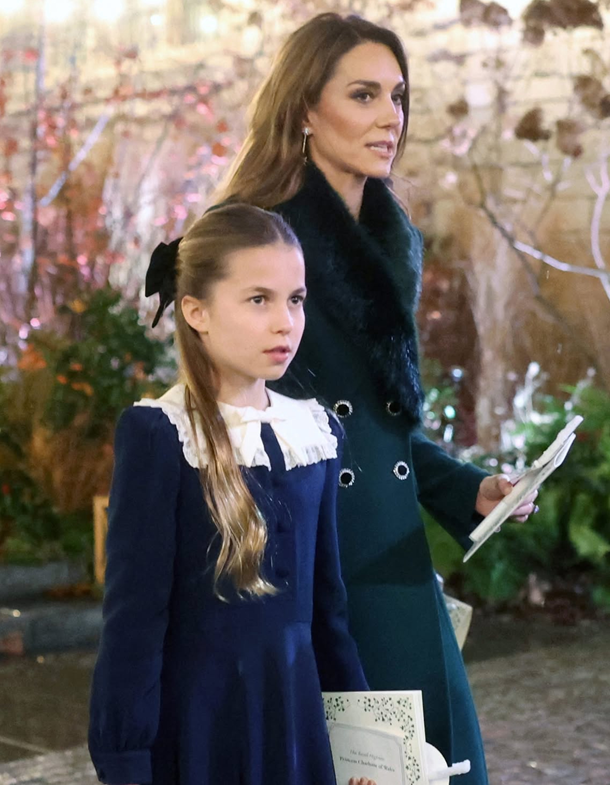
Catherine, Princess of Wales, Princess Charlotte, and the Art of Royal Presence at Westminster Abbey
There are entrances that are merely logistical.
Then there are entrances that become cultural memory.
This year, as Catherine, Princess of Wales, stepped out into the crisp December air of Westminster Abbey alongside her daughter, Princess Charlotte, Britain witnessed the latter — a tableau of grace, lineage, and quiet emotional power that transformed a simple festive arrival into one of the defining royal images of the age.
Cameras clicked, choristers inhaled, admirers held their breath.
Because two figures emerged not as symbols alone, but as living embodiments of continuity:
a future queen consort and a future woman of influence — arriving not in ceremony, but in spirit.
A Mother and Daughter, Moving as One
Catherine has long mastered the lexicon of symbolic dressing, but on this night she elevated it to visual poetry:
- The deep, winter-red coat — cardinal, festive, resolute.
- The deliberate simplicity of her silhouette — elegance without ostentation.
- The wool textures that nodded to British craft.
- The subtle gold accents that caught the candlelight like passing stars.
Princess Charlotte, walking beside her, mirrored her mother with that rare composure that astonishes even seasoned royal-watchers.
There was no mimicry.
Only resonance.
It was the portrait of a young girl learning, absorbing, and — without yet knowing it — rehearsing her own lifelong choreography with public life.
There is a moment when a child begins to step into the mythology of a nation.
This was Charlotte’s.
Catherine as the Anchor of Modern Royal Femininity
The Princess of Wales carries a role that is both historic and contemporary, ceremonial yet personal — and yet she never appears crushed beneath it.
Instead, she seems to grow taller in public, as though duty itself were oxygen.
This evening at Westminster Abbey revealed again why she has become one of the most admired public figures of the 21st century:
- her calmness in crowds,
- her warmth without performative excess,
- her gentle but unmistakable authority.
She does not dominate a scene; she completes it.
Royal watchers often speak of Catherine’s “radiance,” but what they truly mean is her rare equilibrium — the quality of someone who understands both the weight of tradition and the psychology of the society observing her.
And this night, walking beneath the gothic arches while holding Charlotte in her periphery with instinctive maternal awareness, Catherine embodied that equilibrium flawlessly.
Princess Charlotte: A Future Force in Formation
There is something uniquely compelling about Charlotte.
Not simply as the daughter of a future king, nor merely as a princess, but as a child who displays a highly developed sense of presence.
She does not shrink.
She does not fidget.
She does not look lost.
Rather, she moves with a kind of unforced seriousness, as though some inner compass is already pointing toward the role she will one day play in British public life.
Her smile is not the shy smile of a child coerced into formality, but the bright, contained smile of someone who understands — and enjoys — the rhythm of the moment.
Observers noted:
- her confident little stride,
- the way she looked up at the Abbey’s façade,
- the tiny, barely perceptible moment when she instinctively matched her mother’s pace.
These are the micro-moments that shape a nation’s expectations.
Charlotte may not inherit a throne, but she will inherit influence — and the Abbey arrival hinted at just how effortlessly she will wear it.
Westminster Abbey: The Cathedral That Remembers Everything
No building in the United Kingdom holds and radiates history like Westminster Abbey.
It is a vessel of coronations, weddings, farewells, and reconciliations — a cathedral whose stones have absorbed the breath of monarchy for a thousand years.
To walk into it is to walk into a living archive.
But to walk into it at Christmas, for a concert dedicated to family, compassion, and communal spirit, is to participate in a national ritual of emotional recalibration.
As Catherine and Charlotte stepped forward, the Abbey’s candles shimmered on the wet pavement, turning the entrance into a cinematic threshold:
the warmth of an ancient sanctuary meeting the cold of a modern London night.
The scene captured something Britain often yearns for — continuity without stagnation, tradition without rigidity, symbolism without stiffness.
The Magic of the Carol Service: Sound, Light, and Emotional Literacy
Inside, the Carol Service — an initiative Catherine herself has championed — was not merely an event but an act of cultural stewardship.
It brought:
- children and families,
- volunteers and nurses,
- teachers and first responders,
- musicians, choristers, and community leaders.
This is Catherine’s quiet genius:
she never uses a platform to elevate herself; she uses it to elevate others.
The concert celebrated kindness, connection, and the invisible labour of countless Britons — themes perfectly aligned with Catherine’s long-standing advocacy for mental health and early childhood development.
Charlotte, experiencing this as both participant and heir to its emotional vocabulary, absorbed something essential:
the fact that royalty is not grandeur alone, but service wrapped in ceremony.
The Cultural Resonance of Their Arrival
Why did this particular entrance capture so much attention?
Why did it stir something deep even in those who are not royalists?
Because it told a multi-layered story in a single moment:
- A mother leading her daughter into the heart of British tradition.
- A future queen consort demonstrating stability in a fragile era.
- A young princess stepping into her public identity not with anxiety, but with delight.
In a time of political churn and cultural volatility, this arrival offered something rare:
a reminder that some symbols still work, some rituals still matter, and some human connections still transcend the noise.
A Final Reflection: The Poetry of Two Generations Walking Together
In Catherine and Charlotte, the nation sees two timelines converging:
- The present, embodied by a woman whose grace under pressure has made her the emotional axis of the modern monarchy.
- The future, embodied by a child whose confidence and acuity already hint at a formidable adulthood.
Their arrival at Westminster Abbey was more than an image.
It was a message.
That elegance need not shout.
That resilience can be gentle.
That the monarchy, when expressed through humanity rather than hierarchy, still possesses astonishing emotional power.
A mother and daughter, hand in hand, stepping into candlelight.
A kingdom watching.
A tradition renewed.