Skypark Business Center South, Luxembourg
By Rojina Bohora
Publication date: 29 June 2023, 09:00 GMT
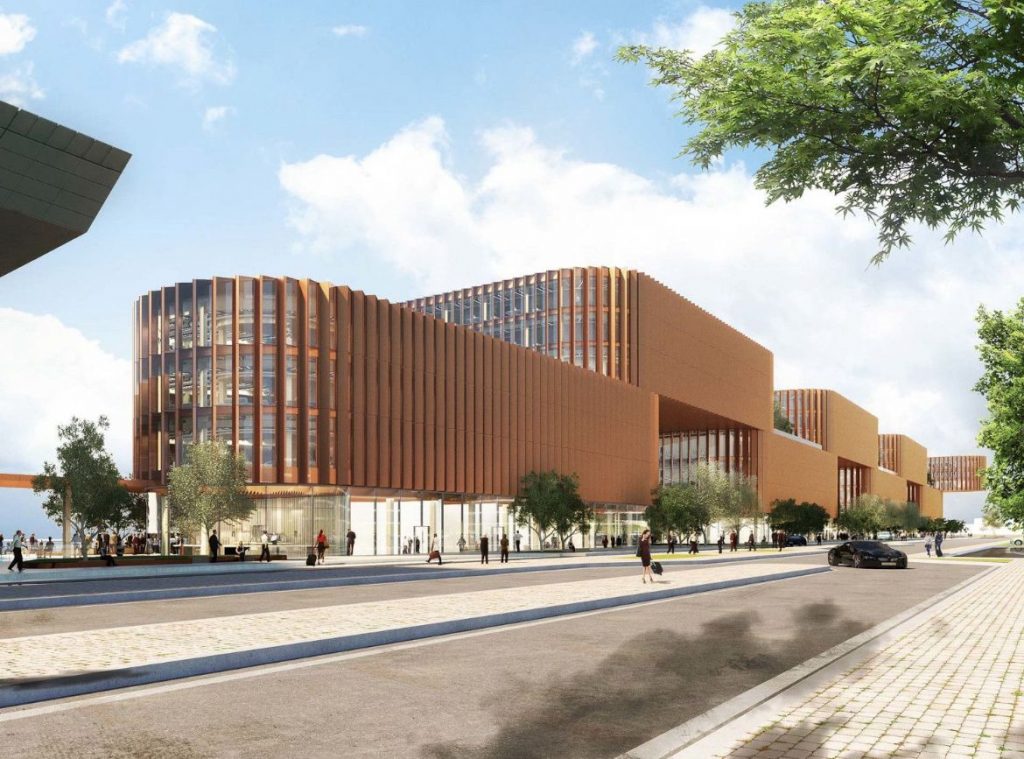
(Image credit: Skypark Business Center South, Luxembourg — Architecture by Bjarke Ingels Group (BIG). Photograph via Wikimedia Commons, licensed under Creative Commons Attribution–ShareAlike 4.0 [CC BY-SA 4.0]).
When the Office Learned to Breathe: Timber, Copper, and the Rebalancing of Work
I.The Office After the Reckoning
By the early 2020s, the office building had become a contested typology.
Remote work challenged its necessity, climate accounting questioned its material excess, and workers increasingly rejected sealed interiors that prioritised efficiency over wellbeing. The office was no longer assumed; it had to be argued for.
Skypark Business Center South enters this debate with unusual composure.
Completed adjacent to Luxembourg Airport in 2023, the building does not attempt to resurrect the office through spectacle or nostalgia. Instead, it proposes a quieter recalibration: work as inhabitable landscape, not sealed machine.
II.Timber as Structural Statement
The building’s most consequential decision is material.
Skypark Business Center South employs a hybrid timber structure — not as interior flourish, but as primary system. Exposed wood defines ceilings, columns, and structural rhythm, introducing warmth and tactility where offices have traditionally privileged neutrality.
This choice is not cosmetic.
It materially reduces embodied carbon and signals a departure from steel-and-concrete default logic.
Timber here is not trend.
It is position.
III. Copper That Ages, Not Shines
Wrapping the building is a copper-toned façade — often mistaken for extravagance, but in fact a study in restraint.
Copper does not maintain a fixed appearance. It oxidises, darkens, and patinates. It records time.
In choosing a material that visibly ages, the architecture rejects the office tower’s obsession with perpetual newness. The building is designed to change — to register use, weather, and years rather than deny them.
This is an office that expects to grow old.
IV.The Terraced Section: Work Meets Topography
Rather than stacking floors into anonymous repetition, Skypark Business Center South steps its massing, creating terraces that cascade like an alpine slope.
These terraces are not token balconies. They are substantial, planted, and directly connected to interior workspaces. Employees step outside without leaving the building — not into spectacle, but into continuity.
Work here does not retreat from nature.
It coexists with it.
V.The Office as Environmental Mediator
Environmental performance is not isolated to systems; it is embedded in form.
Stepped terraces reduce solar gain. Timber moderates acoustics. Daylight penetrates deeply, reducing reliance on artificial lighting. Operable elements reintroduce human agency into comfort.
The building does not promise perfect consistency.
It promises adaptability.
This matters in an era when comfort is increasingly understood as psychological as well as thermal.
VI.Against the Glass Box Legacy
For decades, the glass box symbolised transparency, progress, and corporate power. It also delivered glare, overheating, and detachment.
Skypark Business Center South rejects this inheritance without theatrical opposition. Its envelope is textured, its openings measured, its presence calm.
Transparency here is social rather than literal — achieved through spatial openness and shared amenity, not through total exposure.
VII. Workspaces That Encourage Presence
Inside, the building avoids the binary of open-plan versus cellular offices.
Spaces vary in scale and acoustic character. Movement between them is legible. Informal gathering areas are treated as primary, not residual.
The architecture does not force collaboration.
It makes it comfortable.
In doing so, it acknowledges that meaningful work depends on choice rather than prescription.
VIII. Sustainability Without Moral Theatre
The building performs well environmentally — but it does not advertise its virtue.
There are no exaggerated diagrams, no performative gestures, no eco-symbolism pressed into form. Sustainability is operational, not rhetorical.
This restraint lends credibility.
The building does not ask to be admired for its ethics.
It expects them to be assumed.
IX.Luxembourg’s Corporate Landscape Reconsidered
Luxembourg’s built environment is often associated with financial anonymity and infrastructural efficiency. Skypark Business Center South introduces a different register — one that values atmosphere, material honesty, and long-term performance.
It suggests that corporate architecture can be civic in temperament, even when privately commissioned.
X.Timber and Trust
Exposed timber in workplaces alters behaviour subtly.
It absorbs sound.
It warms light.
It invites touch.
These effects are not incidental. They shape how people occupy space, how long they stay, how they interact.
The building trusts its users — and is rewarded with presence.
XI.Beyond the Post-Pandemic Office
Skypark Business Center South does not attempt to define the future of work universally.
Instead, it offers a plausible answer to a pressing question:
Why come into the office at all?
The answer here is not control or surveillance.
It is quality of experience.
XII. Conclusion: An Office That Chose Care Over Control
Skypark Business Center South reframes the office not as obligation, but as option.
By embracing timber, accepting material ageing, and opening workspaces to light, air, and landscape, the building argues that productivity follows dignity — not the other way around.
In an era when workspaces must justify their existence anew, this building does so without rhetoric.
It simply makes being there worthwhile
You May also like
By Rojina Bohora
By Rojina Bohora
By Rojina Bohora