
Riyadh Metro Stations, Riyadh
By Rojina Bohora
Publication date: 29 April 2015, 09:00 GMT
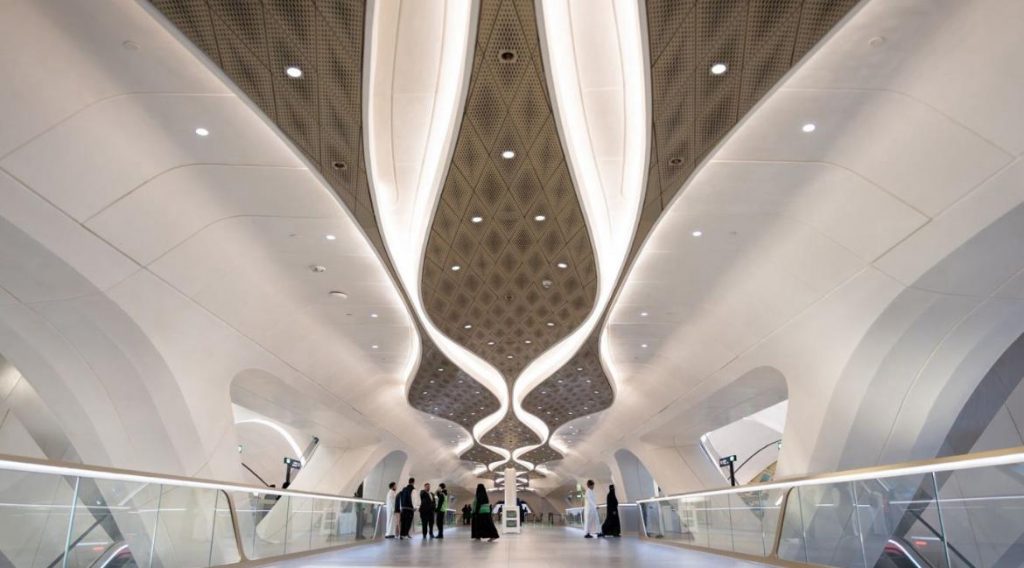
(Image credit: Riyadh Metro Stations — Architecture by Zaha Hadid Architects, Snøhetta, and others. Photograph via Wikimedia Commons, licensed under Creative Commons Attribution–ShareAlike 4.0 [CC BY-SA 4.0])
Architecture in Motion: How a City Rehearsed Its Future Below Ground
I.Infrastructure as Cultural Turning Point
Mass transit rarely announces cultural change.
It usually follows it.
In Riyadh, the metro did the opposite.
When the designs for the Riyadh Metro stations were unveiled in April 2014, they marked more than the arrival of new infrastructure. They signalled a city preparing to re-script how it moves, gathers, and imagines itself — publicly, visibly, and irreversibly.
This was not merely about trains.
It was about urban identity entering motion.
II.The Scale of the Proposition
Riyadh’s metro project is among the largest public transport undertakings ever attempted: six lines, more than eighty stations, traversing a city long defined by car dependency, dispersed urbanism, and infrastructural opacity.
To address this scale, the city turned not to a single architectural voice, but to a constellation of global practices, each tasked with shaping key stations as civic anchors.
The result is not stylistic unity.
It is urban pluralism by design.
III. Stations as Civic Rooms, Not Technical Nodes
In many cities, metro stations are treated as technical voids — spaces of passage rather than presence.
Riyadh rejected this premise.
Each major station is conceived as a civic room: legible, generous, architecturally articulate. Movement is choreographed, not compressed. Light is introduced deliberately, even underground.
The stations do not hide mobility.
They celebrate it.
IV,Zaha Hadid Architects: Flow as Structure
Zaha Hadid Architects’ contributions are immediately recognisable — not through excess, but through continuity of motion.
Surfaces fold, stretch, and taper, creating environments that feel shaped by movement itself. Circulation paths are intuitive, guiding bodies without signage overload or spatial aggression.
These stations do not impose order.
They anticipate it.
Importantly, the forms are not arbitrary. They respond to crowd dynamics, climate control, and structural necessity. The architecture’s fluidity is disciplined rather than ornamental.
V.Snøhetta at Qasr Al Hokm: Reflection and Restraint
If Hadid’s stations articulate movement, Snøhetta’s Qasr Al Hokm station articulates presence.
Wrapped in stainless steel that reflects the desert light, the station appears mutable — shifting with sun, sky, and activity. The material choice is not about spectacle, but about environmental dialogue.
The building absorbs its context visually while asserting civic dignity spatially. It sits comfortably between tradition and futurity, acknowledging Riyadh’s historic core without mimicking it.
This is architecture that understands symbolism without leaning on iconography.
VI.Climate as Architectural Driver
Riyadh’s climate is unforgiving. Extreme heat, dust, and solar exposure shape every architectural decision.
The metro stations respond through:
- deep canopies
- controlled daylight
- shaded transitions
- thermally efficient envelopes
Climate mitigation is not hidden.
It is formal logic.
The stations teach a city accustomed to sealed interiors that comfort can be achieved through design intelligence rather than isolation.
VII. Gender, Visibility, and Public Space
Public transport in Riyadh carries social implications beyond mobility.
The metro stations are among the most inclusive public interiors the city has produced — spaces where visibility, safety, and legibility are prioritised. Architecture here quietly participates in social recalibration.
There is no declarative symbolism.
Change occurs through use.
VIII. Against the Myth of Imported Modernity
It would be easy to frame the Riyadh Metro stations as imported global architecture — signature forms dropped into a local context.
This reading is incomplete.
While the designers are international, the architectural problems addressed are deeply local: heat, scale, cultural expectation, public behaviour, and urban dispersal.
Modernity here is not aesthetic import.
It is situational response.
IX.Infrastructure That Teaches the City How to Move
Cities learn from their infrastructure.
By designing metro stations as dignified, comprehensible, and spatially generous, Riyadh sets expectations for how public life can unfold. Movement becomes shared rather than solitary. Waiting becomes civic rather than residual.
The metro does not merely carry people.
It conditions urban behaviour.
X.A Network of Landmarks Without Monumentality
Despite their architectural ambition, the stations avoid monumentality in the traditional sense.
They are landmarks through repetition and reliability, not singular dominance. Their power lies in becoming familiar — daily, habitual, trusted.
This is infrastructure that earns affection through consistency rather than awe.
XI.Anticipating a Different City
The true significance of the Riyadh Metro stations lies not in their immediate visual impact, but in their anticipatory nature.
They were designed for a city that did not yet fully exist — a Riyadh less dependent on cars, more public in movement, more collective in rhythm.
Architecture here is speculative in the most responsible sense: projecting possibility without forcing outcome.
XII. Conclusion: When Movement Becomes Civic
The Riyadh Metro stations represent a pivotal moment in the city’s architectural and social evolution.
They show that infrastructure can be:
- dignified without being monumental
- modern without being alien
- ambitious without being aggressive
They remind us that cities change not only through policy or spectacle, but through the daily choreography of bodies in space.
In giving movement architectural care, Riyadh rehearsed a future — quietly, decisively, below ground — before it ever arrived above it.
You May also like
By Rojina Bohora
By Rojina Bohora
By Rojina Bohora