
Rethymno House, Crete
By Rojina Bohora
Publication date: 18 June 2020, 09:00 GMT
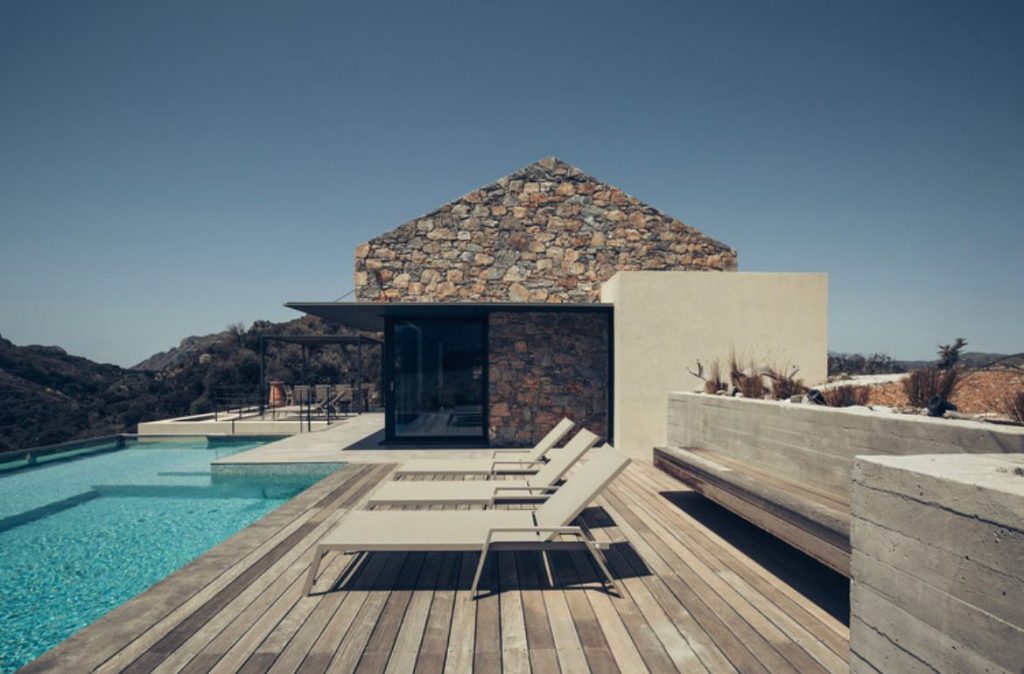
(Image credit: Rethymno House, Crete — Architecture by Polyergo Studio. Photographs by Yiorgos Kaplanidis, released for editorial use via the architects. Used with attribution).
White Geometry, Moving Air: Architecture That Learns From an Island
I.An Island That Refuses the Object
Crete does not reward architectural excess.
Its light is unforgiving, its winds constant, its terrain older than any design language imposed upon it. Buildings that attempt to dominate the landscape are quickly exposed — bleached, battered, and made uncomfortable by climate alone.
The Rethymno House, completed in early summer 2020 in the hills above Crete’s northern coast, understands this instinctively.
It does not arrive as object.
It arrives as arrangement.
II.Architecture as Settlement, Not Statement
Rather than a single volume, the house is composed as a sequence of low, interlocking geometries — courtyards, terraces, and stepped planes unfolding along the slope.
This strategy echoes the logic of Cretan villages, where buildings accrete over time, shaped by topography rather than imposed upon it. The house feels assembled rather than designed in one stroke.
Architecture here is not declarative.
It is incremental.
III. White Without Abstraction
White architecture in the Mediterranean is often reduced to image — a shorthand for lifestyle rather than climate intelligence.
At Rethymno House, white is functional.
It reflects heat, amplifies daylight into shaded spaces, and dissolves mass against the glare of sky and sea. Walls read less as surfaces than as instruments — shaping light and air rather than framing views theatrically.
The colour is not aesthetic choice.
It is environmental response.
IV.Courtyards as Climatic Engines
The house’s courtyards are not nostalgic references. They are working devices.
Air is drawn through the plan, cooled by shade and evaporative effect. Movement is always mediated by exterior space, allowing the building to breathe rather than rely on mechanical correction.
Living occurs between inside and outside — not as luxury, but as necessity.
The house does not seal itself from the island.
It participates in it.
V.Every Opening Has a Job
Windows at Rethymno House are never arbitrary.
Each opening frames the Aegean deliberately, but never excessively. Views are offered, not consumed. The sea appears repeatedly, but always in fragments — through corridors, across courtyards, beyond thresholds.
This restraint prevents the landscape from becoming backdrop.
The house does not display the sea.
It acknowledges it.
VI.Polyergo Studio and the Discipline of Context
Polyergo Studio’s work consistently resists the flattening effects of global minimalism.
At Rethymno, their restraint is precise. Proportions are tuned to human scale. Transitions are slow. The architecture accepts the island’s pace rather than accelerating it.
This is minimalism that has learned patience.
VII. Materials That Accept Weather
Concrete, plaster, stone, and glass are used without fetish.
Surfaces are expected to age, to mark time, to respond to salt air and sun. The house is designed not to remain pristine, but to settle into use.
Architecture here does not fight entropy.
It accommodates it.
VIII. A House Without Front or Back
There is no privileged façade.
The building turns gently in multiple directions, acknowledging sun paths, wind, and terrain rather than street or spectacle. Arrival is understated; departure barely marked.
This lack of hierarchy reinforces the sense that the house belongs to the land before it belongs to its occupants.
IX.Vacation Without Performance
Though a holiday home, the architecture avoids the tropes of leisure design.
There is no excess glazing, no dramatic cantilever, no choreographed luxury. Comfort is achieved through orientation, shade, and proportion rather than display.
The house encourages slowness — a rare architectural gift.
X.Privacy as Spatial Outcome
Privacy at Rethymno House is not achieved through enclosure, but through sequencing.
Spaces turn inward before opening outward. Courtyards buffer rooms. Walls shield without closing off. Occupation feels protected without feeling withdrawn.
This balance is architectural intelligence, not aesthetic minimalism.
XI.An Architecture That Could Not Travel
The Rethymno House could not be transplanted elsewhere without losing meaning.
Its proportions, surfaces, and spatial logic are inseparable from Crete — from wind direction, solar intensity, and cultural memory.
This specificity gives the building its quiet authority.
XII. Conclusion: When Architecture Learns the Wind
Rethymno House does not attempt to redefine Mediterranean architecture.
It refines it.
By arranging space rather than sculpting form, by working with air rather than against it, and by letting the island remain louder than the building, the project achieves something increasingly rare:
Architecture that knows where it is.
In Crete’s hills, among light and breeze, the house does not compete.
It belongs.
You May also like
By Rojina Bohora
By Rojina Bohora
By Rojina Bohora