
Perelman Performing Arts Center, New York City
By Rojina Bohora
Publication date: 3 October 2023, 09:00 GMT
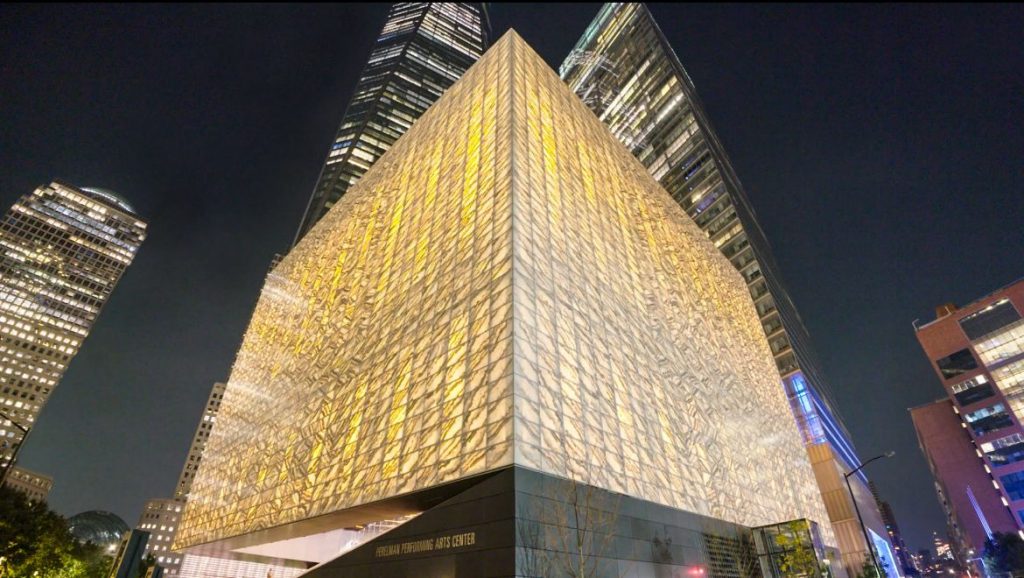
(Image credit: Perelman Performing Arts Center (PAC NYC) — Architecture by REX with Davis Brody Bond. Photographs via Wikimedia Commons, licensed under Creative Commons Attribution–ShareAlike 4.0 ([CC BY-SA 4.0]).
A Quiet Cube at the Loudest Address: Architecture That Learns to Reconfigure Itself
I.Building Where Memory Refuses Simplification
Few sites ask more of architecture than the World Trade Center.
Every intervention must negotiate grief, resilience, civic expectation, and the impossibility of closure. In this charged context, the Perelman Performing Arts Center (PAC NYC) chose a strategy that is almost disarming in its restraint.
It arrives not as monument, nor as gesture, but as instrument.
A cube. Quiet. Exact. Patient.
II.The Cube as Ethical Decision
The building’s exterior form is uncompromisingly simple: a perfect cube, wrapped in thin slabs of translucent marble.
This geometry is not aesthetic bravado. It is ethical clarity.
At a site saturated with symbolism, the cube refuses metaphor. It does not compete with the memorial. It does not narrate trauma. It offers presence without commentary.
Architecture here steps back — deliberately.
III. Marble That Glows, Not Impresses
The marble façade performs a subtle transformation throughout the day.
In daylight, it reads as solid and composed. At night, it becomes lantern-like, glowing softly from within. The effect is neither celebratory nor mournful.
It is attentive.
Light does not dramatise the building; it humanises it.
IV.REX and the Architecture of Flexibility
Inside the cube, certainty dissolves.
REX’s defining contribution is a system of moveable walls, floors, and seating platforms that allow the building’s three performance spaces to reconfigure into more than sixty spatial arrangements.
Opera one night. Dance the next. Experimental theatre the night after.
Architecture here is not container.
It is mechanism.
V.A Performing Arts Center That Refuses a Fixed Identity
Traditional theatres encode hierarchy: stage and audience, front and back, performer and spectator.
PAC NYC dismantles this rigidity.
Spaces expand, contract, rotate, and invert. Audience members may surround performers, sit above them, or share the same plane.
This adaptability mirrors contemporary performance itself — hybrid, interdisciplinary, resistant to categorisation.
VI.Engineering as Cultural Infrastructure
The building’s transformation relies on extraordinary engineering discipline.
Moveable walls weighing tens of tonnes glide with millimetric precision. Acoustic performance is recalibrated with each configuration. Structural clarity supports constant change without visual clutter.
Flexibility here is not improvisation.
It is pre-engineered possibility.
VII. Silence as Exterior Strategy
While the interior celebrates motion, the exterior remains calm.
There are no banners, no expressive cuts, no iconic gestures. The building does not announce what is happening inside.
This silence is generous.
It allows the surrounding memorial landscape to remain primary, while culture unfolds without spectacle.
VIII. Ground Zero, Reclaimed Through Use
PAC NYC contributes something the site desperately needed: life without performance of resilience.
Audiences arrive not to commemorate, but to participate. Laughter, applause, tension, and conversation re-enter the urban fabric organically.
The building does not symbolise healing.
It enables it.
IX.Architecture That Serves Artists First
Unlike many cultural landmarks, PAC NYC is unapologetically artist-centric.
Back-of-house spaces are generous. Technical systems prioritise experimentation. The building does not privilege donor visibility over creative process.
This inversion of priorities is architectural — and political.
X.A Cube That Contains Change
The genius of PAC NYC lies in its paradox.
A perfectly stable exterior contains radical instability within. Permanence holds flexibility. Stillness shelters transformation.
Few buildings articulate this duality so clearly.
XI.New York’s Continuing Experiment
New York has always been a laboratory for performance and architecture alike.
PAC NYC extends this tradition without nostalgia. It offers a model for cultural buildings that prioritise adaptability over authorship.
In a city defined by change, this feels exactly right.
XII. Conclusion: When Architecture Refuses to Finish the Sentence
The Perelman Performing Arts Center does not tell a story.
It sets a condition.
By pairing a calm, dignified exterior with a radically mutable interior, the building reframes what civic architecture can be at a site of immense historical weight.
It does not ask to be remembered.
It asks to be used, rearranged, and lived in — again and again.
You May also like
By Rojina Bohora

By Rojina Bohora
By Rojina Bohora