
Miami Design District, Miami
By Rojina Bohora
Publication date: 14 December 2017, 09:00 GMT

(Image credit: Miami Design District — Master development by Craig Robins with architectural contributions by Sou Fujimoto Architects, Diller Scofidio + Renfro, and others. Photographs via Wikimedia Commons, licensed under Creative Commons Attribution–ShareAlike 4.0 [CC BY-SA 4.0]).
Retail as Civic Theatre: When a Neighbourhood Became an Architectural Conversation
I.When Shopping Stopped Being the Point
Retail districts rarely invite serious architectural consideration.
They are typically judged by footfall, brand mix, and turnover — not by spatial intelligence or civic contribution. The Miami Design District refuses this hierarchy. It insists that commerce can be context, not just content.
By the time its central public realm reached completion in late 2017, the district had evolved into something more ambitious than luxury retail.
It had become a neighbourhood authored through architecture.
II.Craig Robins and the Long Game of Urban Curation
The transformation of the Miami Design District was not the result of a single vision or signature style.
It was an act of curation — patient, incremental, and unusually permissive. Craig Robins invited architects not to conform, but to converse. The result is a district composed of distinct voices rather than unified image.
This refusal of uniformity is its defining strength.
III. Architecture Without a Master Aesthetic
The district resists the idea of a masterplan as visual coherence.
Instead, it operates through adjacency: a lattice canopy by Sou Fujimoto near a minimalist façade; a sculptural stair adjacent to open plaza; art installations interwoven with circulation.
The experience is not seamless.
It is stimulating.
This friction keeps the district legible as city rather than mall.
IV.Palm Court as Urban Living Room
Palm Court functions as the district’s civic heart.
Neither square nor atrium, it is an open-air room — shaded, permeable, and social. Architecture here shapes atmosphere rather than enclosure. Canopies modulate light. Planting softens scale. Seating invites occupation without purchase.
It is public space that does not apologise for elegance.
V.Sou Fujimoto’s Lightness as Counterweight
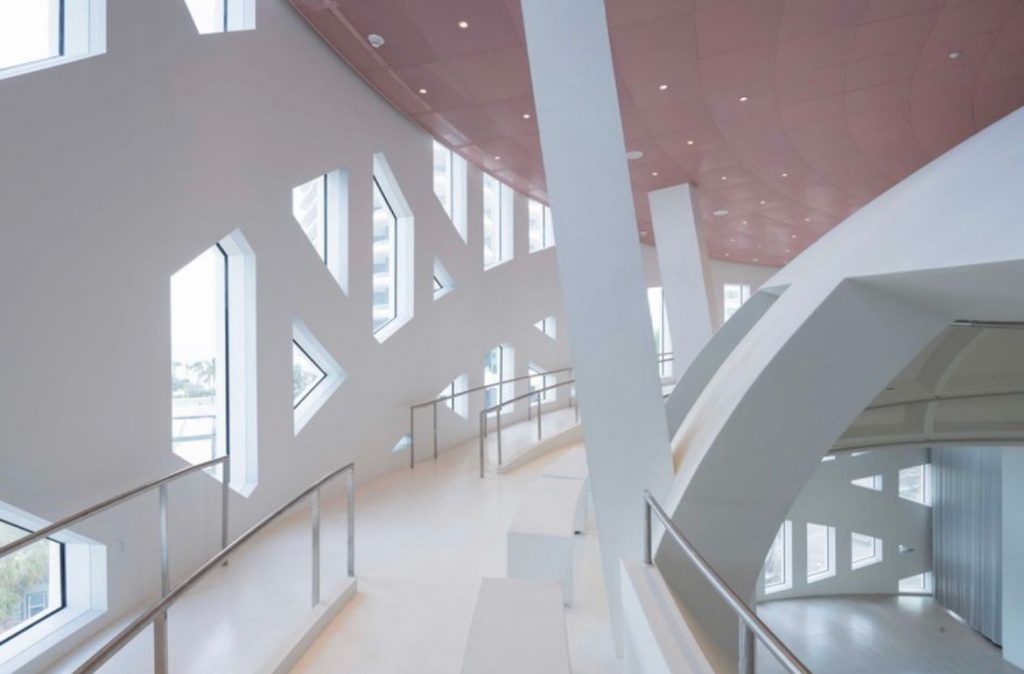
Sou Fujimoto’s contribution — most visibly the perforated lattice structures — introduces a sense of lightness and play.
These elements do not dominate. They filter. They allow sky, movement, and shadow to remain present. Architecture here behaves as climate mediator, not monument.
The district breathes because of this restraint.
VI.Diller Scofidio + Renfro and the Choreography of Movement
Movement through the district is deliberately choreographed.
Passages compress and release. Sightlines bend. Installations interrupt expectation. Diller Scofidio + Renfro’s influence is felt less in singular objects than in experiential sequencing.
The district unfolds like a walkable exhibition — curated but unscripted.
VII. Art as Infrastructure, Not Ornament
Public art in the Miami Design District is not decorative afterthought.
Works by artists such as John Baldessari are embedded into circulation and façades, blurring the line between architecture and artwork. Art becomes orientation device, meeting point, and spatial punctuation.
This integration elevates daily movement into encounter.
VIII. Climate-Specific Urbanism
Miami’s climate is unforgiving to careless design.
The district responds through shade, porosity, and outdoor comfort rather than enclosure. Covered walkways, planted courtyards, and permeable edges allow life to remain outside — where the city belongs.
Air conditioning does not define experience.
Architecture does.
IX.Luxury Without Withdrawal
Despite its luxury brands, the district does not withdraw from the city.
There are no gates, no defensive thresholds. Public space remains genuinely public. The architecture encourages wandering without transaction.
This openness complicates the narrative of exclusivity.
X.A District That Invites Interpretation
The Miami Design District does not explain itself.
There are no didactic plaques announcing architectural significance. Visitors are free to experience, ignore, or reinterpret the space.
This refusal to instruct is an architectural ethic.
XI.The Risk of Becoming a Model
The district’s success invites imitation — and risk.
Copied superficially, its lessons could be reduced to aesthetic collage. Its real achievement lies deeper: in trusting architecture to do cultural work without demanding consensus.
XII. Conclusion: When Commerce Funds the Commons
The Miami Design District demonstrates a rare possibility:
That private development, when guided by architectural ambition and civic generosity, can produce genuine urban value.
It is not perfect. It is not neutral.
But it is alive — and alive because architecture here is allowed to argue, differ, and coexist.
In a city often defined by image, the district offers something more durable:
A place where architecture becomes conversation —
and the city listens back.
You May also like
By Rojina Bohora
By Rojina Bohora
By Rojina Bohora