Just For Show or Preparing For Death?
By Anne Canal
Publication date 16th March 2026: 13:45 GMT
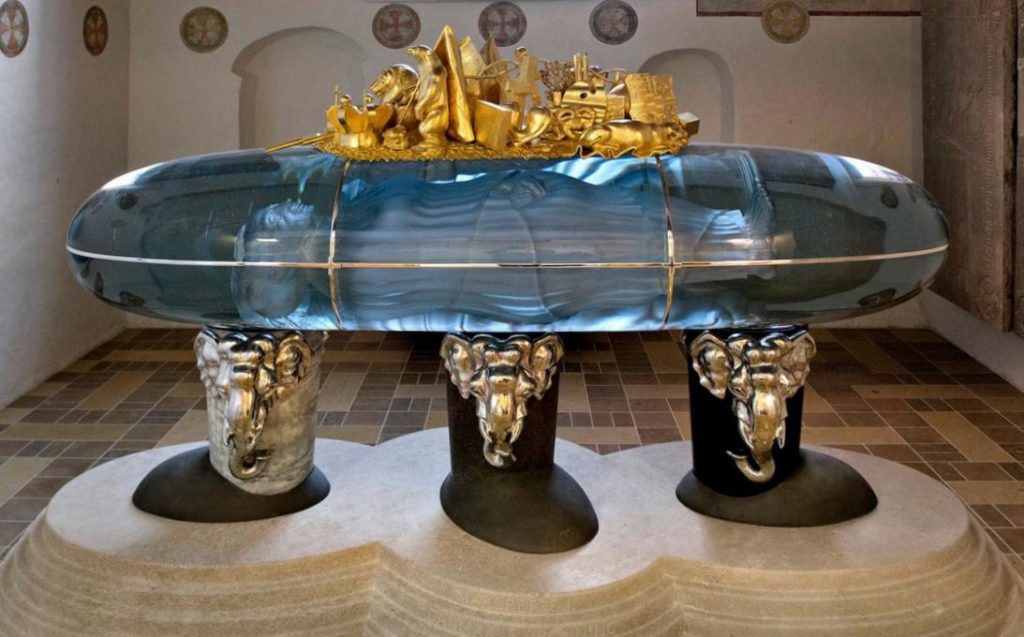
Image Credit: Wikipedia
Elon Musk recently said in an interview that he hasn’t been persuaded in going into the life longevity business because he doesn’t know how much of a good thing it would be for humanity.
Someone else who clearly thinks that way is Margrethe II of Denmark, the Queen Emeritus of Denmark.
In a world where billionaires fund laboratories searching for ways to extend the human lifespan, the former Danish monarch has chosen a path that feels almost philosophically rebellious: she has invested not in prolonging life, but in preparing for death.
Long before most people would even consider the end of their own lives, Margrethe II oversaw the creation of a sarcophagus that will one day hold her remains. It sits today inside Roskilde Cathedral, the burial church of Danish kings and queens, designed by the renowned Danish sculptor Bjørn Nørgaard. The monument is already complete. It waits patiently for a moment that could still lie decades away.
In a curious way, it represents the opposite of the modern technological dream.
While laboratories pursue age-reversal therapies and Silicon Valley speaks confidently about living far longer than previous generations, the Queen Emeritus has quietly invested in what she will need after life.
A Monarch Who Is Also an Artist
Margrethe II is not merely a ceremonial figure. She is widely recognised as a painter, illustrator, and costume designer. Throughout her life she has produced artwork, designed theatrical costumes, and participated deeply in Denmark’s cultural life.
This artistic sensibility makes the existence of her future tomb even more intriguing.
Artists often seek permanence through creation—through books, paintings, or architecture that survive their creators. Yet the queen has extended that artistic instinct into a domain most people prefer to avoid contemplating: the architecture of her own death.
The glass sarcophagus prepared for her burial is not simply a coffin waiting in storage. It is a sculptural monument embedded in one of Scandinavia’s most historic cathedrals.
In that sense, it is both a work of art and a statement of worldview.
The Contrast With the Longevity Age
Modern culture increasingly treats death as a technical problem waiting to be solved.
Biotechnology companies research genetic repair. Venture capital pours into anti-aging startups. Futurists speculate about centuries-long lifespans or even digital immortality.
The idea that death might one day become optional has moved from science fiction to serious scientific debate.
Against this backdrop, the existence of a completed royal sarcophagus for a living queen feels almost radical.
Margrethe II has not invested her attention in laboratories searching for eternal youth. Instead, she has embraced a much older human tradition: preparing a dignified end.
The Philosophy of Completion
This does not mean the Queen Emeritus lacks curiosity about the future. Quite the opposite.
Her reign of more than fifty years bridged eras of immense change—from the Cold War to the digital age. She abdicated in 2024 in favour of her son, Frederik X, demonstrating an unusual willingness to allow generational renewal.
But the existence of her tomb reveals something deeper: a philosophy of completion.
A life, in this view, is not meant to be endlessly prolonged. It is meant to be lived fully and then concluded with dignity.
By commissioning her sarcophagus decades before it will be used, Margrethe II has effectively written the final punctuation mark of her own story.
Preparing for Death as an Act of Life
There is a paradox in preparing for death.
Far from diminishing life, it can sharpen one’s sense of purpose. Knowing that life has an endpoint often inspires individuals to use their time wisely.
The queen’s sarcophagus embodies this paradox. Its very existence suggests calm acceptance rather than fear.
It is not hidden away. It stands visibly among the tombs of Danish monarchs stretching back centuries, quietly acknowledging that one day another chapter of the nation’s history will close.
The Question the Sarcophagus Asks
Is the monument simply a ceremonial display—a royal tradition carried forward out of habit?
Or is it something more deliberate?
When placed beside today’s global fascination with longevity science, the tomb of Margrethe II invites reflection.
If the wealthiest minds of our era seek to escape mortality, the Danish queen seems to offer a different answer: that perhaps the purpose of life is not to outrun death but to arrive at it having lived well.
A Different Kind of Legacy
he legacy of a monarch is often measured in political achievements or historical events.
But Margrethe II’s legacy may also include something subtler: a cultural reminder that accepting mortality can be a form of wisdom.
Her prepared sarcophagus does not represent pessimism. It represents confidence that a life well lived does not need endless extension.
In a century fascinated by defeating death, the Queen Emeritus of Denmark has instead chosen to design it.
And in doing so, she may have created one of the most quietly philosophical monuments of our time.
You May also like
By Sam Stafford

By Rojina BohoraBy Rojina Bohora
By Sam Stafford & Carolina Berghinz