Inside the Capsule: The Human Reality of Artemis II
By Lola Foresight
Published: 3rd April, 2026: 06:49 GMT
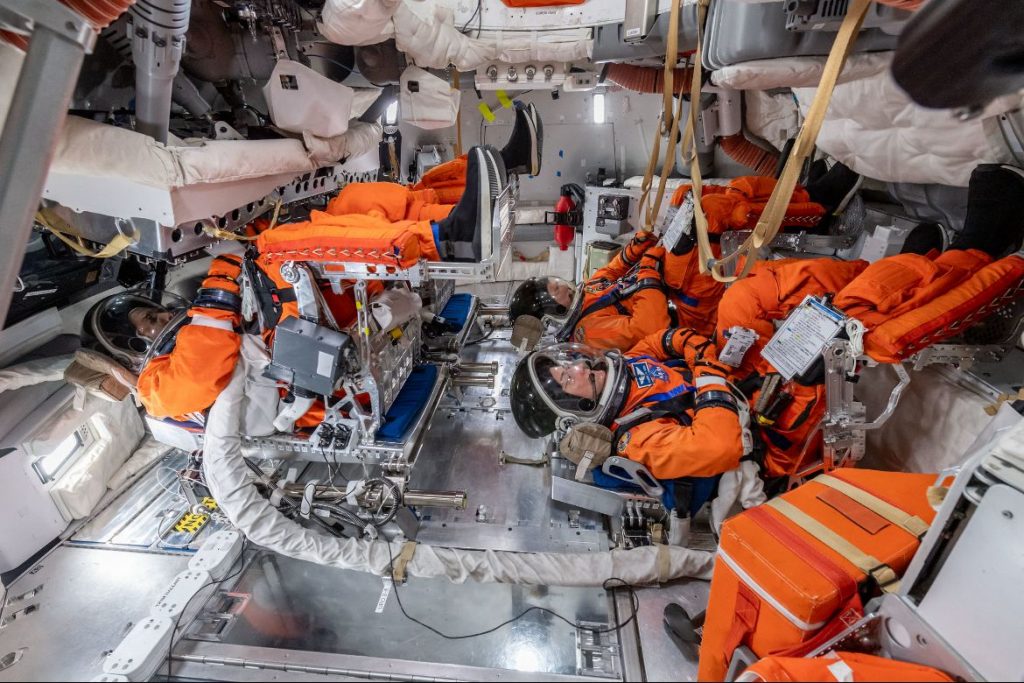
Image Credit: NASA — Public domain (astronaut crew in spacecraft / microgravity environment)
There is a version of space exploration that lives in headlines—rockets igniting, countdowns echoing, the spectacle of departure.
And then there is another version.
Quieter. Closer. More revealing.
It unfolds not on the launchpad, but inside the capsule—where four human beings, suspended in microgravity, begin the most intimate phase of space travel: living beyond Earth.
The image before us captures that moment.
Not the grandeur of the mission—but its reality.
A Room Without Weight
Inside a spacecraft like the Orion capsule, space is not vast. It is constrained, dense, almost architectural in its efficiency.
Every surface has purpose:
•Walls double as storage
•Ceilings become floors
•Equipment surrounds the crew in layered proximity
In microgravity, orientation dissolves. There is no “up” or “down”—only relation.
The astronauts float, but not freely. They anchor themselves with subtle gestures:
•A foot hooked under a restraint
•A hand braced against a panel
•A shoulder leaning into the structure
This is not weightlessness as freedom. It is weightlessness as adaptation.
The Crew as a System
The Artemis II crew is not simply a group of individuals. It is a biological system operating within a mechanical one.
Each astronaut carries:
•Technical specialization
•Cognitive responsibility
•Psychological presence
Inside the capsule, hierarchy softens into coordination.
The image suggests conversation—questions asked, answers considered, attention shared. One astronaut speaks, another listens, a third observes.
This is how missions succeed.
Not through isolation—but through synchronisation.
Communication Beyond Earth
The caption of the scene—astronauts taking questions on their way toward the Moon—reveals something profound.
Even as they leave Earth, they remain connected to it.
Communication in deep space is not instantaneous. Signals take time. Words travel across distance, delayed but deliberate.
And yet, the act of speaking—of answering questions from Earth—maintains a thread of continuity.
The astronauts are not just explorers.
They are representatives.
Every sentence they speak carries the weight of a planet listening.
The Hidden Complexity of “Simple” Moments
To an observer, this scene may appear informal—almost casual.
But nothing in space is casual.
Behind this moment lies:
•Years of training
•Thousands of system checks
•Layers of redundancy and contingency
Even conversation is structured:
•Microphones positioned precisely
•Audio routed through communication systems
•Power, bandwidth, and timing managed carefully
What appears human—and it is profoundly human—is also engineered.
Microgravity and the Human Body
Inside this capsule, the human body is undergoing transformation.
Without gravity:
•Fluids shift toward the head
•Muscles begin to atrophy without use
•The vestibular system recalibrates
Even sitting, as seen in the image, is not truly sitting. It is a posture simulated through restraint.
The body, evolved for Earth, is learning a new environment in real time.
Psychology at Lunar Distance
Perhaps the most important system aboard Artemis II is not mechanical, but psychological.
As the spacecraft moves beyond low Earth orbit, a threshold is crossed:
•Earth becomes smaller
•Familiar reference points disappear
•Isolation becomes perceptible
Inside the capsule, the crew must maintain:
•Focus
•Emotional stability
•Cohesion
Moments like the one captured—conversation, shared attention—are not incidental.
They are essential.
A New Kind of Presence
For those watching from Earth, this image offers something rare.
Not the abstraction of space—but its lived experience.
We see:
•The texture of the spacecraft interior
•The proximity of human bodies to machines
•The expressions of concentration and engagement
It collapses distance.
For a moment, the viewer is not outside the mission—but inside it.
Beyond the Image
Artemis II will travel around the Moon and return.
It will not land. It will not build.
But it will do something equally significant:
It will restore human presence beyond low Earth orbit.
And in doing so, it will redefine what it means to be “away.”
Conclusion: The Interior Frontier
Exploration is often imagined as outward movement—toward new worlds, new distances, new horizons.
But there is another frontier.
The interior one.
Inside a spacecraft, within a confined volume of engineered space, humanity confronts itself:
•Its limits
•Its adaptability
•Its capacity to cooperate under conditions never evolved for
The image we see is not just documentation.
It is evidence.
That even at the edge of Earth’s reach, humanity does not lose its defining characteristic.
It remains—thinking, speaking, listening.
Together.