
Guoco Tower (Tanjong Pagar Centre), Singapore
By Rojina Bohora
Publication date: 30 September 2016, 09:00 GMT
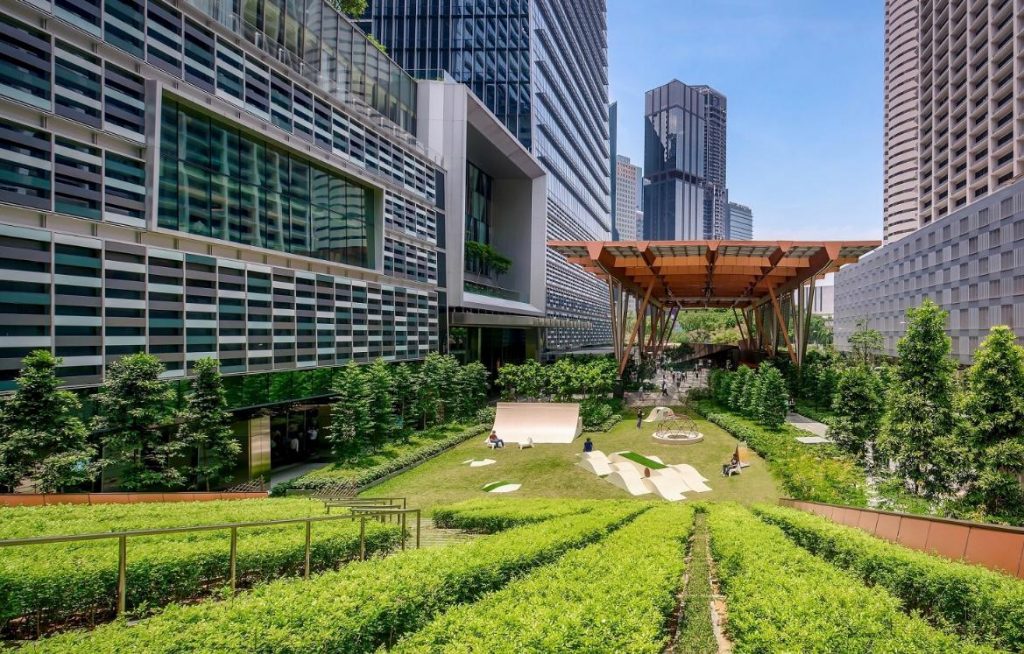
(Image credit: Guoco Tower (Tanjong Pagar Centre), Singapore — Architecture by Skidmore, Owings & Merrill. Photograph via Wikimedia Commons, licensed under Creative Commons Attribution 4.0 [CC BY 4.0]).
Height With a Heart: How a Skyscraper Learned to Become a Neighbou
I.The Tall Building as Social Problem
Tall buildings are rarely accused of intimacy.
They dominate skylines, centralise capital, and concentrate power vertically. Even when mixed-use, they often remain socially aloof — islands of efficiency rising above the city rather than participating in it.
Guoco Tower, completed as the centrepiece of Singapore’s Tanjong Pagar redevelopment in 2016, sets out to confront this condition directly.
At 290 metres, it became Singapore’s tallest building at the time of its opening. Yet its ambition lies less in height than in completeness — the insistence that vertical density must be paired with civic generosity
II.The Return of the Ground Plane
The most consequential decision in Guoco Tower’s design is not found in its upper floors, but at its base.
Rather than sealing the ground plane behind security lines and retail frontage, the project opens it up as public territory. Landscaped plazas, shaded walkways, and direct connections to transit transform what could have been a residual zone into an urban room.
This move reasserts a simple but radical principle: height does not excuse withdrawal.
The tower rises, but the city remains continuous beneath it.
III. A Vertical Neighbourhood, Not a Monolith
Guoco Tower is not a single-use icon. It is a vertical neighbourhood composed of offices, residences, a hotel, retail, and public amenities — stacked, but not isolated.
Each program is given spatial clarity and environmental quality. Transitions are legible. Shared spaces are deliberate rather than incidental.
The building does not collapse uses into anonymity.
It layers them with intention.
This is critical in Singapore, where density is not optional but foundational.
IV.Greenery as Structural Logic
Singapore’s identity as a “City in a Garden” is often expressed horizontally. Guoco Tower tests whether this ethos can be translated vertically without becoming ornamental.
Sky gardens punctuate the tower, providing shaded outdoor spaces, cooling effects, and visual relief. These are not token terraces. They are substantial, accessible, and integrated into circulation.
Vegetation here is not applied decoration.
It is environmental infrastructure.
The tower breathes through its gardens, reducing heat gain and offering respite in the sky
V.Climate Discipline Without Spectacle
The tower’s environmental performance is achieved through disciplined strategies rather than expressive devices.
High-performance glazing reduces solar gain. Orientation and massing are calibrated for prevailing conditions. Shading is embedded rather than appended.
There is no performative sustainability narrative.
No visible gadgetry clamouring for recognition.
The building’s confidence lies in competence.
VI.Infrastructure as Urban Glue
Guoco Tower is directly connected to Singapore’s MRT network, buses, and pedestrian systems. This integration is not a convenience feature; it is a structural commitment to public mobility.
By anchoring such density to transit, the project reinforces a model of urban growth that prioritises shared infrastructure over private dependence.
Movement here is collective, not individualised.
VII. The Office After Isolation
Office towers often function as sealed environments — climatically controlled, socially detached, temporally rigid.
Guoco Tower resists this model.
Daylight is prioritised. Views are expansive without being disorienting. Communal spaces encourage interaction rather than segregation. The tower’s mixed-use nature ensures that it remains active beyond office hours.
Work is not isolated from life.
It is embedded within it.
VIII. Material Restraint at Scale
Formally, the tower avoids excessive articulation. Its silhouette is clean, its detailing precise, its material palette restrained.
This restraint allows the building to sit comfortably within Singapore’s skyline without demanding singularity. It is recognisable without being domineering.
The architecture understands that urban presence is cumulative, not competitive
IX.Height Without Heroics
Guoco Tower does not treat height as virtue in itself.
There is no dramatic crown, no exaggerated taper, no attempt to perform supremacy. The building’s top is resolved calmly, its skyline contribution measured rather than declarative.
This anti-heroic approach reframes tall-building ambition as civic rather than symbolic.
X.Density as Social Contract
The true test of dense architecture is not how efficiently it stacks program, but how responsibly it redistributes value.
Guoco Tower gives back through:
- public open space
- transit integration
- environmental mitigation
- programmatic diversity
Density here is not extraction.
It is exchange
XI.Singapore’s Quiet Radicalism
Singapore’s architectural culture is often described as pragmatic. Guoco Tower reveals how pragmatism can become radical when applied consistently.
The building does not attempt to redefine the skyscraper typology globally. It refines it locally, responding to climate, infrastructure, and social expectation with precision.
This local intelligence gives it global relevance.
XII. Conclusion: When Height Learns Humility
Guoco Tower demonstrates that the skyscraper need not be an instrument of detachment.
It can be:
- tall without being aloof
- dense without being oppressive
- complex without being chaotic
By treating height as responsibility rather than spectacle, the building offers a model for vertical urbanism that is not only efficient, but considerate.
In a city that has mastered density, Guoco Tower suggests the next lesson:
That true height is measured not in metres —
but in how generously a building meets the city below.
You May also like
By Rojina Bohora
By Rojina Bohora